Solar Panel Efficiency: Mono vs Poly vs Thin-Film
Compare solar panel efficiency across monocrystalline, polycrystalline, and thin-film panels so you can choose the best type for your roof and budget.
When I first started looking at solar, I honestly thought all panels were basically the same rectangle with a different logo on the corner.
Then I started planning a real system.
Suddenly, I was swimming in terms like monocrystalline, polycrystalline, and thin-film… and every installer had a different opinion about which was “best.”
If you’re in that same “I just want to know what to put on my roof” phase, this guide is for you.
By the end, you’ll know:
- Which type is most efficient in the real world
- How much more energy can mono squeeze out of the same square footage
- How cost, heat, shade, lifespan, and warranties differ
- Which type actually makes sense for small roofs, weird roofs, RVs, and microhomesteads
Let’s make sense of this.
2. Quick Comparison Snapshot (For Skimmers)
Here’s the 10-second version:
| Type | Typical Efficiency | Cost per Watt | Space Needed | Best For |
|---|---|---|---|---|
| Monocrystalline | Highest | Higher | Least roof area | Small roofs, high usage, long-term systems |
| Polycrystalline | Medium | Lower | More roof area | Larger roofs, budget installs |
| Thin-Film | Lowest (rooftop) | Panel cheap, BOS can be more | Most roof area | RVs, sheds, metal roofs, odd shapes, huge area |
One-sentence takeaways:
- Monocrystalline – Max power per square foot. Great when roof space is precious.
- Polycrystalline – Solid middle ground if you have space and want to save a bit upfront.
- Thin-Film – Lightweight, flexible, niche. Great for RVs, sheds, and large, simple metal roofs.
Now let’s slow down and unpack why.
3. What Are Mono, Poly, and Thin-Film Panels?
3.1 Monocrystalline Panels (Mono)
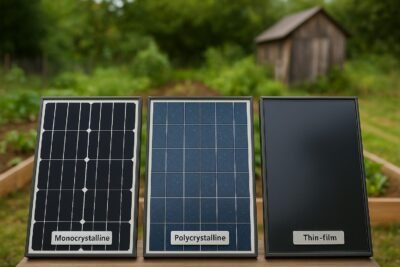
- Made from a single crystal of silicon.
- Cells look uniform and dark, often solid black or very dark gray.
- Typical residential “modern” panels you see in new installs.
- Known for high efficiency and a clean, uniform look.
In plain English: mono panels are like the “premium” option—more power from the same footprint.
3.2 Polycrystalline Panels (Poly)
- Made from multiple crystals melted together.
- Cells have a speckled, bluish look.
- A bit less efficient than mono, but usually cheaper per panel.
- Common in slightly older systems or more budget-conscious installs.
Think of poly as the “value” option: still good, just not quite as power-dense.
3.3 Thin-Film Panels
“Thin-film” isn’t one single thing; it’s a whole family:
- Very thin layers of semiconductor are deposited on glass, metal, or flexible backing.
- Can be flexible or rigid.
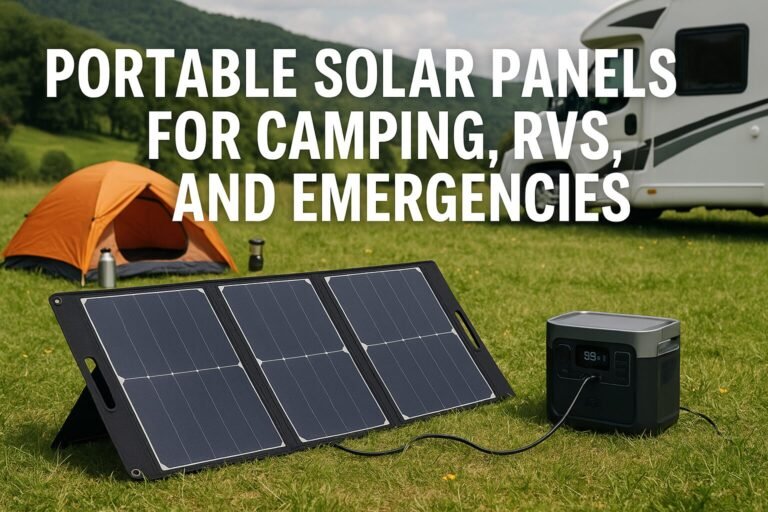
- Often used on RVs, vans, metal roofs, and big commercial roofs.
- Lower efficiency per square foot, but sometimes easier to install on tricky surfaces.
Thin-film is the oddball cousin: it doesn’t look like the classic framed rectangle, but it can go places conventional panels can’t.
4. Efficiency in the Real World
Key questions:
- Which type is most efficient?
- How much more energy per square foot does mono actually give you?
4.1 Lab Efficiency vs Real Rooftops
Panel datasheets love to shout about efficiency. That’s just:
How much of the sunlight hitting the panel gets turned into electricity.
But real-world output also depends on:
- Roof angle and direction
- Shade from trees, chimneys, neighbors
- Heat buildup on the roof
- Inverter, wiring, and other system losses
So we’ll talk about typical ranges, not perfect lab numbers.
4.2 Efficiency Comparison by Type
On a typical home roof, you’ll roughly see:
- Monocrystalline: highest efficiency
- Polycrystalline: a bit lower
- Thin-film: lowest per square foot (but sometimes better in low light on huge roofs)
Let’s do a simple, same roof area comparison.
Say you’ve got 200 square feet of good roof:
- Mono: might give you around 3.8 kW of panel capacity
- Poly: closer to 3.2 kW
- Thin-film: maybe around 2.3 kW
Over a year, if that roof sees decent sun, that same 200 sq ft might produce ballpark:
- Mono: ~5,700 kWh
- Poly: ~4,800 kWh
- Thin-film: ~3,400 kWh
The exact numbers will depend on your location, but the relative difference is the point:
Mono squeezes significantly more energy out of the same footprint.
4.3 When Efficiency Really Matters
Efficiency becomes a big deal when:
- You have a small roof
- You have lots of obstructions (vents, dormers, skylights)
- You want to offset a big chunk of your usage
- You’re planning for future loads (EV, mini-split, workshop, etc.)
For many microhomesteaders with limited space, monocrystalline is the go-to just because every square foot matters.
5. Cost Per Watt and Payback Time
Key question: How do cost differences per watt change payback?
5.1 Hardware Cost: Panel vs System
At the panel level, you’ll often see:
- Mono: a bit more per watt
- Poly: a bit less per watt
- Thin-film: panel itself can be cheap per watt, but…
That’s only part of the story.
5.2 Balance of System (The Hidden Cost)
You don’t just pay for the panel. You also pay for:
- Racking and mounting
- Wiring and conduit
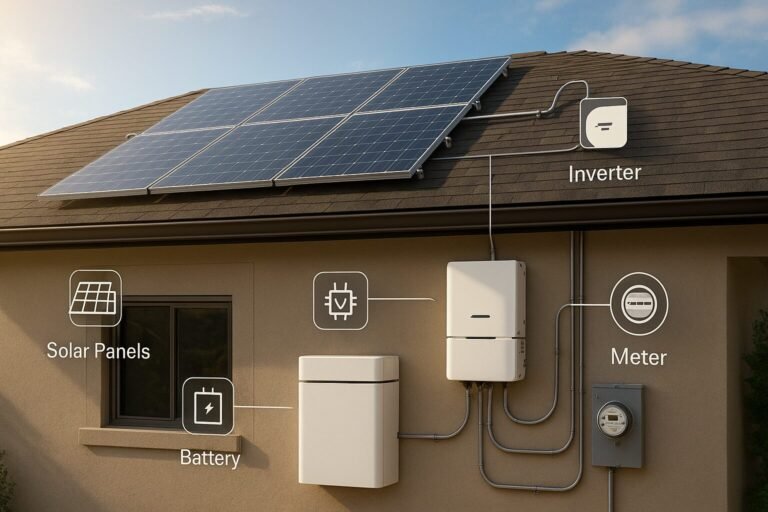
- Inverter(s) and labor
- Permits and inspections
Here’s the catch: if you choose lower-efficiency panels, you may need:
- More panels
- More racking
- More clamps, wiring, and labor
So while poly or thin-film might look cheaper per panel, a bigger array can eat up that savings in mounting hardware and labor.
5.3 Payback and ROI by Panel Type
In many cases:
- If roof space is free and abundant, poly can make sense as a budget play.
- If roof space is tight or labor is pricey, paying a little more for mono can actually improve payback, because you get more kWh out of a similar install cost.
So the “cheapest panel” is not always the cheapest system or the fastest payback.
6. Heat, Shade, and Cloudy Days
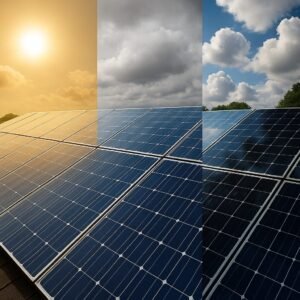
Key questions:
- Which type handles high heat better?
- Which does better in shade and low light?
6.1 High-Temperature Performance
All silicon panels lose some efficiency when they get hot. Roofs get really hot in summer.
You’ll see this on datasheets as a temperature coefficient. Lower (in magnitude) is better.
Roughly speaking:
- Mono and poly are similar, with mono often slightly better on modern models.
- Thin-film can sometimes handle heat a bit differently, but because its baseline efficiency is lower, you still need more area to match output.
Practical takeaway: In a very hot, very sunny climate, you still usually pick good-quality mono. You just pay attention to the roof ventilation and airflow under the panels.
6.2 Shade and Cloudy Weather
No panel type loves shade. A small shadow on one part of a string can drag down the whole string.
In general:
- Crystalline panels (mono/poly): solid in normal sun, but sensitive to hard shade (branches, chimneys).
- Thin-film: lower peak efficiency, but sometimes behaves a bit better in soft, diffuse light (overcast days, evenly cloudy skies).
However, for a typical home roof, the bigger factors are:
- Good array design (avoid shade paths)
- Using optimizers or microinverters if you have unavoidable shade
- Trimming or removing problem branches if possible
6.3 Matching Panel Type to Your Climate
- Hot, sunny desert or tropical roof: Mono with good airflow and decent temperature coefficient.
- Cool, cloudy climate with a big, simple roof: Mono or poly both work; arrays can be slightly bigger.
- Mixed climate, lots of trees: Focus on shade-aware design and electronics more than changing panel type.
7. Lifespan, Degradation, and Warranties
Key questions:
- How long do these panels actually last?
- Do different types wear out faster?
- Are warranties different?
7.1 Degradation Over Time
All panels gradually produce less over the years. You’ll see this as a % per year degradation.
Rough picture:
- Mono: very low annual degradation on modern panels
- Poly: similar ballpark, sometimes slightly higher
- Thin-film: depends on the specific tech; some degrade faster, others are competitive
Over 20–25 years, a good mono panel might still be producing 80–90% of its original output. That’s a big deal for long-term planning.
7.2 Product vs Performance Warranties
Most manufacturers offer:
- A product warranty – covers workmanship and defects (think 10–25 years).
- A performance warranty – guarantees a minimum % of the original output after a certain number of years.
You’ll often see:
- Mono panels with longer product warranties and better performance guarantees (especially from top brands).
- Poly with similar but sometimes slightly shorter/less generous terms.
- Thin-film warranties vary more, depending on the specific product and use case.
When comparing quotes, don’t just look at kW. Look at how long that kW is promised to stick around.
7.3 What That Means for a 20–30 Year Microhomestead Plan
If you’re building a long-term homestead and planning to stay put:
- A panel that costs a little more but produces more energy for 25+ years can be a better deal than a cheaper one that fades faster.
- That’s often why people lean toward higher-quality mono for their main roof array.
8. Aesthetics and Curb Appeal
Key question: Which looks better, and does that matter for resale?
8.1 How Each Panel Type Looks
- Monocrystalline:
- Dark, often black cells.
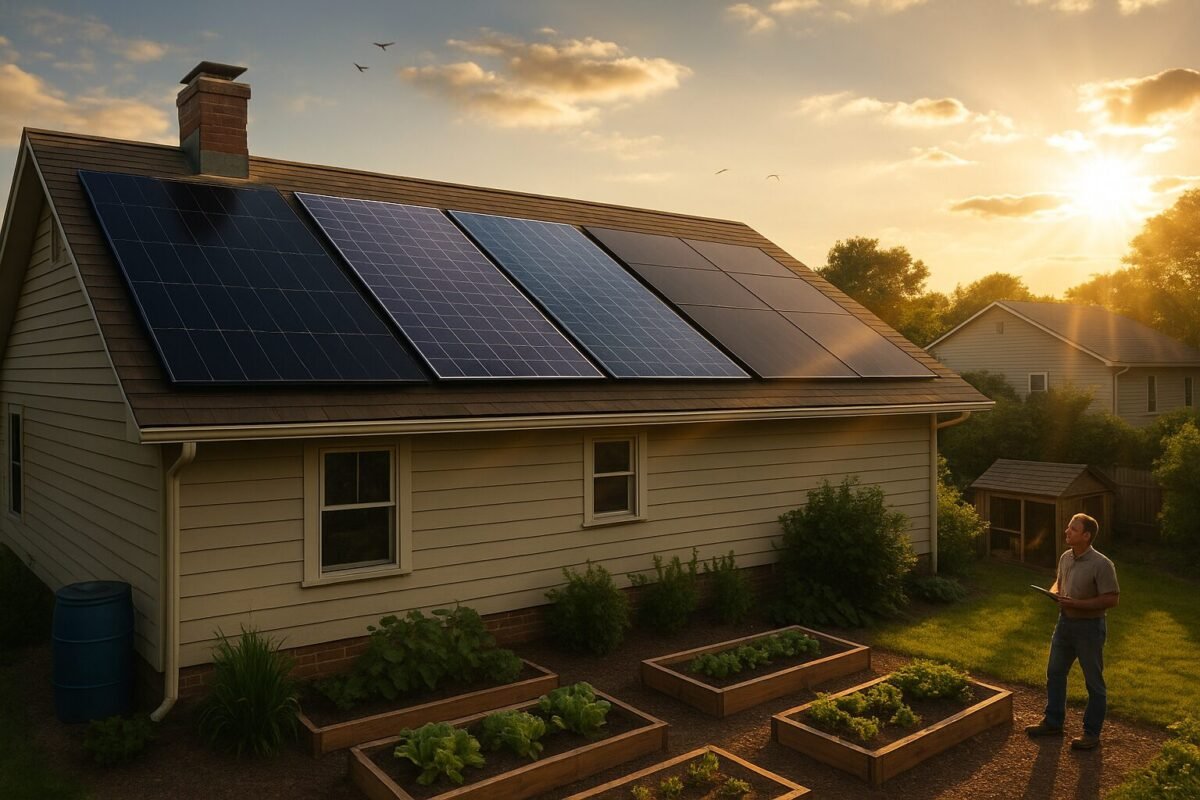
- Modern mono panels with black frames and backsheets look sleek and uniform.
- Polycrystalline:
- Bluish, “sparkly” pattern.
- More obvious cell edges, more “old-school solar” look.
- Thin-film:
- Can look like smooth dark glass or strips laid out on metal roofing.
- Often very low-profile.
8.2 Matching to Your Roof
- Dark roofs + black mono panels = very clean look.
- Light-colored roofs might show off panel edges more.
- Thin-film on metal roofing can almost disappear from street level.
If you have an HOA or you care a lot about how your roof looks, aesthetics can be the tiebreaker between two otherwise similar options.
8.3 Aesthetics and Resale Value
Buyers may not know mono vs poly, but they do notice:
- “That roof looks good” vs “that roof looks cluttered.”
- Whether the system looks modern and thoughtfully installed.
A clean-looking mono array with neat conduit runs and good cable management will usually help resale more than hurt it.
9. Roof Size, Shape, and Structural Limits
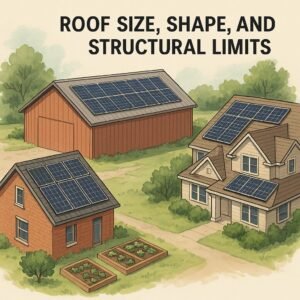
Key question: For small or weird roofs, what makes the most sense?
9.1 When Roof Space Is the Bottleneck
If you’re in a small home, townhome, or ADU, you might have:
- Just one or two roof faces with good sun
- Limited, chopped-up sections between vents and skylights
In those cases, every square foot matters, and monocrystalline usually wins because:
- More watts per panel
- More kWh per year from the same limited footprint
9.2 Weird Roofs and Obstacles
If your roof has:
- Dormers
- Turrets
- Multiple small planes
- Random vents everywhere
You have two main options:
- Use high-efficiency mono and carefully tuck panels where they fit.
- Or, if you have lots of secondary surfaces (garage, shed, barn), spread the load around.
Thin-film can help on long, uninterrupted surfaces like a big metal barn roof, but on a chopped-up house roof, mono is usually easier to design around.
9.3 Weight and Structural Load
Standard framed crystalline panels (mono and poly) are pretty similar in weight per square foot.
Thin-film can be lighter and lower profile, which can help when:
- You’re working with older structures
- You want to avoid adding much weight to a shed or carport
- You’re bonding to metal roofing without rails
That’s one place where thin-film really shines: big, light, low-pitch structures.
10. Is Thin-Film a Good Choice for Homes?
Key question: Is thin-film only for RVs and sheds, or can it work on a regular house?
10.1 Where Thin-Film Shines
Thin-film can be a great choice when:
- You have a huge roof or structure with tons of area.
- You’re working with a metal roof that’s perfect for peel-and-stick or clamp-on thin-film.
- You care about low weight, low profile, or flexibility (RVs, vans, curved roofs).
On an RV or a small off-grid cabin, thin-film can be a friendly option.
10.2 Where Thin-Film Struggles
On a typical suburban house:
- Roof area is limited.
- You want to maximize kWh per square foot.
- Labor and racking costs matter a lot.
Because thin-film is less efficient, you often can’t hit your desired system size before you run out of space. In that case, mono almost always wins.
10.3 Building-Integrated PV (Solar Shingles, etc.)
Some thin-film and advanced products show up as:
- Solar shingles
- Integrated metal roofing with PV layers
These can look fantastic, but:
- They’re often more expensive per watt.
- They can be trickier to service.
For a microhomesteader on a budget, traditional framed mono panels are usually the best balance of cost, performance, and simplicity.
11. Best Panel Type for Off-Grid and Microhomesteads
Key question: If I’m off-grid or planning a serious microhomestead, what’s the most practical choice?
11.1 Off-Grid Design Priorities
When you’re off-grid, the priorities shift:
- Reliable charging for batteries
- Solid performance in your worst months (winter, cloudy season)
- Enough headroom for critical loads (pump, fridge, lights, maybe a mini-split)
11.2 Mono vs Poly Off-Grid
For most off-grid setups:
- Monocrystalline is the default:
- More power per square foot.
- Easier to expand within a limited footprint.
- Pairs well with modern MPPT charge controllers.
- Polycrystalline can still work great if:
- You have lots of roof or ground space.
- You’re trying to get started on a tighter budget.
Both can be solid. The deciding factor is usually space constraint vs budget.
11.3 Where Thin-Film Fits in Off-Grid Life
Thin-film can make sense for:
- RVs and vans (lightweight, flexible, conform to roof curves)
- Sheds, barns, or greenhouse roofs where you’ve got tons of area
- Auxiliary arrays for specific loads (like a separate array for a greenhouse fan system)
A hybrid approach is common:
- Mono array on the main house feeding the main battery bank.
- Thin-film or extra panels on sheds, barns, or RVs for bonus loads.
12. Putting It All Together: Simple Decision Paths
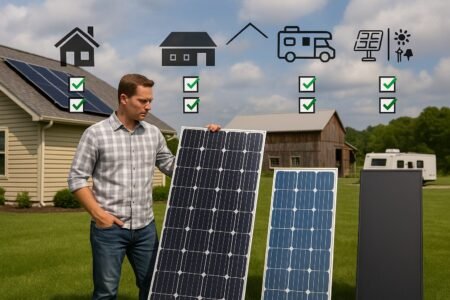
Here’s a simple “If this, then that” guide.
- Small roof + high power needs
→ Go monocrystalline. You need every watt. - Large, simple roof + moderate budget
→ Poly or mono both work. If the budget is tight and you have the space, poly can be fine. - Huge metal barn/shed roof + lots of area
→ Consider poly or thin-film. Thin-film can be nice on long, low-slope metal roofs. - RV, van, curved roof, or lightweight structure
→ Thin-film or low-profile mono designed for mobile/off-grid applications. - Off-grid microhomestead with batteries
→ Main array: monocrystalline. Add-ons: mono or thin-film wherever they fit.