Category Archives: Solar Panels

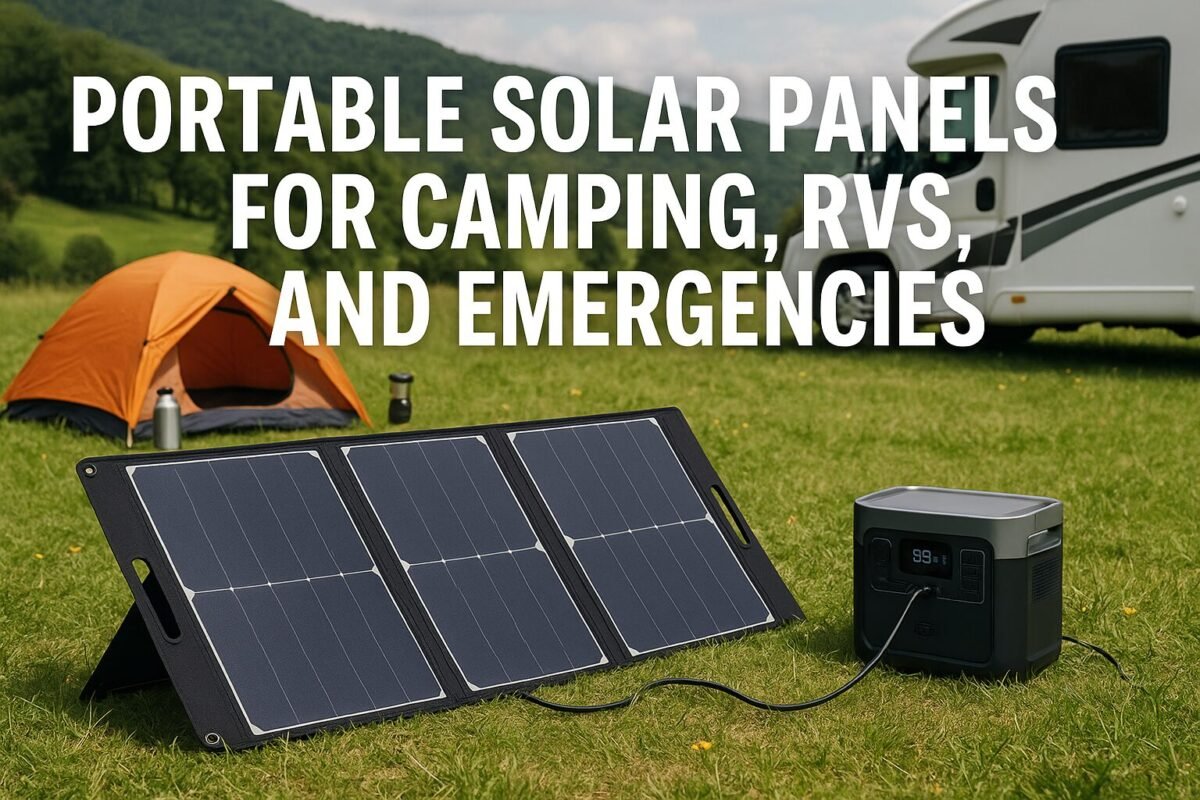
Portable Solar Panels for Camping, RVs, and Emergencies: Simple Guide

Learn how to choose, size, and use portable solar panels for camping, RVs, and emergency backup—plus real-life tips, and example setups. With the rise of portable solar panels for camping, it’s easier than ever to power your devices while enjoying nature.

As you plan your next adventure, don’t forget about portable solar panels for camping as a reliable power solution.

I still remember the first time I dragged a little “solar kit” to a campsite.
I thought I was a genius… right up until the panel spent most of the day in the shade, my phone barely charged, and my lantern died halfway through a card game.

Portable solar panels for camping are a game changer, allowing you to charge your gadgets and keep the lights on during your outdoor adventures.

If you’ve ever wondered:

  • “What size portable solar panel do I really need?”
  • “Can this thing actually run my fridge or just my phone?”
  • “Is it strong enough for emergencies, or is it just a toy?”

…this post is for you.

Think of this as the hand-holding, no-math-degree-needed guide to portable solar for camping, RVs, and power outages at home.


TL;DR Snapshot

If you only read one thing, make it this:

  • For weekend camping (phones, lights, small fan):
    Start with a 100W folding solar panel + a 300–500Wh power station.
  • For RVs/vanlife (lights, fridge, devices):
    Aim for 200–400W of portable panels + a 1,000Wh+ power station or house battery.
  • For emergencies at home (phones, lights, small devices):
    Plan on 200W+ of panels + 500–1,000Wh of storage as a “keep the basics alive” kit.
  • Portable solar is great for small stuff and quiet backup.
    It’s not a magic “power my whole house forever” solution.

You can absolutely start small, learn as you go, and grow your kit over time.


Skim-Stopper Box: Super-Quick Answers

Q: Can a portable solar panel power my whole RV or house?
A: Usually no. Portable panels are better for charging a battery that runs small stuff (lights, phones, fans, maybe a small fridge).

Q: What size panel should I get for camping?
A: Most people are happy with a folding 100W panel + 300–500Wh power station.

Q: How do I know if it’s big enough?
A: Add up what you want to run in a day (in watt-hours), then make sure your battery stores that much and your panel can refill most of that on a sunny day. I’ll walk through this step by step below.

Q: Is portable solar worth it for emergencies?
A: If you want quiet power for phones, lights, radios, and medical devices, yes. It’s not a whole-house solution, but it can make outages a lot less stressful.


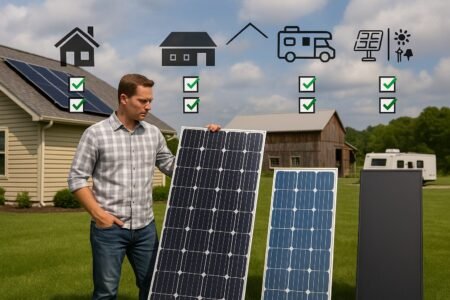
1. What Counts as “Portable Solar”?

For long trips, consider investing in high-capacity portable solar panels for camping.

When I say portable solar, I’m talking about:

  • Folding/briefcase panels
    • Panels that fold up like a suitcase with a handle.
    • Often 60W, 100W, 200W, etc.
    • Great for camping and RVs.
  • Flexible or roll-up panels
    • Lighter, sometimes less durable.
    • It can be strapped to a backpack, tent, or RV roof.
  • Portable “solar generator” or power station + panel
    • The “box” with outlets is actually a battery with an inverter.
    • The portable panel plugs in to charge the battery.
    • Nice all-in-one option for non-techy folks.
  • Tiny trickle chargers (5–20W)
    • Good for keeping a car battery topped off or slowly charging a phone.
    • Not enough if you want to run multiple devices daily.

Portable solar panels for camping have revolutionized the way we think about outdoor power solutions.

With portable solar panels for camping, you can ensure that your essential devices stay operational even in remote areas.

The important thing to remember:

Portable panels charge a battery. The battery actually runs your stuff.

You’ll see panels and power stations sold together as kits, but you can also mix and match.

If you’re brand new to solar in general, it might help to quickly scan a beginner’s guide first, then hop back here:
👉 How Solar Works (Beginner Guide)


Portable Solar Panels for Camping: A Quick Overview

2. Step-by-Step: How to Size a Portable Solar Setup (No Math Degree Needed)

Let’s walk through this like we’re planning a weekend camping trip.

Step 1: Decide what you want to power

Make a simple list. For example:

  • 2 phones
  • 1 LED lantern
  • 1 small USB fan at night
  • Maybe a tablet or small laptop for a movie

Step 2: Find the “watts” and “hours”

You don’t need perfect numbers. Close is fine.

  • Phone: ~10W while charging, maybe 10–20Wh per full charge
  • LED lantern: ~5–10W
  • Small USB fan: ~5W
  • Tablet/laptop: 20–60W depending on size

Now guess how long you’ll use each per day:

  • Phones: 2 full charges per day, total → 40Wh
  • Lantern: 5W × 4 hours → 20Wh
  • Fan: 5W × 8 hours → 40Wh
  • Tablet: 30W × 2 hours → 60Wh

Add them up:

  • 40 + 20 + 40 + 60 = 160Wh per day

Let’s pad it a bit for “real life” → call it 200Wh per day.

Step 3: Choose your battery (power station size)

Your battery or power station is rated in Wh (watt-hours).

  • For 200Wh/day, a 300–500Wh power station is perfect:
    • Enough room for cloudy moments and “oops” usage.
    • You won’t have to baby every single watt.

Step 4: Size your solar panel

Remember, portable solar panels for camping are not just a luxury; they can be essential for a smooth trip.

Your panel’s job is to refill the battery each day.

Very rough but practical rule of thumb:

Daily energy from panel ≈ Panel watts × 4 hours × 0.6 (real-world fudge factor)

That 0.6 accounts for shade, heat, imperfect aim, etc.

Example with a 100W panel:

  • 100W × 4h × 0.6 ≈ 240Wh per sunny day

Perfect. That matches our 200Wh/day target with a bit of cushion.

So, for our simple camping example:

  • Battery: 300–500Wh
  • Panel: 100W folding panel

When selecting your portable solar panels for camping, consider the wattage and the type of devices you’ll be using.

This is why I say:

For most weekend campers, 100W panel + 300–500Wh power station feels “just right.”


3. Quick Starter Setups (Camping, RV, and Emergencies)

Here are some simple starting points. You can tweak up or down.

A. Lightweight Hiking / Minimalist Camping

You want: phone, headlamp, maybe a tiny fan.

  • Panel: 20–40W lightweight or foldable panel
  • Battery: 100–200Wh power bank/power station
  • Use case: Backpacking, bikepacking, or ultralight car camping.

You’ll be watching the weather and your usage a bit more closely, but it’s doable.


B. Car / Tent Camping (Most Common Scenario)

You want: phones, lanterns, a fan, maybe a tablet/laptop.

  • Panel: 80–120W folding panel
  • Battery: 300–500Wh power station
  • What it can realistically do:
    • Phones, lights, fans, and small gadgets daily.
    • Occasional use of a small laptop or mini-projector.
    • You’ll notice cloudy days, but you’re mostly comfortable.

C. Small RV / Van Boondocking

You want: lights, fans, water pump, fridge, devices.

  • Panel: 200–400W (two 100W suitcases or one bigger folding panel array)
  • Battery: 1,000–2,000Wh power station or RV house battery bank
  • What it can realistically do:
    • Run a 12V fridge reliably in decent weather.
    • Run LED lights, fans, devices, and small electronics.
    • Still not enough for A/C or electric heaters.

This is where portable solar starts to blend into “small off-grid system” territory. If you’re going this route, you might also like:
👉 What Affects Solar Panel Efficiency? Real-World Factors, Fixes, and Easy Wins


D. Emergency Home Backup (Phones, Lights, Basic Comfort)

You want: phones, lights, a radio, maybe Wi-Fi, and a small fan or a small fridge.

  • Panel: 200–400W portable solar (folding panels you can set outside)
  • Battery: 500–1,000Wh power station (or bigger if budget allows)
  • What it can realistically do:
    • Keep phones and small devices powered indefinitely in decent weather.
    • Run LED lights, fans, and radio very comfortably.
    • Maybe keep a small fridge or chest freezer going if you’re careful and turn it off at night.

This is not a whole-house solution—but it can turn a stressful outage into an inconvenience instead of an emergency.


4. How to Set Up Portable Solar in Real Life (Simple Walkthrough)

Here’s what setup actually looks like in camp or at home.

Step 1: Pick a sunny spot

  • Set the panel where it will get the most sun between late morning and mid-afternoon.
  • Avoid:
    • Trees and branches
    • RV antennas
    • Shadows from buildings

Even a little shade on part of the panel can seriously hurt output.


Step 2: Aim the panel at the sun

You don’t have to be perfect.

  • In the middle of the day:
    • Tilt the panel like a propped-up book, facing the sun.
    • If your shadow is short and right in front of the panel, you’re in the ballpark.
  • If you don’t want to babysit it, aim it for midday and leave it.

Step 3: Plug into your power station or charge controller

  • All-in-one power station:
    • Plug the panel’s cable into the “solar input” or “DC input” port.
    • The screen should show incoming watts.
  • DIY battery + charge controller:
    • Panel → charge controller → battery → (optional inverter) → devices.
    • Follow the controller’s diagram exactly; polarity matters.

Step 4: Keep batteries cool and dry

Battery/Power Station:

  • Likes shade, not full sun
  • Hates rain puddles and dust
  • Should sit:
    • Under a table
    • Inside the tent/RV (where it won’t overheat)
    • Under a tarp/canopy (well ventilated)

Your panel is okay with the sun. Your battery usually isn’t.

Many campers find success with portable solar panels for camping, especially when combined with a good battery.


Step 5: Use your devices sensibly

When the sun is shining, and the battery is full:

  • Charge power-hungry things (laptop, power tools, etc.).
    When it’s dark or cloudy:
  • Prioritize essentials: lights, phones, fans, radios, and medical devices.

You don’t have to be perfect—just a bit mindful.


5. Portable Solar vs Gas Generator vs Just Using Your Car

You might be wondering, “Why not just run a little gas generator or idle the car?”

Portable Solar: Pros & Cons

Pros

  • Quiet
  • No fuel to store
  • No fumes
  • Great for campsites with noise rules
  • Very low ongoing cost once you buy it

Opting for portable solar panels for camping means you’re equipped for any situation outdoors.

Cons

  • Depends on the weather and daylight
  • Limited power (no big heaters or A/C)
  • Needs a battery if you want power at night

For most campers, portable solar panels for camping provide the perfect balance of convenience and functionality.

Gas Generator: Pros & Cons

Pros

  • Lots of power for size
  • Can run energy-hungry gadgets if sized correctly

Cons

  • Noise
  • Fumes (not safe indoors)
  • Need fuel, maintenance, and safe storage
  • Often not allowed or welcome in peaceful campgrounds

Idling Your Car: Pros & Cons

Pros

  • Uses what you already have
  • An alternator can charge a battery or power a small inverter

Cons

  • Wastes fuel
  • Adds wear to your engine
  • Not great in enclosed spaces
  • Still noisy and smelly compared to solar

For many micro-homesteaders, the sweet spot is:

Portable solar for everyday + mild emergencies, generator or grid for the “big stuff.”


6. Common Mistakes (and Easy Fixes)

I’ve either made these mistakes myself or watched friends make them.

#1: Buying a tiny panel for big expectations

  • A 20W panel will not keep a big power station filled while running a fridge and fans.
  • Fix: Match panel watts and battery Wh to your actual daily needs (Section 2).

#2: Leaving the panel flat on the ground or table

  • Panels lying flat often get less sun and more shade.
  • Fix: Prop the panel up and aim it at the sun—your output can jump a lot.

#3: Letting cords run through high-traffic areas

Many outdoor enthusiasts rely on portable solar panels for camping to keep their devices charged during trips.

  • Trip hazards + potential damage.
  • Fix: Route cords along the edge of the campsite/RV, tape them down, or run them under the RV.

#4: Expecting the panel’s “nameplate” watts in real life

  • A 100W panel rarely gives 100W.
  • Heat, clouds, and angle all cut output.
  • Fix: Use a “real-world” factor (0.6-ish) when planning.

If you want to nerd out on this part a little more (without going full engineer), this post goes deeper:
👉 What Affects Solar Panel Efficiency? Real-World Factors, Fixes, and Easy Wins


Mistake 5: Thinking portable solar can power everything

  • Portable panels are fantastic for small loads.
  • They are not meant for:
    • Air conditioners
    • Electric heaters
    • Electric stoves
    • Big well pumps (unless you build a serious system)

Fix: Use portable solar as a quiet, clean “small power” solution, not a total grid replacement.


7. Simple Checklists (So You Don’t Have to Rethink This Every Time)

Camping Checklist (Weekend Trip)

  • 80–120W folding panel
  • 300–500Wh power station
  • Extension cable for panel (if needed)
  • Shade spot for the battery (under table, inside tent/RV)
  • USB lanterns/headlamps
  • Small USB fan if it’s hot
  • Short, good-quality USB cables (less mess, less loss)

RV / Van Checklist

  • 200–400W worth of portable panels
  • 1,000–2,000Wh power station or house battery bank
  • MC4 or other connector adapters (if mixing brands)
  • Mounting straps or stands for panels
  • Fuse or breaker protection as recommended by the manufacturer
  • Cable management: hooks, clips, or tape

Emergency Backup Checklist (Home)

  • 200–400W panels that can be set up quickly
  • 500–1,000Wh power station
  • List of “critical loads” (phones, lights, radio, medical devices, Wi-Fi, fan, maybe fridge)
  • Dedicate a spot near a window or door to run the panel cable inside
  • Small box/tote with:
    • Flashlights
    • Extension cord
    • Power strip
    • Radio
    • Printed instructions for family members

If you’re thinking about building a more permanent home system later, this post pairs nicely with that journey:
👉 The Essentials of Solar Power for Aspiring Microhomesteaders


8. Tiny FAQ (Because Everyone Asks These)

Q: Can I use portable panels to charge my RV’s main batteries?
A: Often yes, but you’ll need the right charge controller and wiring. Some portable kits are designed specifically to plug into RV systems. Always match the voltage and follow the instructions.


Q: What about cloudy days?
A: Portable solar still works, just slower. This is why having a bit of extra battery is so nice—you ride through clouds on stored energy.


Q: Can I leave the panels out in the rain?
A: Many are water-resistant, but always check the manual. The panel might be okay; the connections and battery usually are not. When in doubt, bring them in or cover them.


Q: Do I need an inverter?
A: If you stick to USB and 12V gadgets, you might not.
If you want to use standard wall plugs, either:

  • Use a power station (built-in inverter)
  • Or add a separate inverter (for advanced DIY setups)

9. Wrapping It Up: Start Small, Learn Fast, Upgrade Later

Portable solar can feel confusing when you’re staring at a wall of numbers and acronyms.

But if you boil it down, it’s really just:

  1. Figure out what you want to power.
  2. Choose a battery big enough for a day or two of that.
  3. Pick a panel (or panels) that can refill that battery on a decent sunny day.
  4. Set it in the sun, point it roughly at the sky, and start learning.

You don’t have to get it perfect on day one. Start with a simple camping kit, get hands-on experience, and let that teach you what you really want for your RV or emergency setup.

Investing in portable solar panels for camping not only enhances your experience but also ensures you have power when you need it most.

By using portable solar panels for camping, you can enjoy a more sustainable way to power your adventures.

There are numerous options for portable solar panels for camping that cater to different power needs.

Choosing the right portable solar panels for camping can make a significant difference in your outdoor experience.

For frequent campers, portable solar panels for camping are an essential investment.

Complement your adventure with portable solar panels for camping that fit your lifestyle and needs.

For those who love nature, portable solar panels for camping can provide a reliable power source anywhere.

With the advancements in technology, portable solar panels for camping are more efficient than ever.

Portable solar panels for camping allow you to enjoy modern conveniences without sacrificing your love for the outdoors.

Keep your devices powered with portable solar panels for camping, making your outdoor experiences more enjoyable.

Explore your options for portable solar panels for camping to find the best fit for your needs.

Don’t underestimate the capabilities of portable solar panels for camping; they can significantly enhance your outdoor experience.

Utilize portable solar panels for camping to ensure you have the power you need on your next trip.
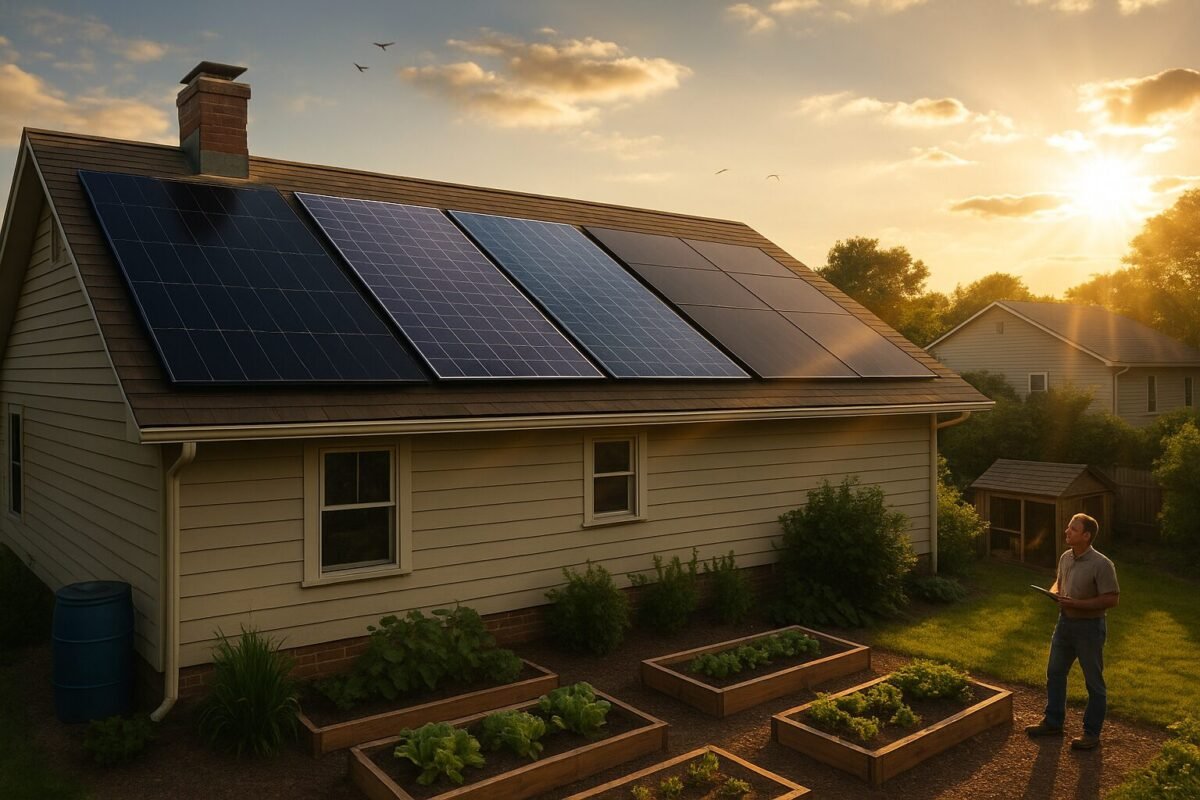
Solar Panel Efficiency: Mono vs Poly vs Thin-Film

Compare solar panel efficiency across monocrystalline, polycrystalline, and thin-film panels so you can choose the best type for your roof and budget.

When I first started looking at solar, I honestly thought all panels were basically the same rectangle with a different logo on the corner.

Then I started planning a real system.

Suddenly, I was swimming in terms like monocrystalline, polycrystalline, and thin-film… and every installer had a different opinion about which was “best.”

If you’re in that same “I just want to know what to put on my roof” phase, this guide is for you.

By the end, you’ll know:

  • Which type is most efficient in the real world
  • How much more energy can mono squeeze out of the same square footage
  • How cost, heat, shade, lifespan, and warranties differ
  • Which type actually makes sense for small roofs, weird roofs, RVs, and microhomesteads

Let’s make sense of this.


2. Quick Comparison Snapshot (For Skimmers)

Here’s the 10-second version:

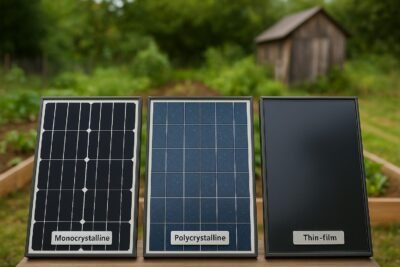
TypeTypical EfficiencyCost per WattSpace NeededBest For
MonocrystallineHighestHigherLeast roof areaSmall roofs, high usage, long-term systems
PolycrystallineMediumLowerMore roof areaLarger roofs, budget installs
Thin-FilmLowest (rooftop)Panel cheap, BOS can be moreMost roof areaRVs, sheds, metal roofs, odd shapes, huge area

One-sentence takeaways:

  • Monocrystalline – Max power per square foot. Great when roof space is precious.
  • Polycrystalline – Solid middle ground if you have space and want to save a bit upfront.
  • Thin-Film – Lightweight, flexible, niche. Great for RVs, sheds, and large, simple metal roofs.

Now let’s slow down and unpack why.


3. What Are Mono, Poly, and Thin-Film Panels?

3.1 Monocrystalline Panels (Mono)

  • Made from a single crystal of silicon.
  • Cells look uniform and dark, often solid black or very dark gray.
  • Typical residential “modern” panels you see in new installs.
  • Known for high efficiency and a clean, uniform look.

In plain English: mono panels are like the “premium” option—more power from the same footprint.


3.2 Polycrystalline Panels (Poly)

  • Made from multiple crystals melted together.
  • Cells have a speckled, bluish look.
  • A bit less efficient than mono, but usually cheaper per panel.
  • Common in slightly older systems or more budget-conscious installs.

Think of poly as the “value” option: still good, just not quite as power-dense.


3.3 Thin-Film Panels

“Thin-film” isn’t one single thing; it’s a whole family:

  • Very thin layers of semiconductor are deposited on glass, metal, or flexible backing.
  • Can be flexible or rigid.
  • Often used on RVs, vans, metal roofs, and big commercial roofs.
  • Lower efficiency per square foot, but sometimes easier to install on tricky surfaces.

Thin-film is the oddball cousin: it doesn’t look like the classic framed rectangle, but it can go places conventional panels can’t.


4. Efficiency in the Real World

Key questions:

  • Which type is most efficient?
  • How much more energy per square foot does mono actually give you?

4.1 Lab Efficiency vs Real Rooftops

Panel datasheets love to shout about efficiency. That’s just:

How much of the sunlight hitting the panel gets turned into electricity.

But real-world output also depends on:

  • Roof angle and direction
  • Shade from trees, chimneys, neighbors
  • Heat buildup on the roof
  • Inverter, wiring, and other system losses

So we’ll talk about typical ranges, not perfect lab numbers.


4.2 Efficiency Comparison by Type

On a typical home roof, you’ll roughly see:

  • Monocrystalline: highest efficiency
  • Polycrystalline: a bit lower
  • Thin-film: lowest per square foot (but sometimes better in low light on huge roofs)

Let’s do a simple, same roof area comparison.

Say you’ve got 200 square feet of good roof:

  • Mono: might give you around 3.8 kW of panel capacity
  • Poly: closer to 3.2 kW
  • Thin-film: maybe around 2.3 kW

Over a year, if that roof sees decent sun, that same 200 sq ft might produce ballpark:

  • Mono: ~5,700 kWh
  • Poly: ~4,800 kWh
  • Thin-film: ~3,400 kWh

The exact numbers will depend on your location, but the relative difference is the point:
Mono squeezes significantly more energy out of the same footprint.


4.3 When Efficiency Really Matters

Efficiency becomes a big deal when:

  • You have a small roof
  • You have lots of obstructions (vents, dormers, skylights)
  • You want to offset a big chunk of your usage
  • You’re planning for future loads (EV, mini-split, workshop, etc.)

For many microhomesteaders with limited space, monocrystalline is the go-to just because every square foot matters.


5. Cost Per Watt and Payback Time

Key question: How do cost differences per watt change payback?

5.1 Hardware Cost: Panel vs System

At the panel level, you’ll often see:

  • Mono: a bit more per watt
  • Poly: a bit less per watt
  • Thin-film: panel itself can be cheap per watt, but…

That’s only part of the story.


5.2 Balance of System (The Hidden Cost)

You don’t just pay for the panel. You also pay for:

  • Racking and mounting
  • Wiring and conduit
  • Inverter(s) and labor
  • Permits and inspections

Here’s the catch: if you choose lower-efficiency panels, you may need:

  • More panels
  • More racking
  • More clamps, wiring, and labor

So while poly or thin-film might look cheaper per panel, a bigger array can eat up that savings in mounting hardware and labor.


5.3 Payback and ROI by Panel Type

In many cases:

  • If roof space is free and abundant, poly can make sense as a budget play.
  • If roof space is tight or labor is pricey, paying a little more for mono can actually improve payback, because you get more kWh out of a similar install cost.

So the “cheapest panel” is not always the cheapest system or the fastest payback.


6. Heat, Shade, and Cloudy Days

Key questions:

  • Which type handles high heat better?
  • Which does better in shade and low light?

6.1 High-Temperature Performance

All silicon panels lose some efficiency when they get hot. Roofs get really hot in summer.

You’ll see this on datasheets as a temperature coefficient. Lower (in magnitude) is better.

Roughly speaking:

  • Mono and poly are similar, with mono often slightly better on modern models.
  • Thin-film can sometimes handle heat a bit differently, but because its baseline efficiency is lower, you still need more area to match output.

Practical takeaway: In a very hot, very sunny climate, you still usually pick good-quality mono. You just pay attention to the roof ventilation and airflow under the panels.


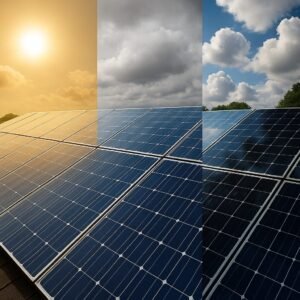
6.2 Shade and Cloudy Weather

No panel type loves shade. A small shadow on one part of a string can drag down the whole string.

In general:

  • Crystalline panels (mono/poly): solid in normal sun, but sensitive to hard shade (branches, chimneys).
  • Thin-film: lower peak efficiency, but sometimes behaves a bit better in soft, diffuse light (overcast days, evenly cloudy skies).

However, for a typical home roof, the bigger factors are:

  • Good array design (avoid shade paths)
  • Using optimizers or microinverters if you have unavoidable shade
  • Trimming or removing problem branches if possible

6.3 Matching Panel Type to Your Climate

  • Hot, sunny desert or tropical roof: Mono with good airflow and decent temperature coefficient.
  • Cool, cloudy climate with a big, simple roof: Mono or poly both work; arrays can be slightly bigger.
  • Mixed climate, lots of trees: Focus on shade-aware design and electronics more than changing panel type.

7. Lifespan, Degradation, and Warranties

Key questions:

  • How long do these panels actually last?
  • Do different types wear out faster?
  • Are warranties different?

7.1 Degradation Over Time

All panels gradually produce less over the years. You’ll see this as a % per year degradation.

Rough picture:

  • Mono: very low annual degradation on modern panels
  • Poly: similar ballpark, sometimes slightly higher
  • Thin-film: depends on the specific tech; some degrade faster, others are competitive

Over 20–25 years, a good mono panel might still be producing 80–90% of its original output. That’s a big deal for long-term planning.


7.2 Product vs Performance Warranties

Most manufacturers offer:

  • A product warranty – covers workmanship and defects (think 10–25 years).
  • A performance warranty – guarantees a minimum % of the original output after a certain number of years.

You’ll often see:

  • Mono panels with longer product warranties and better performance guarantees (especially from top brands).
  • Poly with similar but sometimes slightly shorter/less generous terms.
  • Thin-film warranties vary more, depending on the specific product and use case.

When comparing quotes, don’t just look at kW. Look at how long that kW is promised to stick around.


7.3 What That Means for a 20–30 Year Microhomestead Plan

If you’re building a long-term homestead and planning to stay put:

  • A panel that costs a little more but produces more energy for 25+ years can be a better deal than a cheaper one that fades faster.
  • That’s often why people lean toward higher-quality mono for their main roof array.

8. Aesthetics and Curb Appeal

Key question: Which looks better, and does that matter for resale?

8.1 How Each Panel Type Looks

  • Monocrystalline:
    • Dark, often black cells.
    • Modern mono panels with black frames and backsheets look sleek and uniform.
  • Polycrystalline:
    • Bluish, “sparkly” pattern.
    • More obvious cell edges, more “old-school solar” look.
  • Thin-film:
    • Can look like smooth dark glass or strips laid out on metal roofing.
    • Often very low-profile.

8.2 Matching to Your Roof

  • Dark roofs + black mono panels = very clean look.
  • Light-colored roofs might show off panel edges more.
  • Thin-film on metal roofing can almost disappear from street level.

If you have an HOA or you care a lot about how your roof looks, aesthetics can be the tiebreaker between two otherwise similar options.


8.3 Aesthetics and Resale Value

Buyers may not know mono vs poly, but they do notice:

  • “That roof looks good” vs “that roof looks cluttered.”
  • Whether the system looks modern and thoughtfully installed.

A clean-looking mono array with neat conduit runs and good cable management will usually help resale more than hurt it.


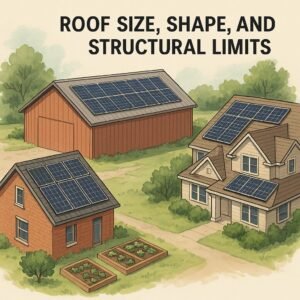
9. Roof Size, Shape, and Structural Limits

Key question: For small or weird roofs, what makes the most sense?

9.1 When Roof Space Is the Bottleneck

If you’re in a small home, townhome, or ADU, you might have:

  • Just one or two roof faces with good sun
  • Limited, chopped-up sections between vents and skylights

In those cases, every square foot matters, and monocrystalline usually wins because:

  • More watts per panel
  • More kWh per year from the same limited footprint

9.2 Weird Roofs and Obstacles

If your roof has:

  • Dormers
  • Turrets
  • Multiple small planes
  • Random vents everywhere

You have two main options:

  • Use high-efficiency mono and carefully tuck panels where they fit.
  • Or, if you have lots of secondary surfaces (garage, shed, barn), spread the load around.

Thin-film can help on long, uninterrupted surfaces like a big metal barn roof, but on a chopped-up house roof, mono is usually easier to design around.


9.3 Weight and Structural Load

Standard framed crystalline panels (mono and poly) are pretty similar in weight per square foot.

Thin-film can be lighter and lower profile, which can help when:

  • You’re working with older structures
  • You want to avoid adding much weight to a shed or carport
  • You’re bonding to metal roofing without rails

That’s one place where thin-film really shines: big, light, low-pitch structures.


10. Is Thin-Film a Good Choice for Homes?

Key question: Is thin-film only for RVs and sheds, or can it work on a regular house?

10.1 Where Thin-Film Shines

Thin-film can be a great choice when:

  • You have a huge roof or structure with tons of area.
  • You’re working with a metal roof that’s perfect for peel-and-stick or clamp-on thin-film.
  • You care about low weight, low profile, or flexibility (RVs, vans, curved roofs).

On an RV or a small off-grid cabin, thin-film can be a friendly option.


10.2 Where Thin-Film Struggles

On a typical suburban house:

  • Roof area is limited.
  • You want to maximize kWh per square foot.
  • Labor and racking costs matter a lot.

Because thin-film is less efficient, you often can’t hit your desired system size before you run out of space. In that case, mono almost always wins.


10.3 Building-Integrated PV (Solar Shingles, etc.)

Some thin-film and advanced products show up as:

  • Solar shingles
  • Integrated metal roofing with PV layers

These can look fantastic, but:

  • They’re often more expensive per watt.
  • They can be trickier to service.

For a microhomesteader on a budget, traditional framed mono panels are usually the best balance of cost, performance, and simplicity.


11. Best Panel Type for Off-Grid and Microhomesteads

Key question: If I’m off-grid or planning a serious microhomestead, what’s the most practical choice?

11.1 Off-Grid Design Priorities

When you’re off-grid, the priorities shift:

  • Reliable charging for batteries
  • Solid performance in your worst months (winter, cloudy season)
  • Enough headroom for critical loads (pump, fridge, lights, maybe a mini-split)

11.2 Mono vs Poly Off-Grid

For most off-grid setups:

  • Monocrystalline is the default:
    • More power per square foot.
    • Easier to expand within a limited footprint.
    • Pairs well with modern MPPT charge controllers.
  • Polycrystalline can still work great if:
    • You have lots of roof or ground space.
    • You’re trying to get started on a tighter budget.

Both can be solid. The deciding factor is usually space constraint vs budget.


11.3 Where Thin-Film Fits in Off-Grid Life

Thin-film can make sense for:

  • RVs and vans (lightweight, flexible, conform to roof curves)
  • Sheds, barns, or greenhouse roofs where you’ve got tons of area
  • Auxiliary arrays for specific loads (like a separate array for a greenhouse fan system)

A hybrid approach is common:

  • Mono array on the main house feeding the main battery bank.
  • Thin-film or extra panels on sheds, barns, or RVs for bonus loads.

12. Putting It All Together: Simple Decision Paths

Here’s a simple “If this, then that” guide.

  • Small roof + high power needs
    → Go monocrystalline. You need every watt.
  • Large, simple roof + moderate budget
    Poly or mono both work. If the budget is tight and you have the space, poly can be fine.
  • Huge metal barn/shed roof + lots of area
    → Consider poly or thin-film. Thin-film can be nice on long, low-slope metal roofs.
  • RV, van, curved roof, or lightweight structure
    Thin-film or low-profile mono designed for mobile/off-grid applications.
  • Off-grid microhomestead with batteries
    → Main array: monocrystalline. Add-ons: mono or thin-film wherever they fit.

Solar Loan vs Lease vs PPA: Which Saves You More?

Compare solar loan vs lease vs PPA options, see who owns the panels, who gets tax credits, and which deal delivers the biggest long-term savings.

When I first started looking at rooftop solar, I thought the hardest part would be picking panels.

Nope.

The real headache was the contracts.

Three companies came out. All three promised “$0 down solar”.
But one pitched a loan, one pushed a lease, and one was obsessed with their PPA (Power Purchase Agreement).

All three companies considered the same sun exposure, roof type, and number of panels.
But totally different answers to questions like:

  • Who owns the system?
  • Who gets the tax credits?
  • What happens when I sell the house?
  • And most importantly: who actually saves the most money?

In this post, I’ll walk you through solar loans vs. solar leasing vs. PPAs in plain English, so you can decide which one actually fits your budget, your risk tolerance, and your plans for your home.


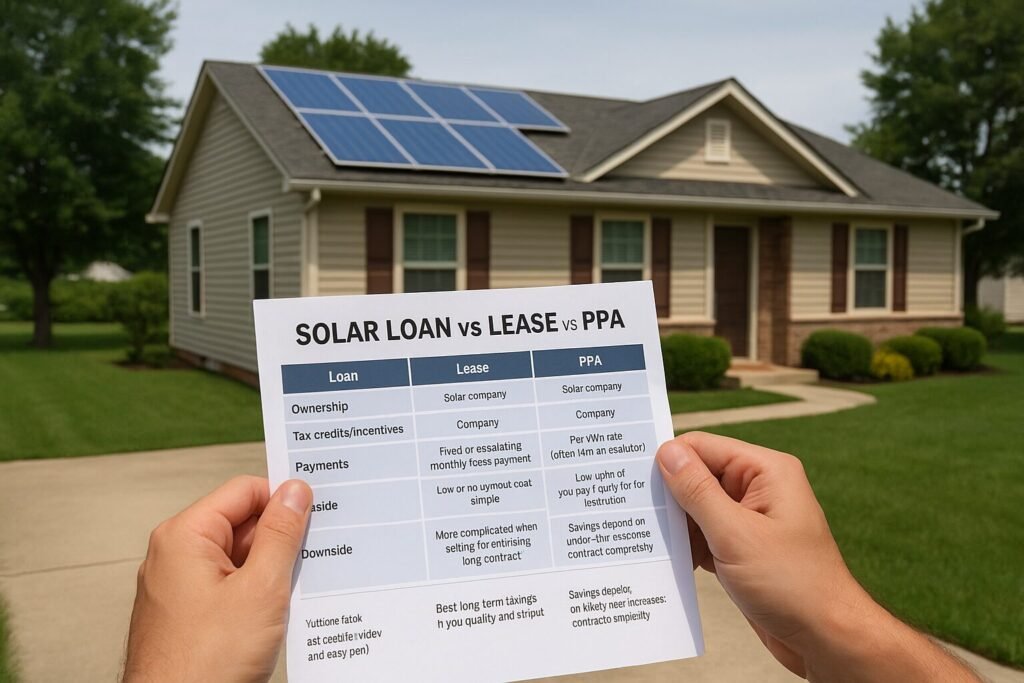
1. Solar Loans vs. Leases vs. PPAs: The Simple Breakdown

Let’s start with quick definitions.

1.1 What is a Solar Loan?

A solar loan works a lot like a car loan or home-improvement loan:

  • You own the solar system.
  • A bank, credit union, solar lender, or sometimes the installer finances it.
  • You make a fixed monthly payment for a set number of years (often 5–20).
  • Once it’s paid off, the system is yours, free and clear.

You’re basically swapping your electric bill for a loan payment + a smaller electric bill.

1.2 What is a Solar Lease?

A solar lease is like leasing a car:

  • The solar company owns the system.
  • You rent the equipment and pay a fixed monthly fee to use it.
  • That payment might stay flat or have a built-in yearly increase (called an escalator).
  • You usually have a contract term of 15–25 years.

You don’t pay for the power per kWh. You pay to “rent” the panels.

1.3 What is a PPA (Power Purchase Agreement)?

A PPA is different:

  • The solar company owns the system, just like with a lease.
  • You don’t pay to rent the system. Instead, you pay for the electricity it produces.
  • You pay a set price per kWh (for example, a bit less than your utility rate).
  • The rate often increases every year by a small percentage unless you negotiate otherwise.

Think of it as switching power providers on your roof rather than at the grid level.

1.4 Quick-Glance Comparison

Here’s the 10-second version:

  • Loan
    • Ownership: You
    • Tax credits/incentives: Usually, you
    • Payments: Fixed loan payment, then $0
    • Upside: Best long-term savings if you qualify and stay put
    • Downside: You take on debt and responsibility
  • Lease
    • Ownership: Solar company
    • Tax credits/incentives: Company
    • Payments: Fixed or escalating monthly lease payment
    • Upside: Low or no upfront cost, simple
    • Downside: More complicated when selling/refinancing; long contract
  • PPA
    • Ownership: Solar company
    • Tax credits/incentives: Company
    • Payments: Per kWh rate (often with an escalator)
    • Upside: Low upfront, you pay mainly for what you use
    • Downside: Savings depend on utility rate increases; contract complexity

2. Who Owns the System—and Why It Matters

Ownership sounds boring, but it affects everything: incentives, resale, control, and long-term savings.

2.1 Ownership with a Solar Loan

With a loan, you own the system from day one. The lender just has a lien or financing agreement, like with a car or home improvement.

That usually means:

  • You decide on maintenance and repairs.
  • You can add panels later (assuming the roof and inverter allow it).
  • The system can be treated as an owned improvement to the property.

2.2 Ownership with a Lease or PPA

With a lease or PPA, the solar company owns the system, not you.

That usually means:

  • They are responsible for maintenance and performance under the contract.
  • You often can’t modify the system without their permission.
  • They decide how and when to upgrade or replace equipment.

2.3 Why Ownership Changes the Math

Ownership decides:

  • Who gets the tax credits and rebates?
  • How your home value may be affected.
  • How easy or hard is it to sell or refinance later?
  • Whether your savings can grow over time once the loan is paid off.

If you like the idea of solar being a permanent upgrade to your property that keeps paying you back, ownership (loan or cash) is usually more attractive.


3. Who Gets the Tax Credits, Rebates, and Incentives?

This is one of the biggest surprises for many people.

You don’t automatically get the solar tax credit just because the panels are on your roof.

3.1 Loans: Incentives Usually Go to You

With a loan, you’re typically the system owner, so:

  • You’re usually the one who can claim federal tax credits (if you qualify).
  • You may also be eligible for state incentives and local rebates.
  • Some incentives reduce the effective cost of your system significantly.

You do need enough tax liability to actually use the credit, so it’s worth talking to a tax professional for your situation.

3.2 Leases & PPAs: Incentives Go to the Company

With leases and PPAs, the solar company owns the equipment, so:

  • They usually claim the tax credits and incentives.
  • In theory, they “pass the savings” to you through lower payments or better terms.
  • In practice, you’re trusting their pricing to reflect that.

This doesn’t automatically make leases/PPAs bad, but it does mean you’re not stacking incentives on top of your own long-term ownership.

3.3 Incentives Change the Real Cost Comparison

Two neighbors can have the same system size and the same roof, but:

  • Neighbor A buys with a loan and uses tax credits and rebates to lower the total cost.
  • Neighbor B signs a lease where the company takes the incentives.

On paper, both got “$0 down.” Over 20–25 years, the financial outcome can be very different.


4. Lifetime Cost and Savings: Who Really Saves the Most?

Everyone loves to show charts with huge savings curves. The tricky part is what assumptions they used.

4.1 Upfront Cost vs. Lifetime Savings

Roughly:

  • Loans: You may put some money down or go zero-down. You may have a payment that’s similar to your current electric bill at first. Over time, once the loan is paid off, your savings can increase dramatically.
  • Leases/PPAs: Often no upfront cost. You start saving a bit (hopefully) from day one, but you keep paying for 15–25 years.

If you’re planning to stay put and can handle a loan, ownership tends to win on total dollars saved over the long term.

4.2 Typical Patterns

  • Solar loan
    • Best when you stay in the home long enough to pay off or nearly pay off the system.
    • After the payoff, your electric bill is mostly just residual usage and fixed utility fees.
  • Solar lease
    • It can be nice if you want predictable payments and don’t want to own anything.
    • But you rarely get that “my panels are now basically free” feeling.
  • PPA
    • Attractive when they offer a kWh rate noticeably lower than your current utility rate.
    • Savings depend heavily on how your usage and utility rates change over time.

4.3 Utility Rate Assumptions Matter

Many proposals assume your utility rates will skyrocket every year.

If that happens, your savings look huge.
If they don’t, your “guaranteed” savings may disappear.

When you compare loan vs lease vs PPA, always ask:

  • What utility rate increase did they assume each year?
  • What PPA or lease escalator did they build in?

If the solar payment is rising faster than your actual utility rates, the deal may get worse over time, not better.


5. Monthly Payments and Cash Flow

Most of us live in a monthly payment world, not a lifetime model world. Let’s talk cash flow.

5.1 Solar Loan Payments

With a loan, you’ll usually see:

  • A fixed monthly payment for the length of the loan.
  • A smaller electric bill because the panels offset some of your usage.

For many people, the goal is a “bill swap”:

Electric bill goes down

  • Solar loan payment
    ≈ About what you were paying before (or a little less).

The big payoff comes later, when the loan is gone.

5.2 Solar Lease Payments

With a lease, you pay:

  • A fixed or escalating monthly lease payment, plus
  • A reduced electric bill (since you’re still connected to the grid).

Your solar payment might start below your old power bill, but if it escalates every year, that gap can close.

5.3 PPA Payments (Pay per kWh)

With a PPA, you:

  • Pay per kWh for the power your system produces.
  • Still get a reduced utility bill because you’re buying less power from the grid.

If the PPA rate starts much lower than your utility rate and the escalator isn’t too aggressive, this can produce steady savings. If the rate and escalator are high, your savings may fade.

5.4 Cash-Flow Scenarios

Here’s how I think about it:

  • Tight monthly budget, no savings, short time horizon
    Lease or PPA might be appealing because of the low upfront cost and simple structure.
  • Steady income, plan to stay in the home 10+ years, okay with a loan
    A loan can give the best balance of reasonable monthly payment + strong long-term savings.

6. Selling Your Home with a Loan, Lease, or PPA

This is the part almost nobody thinks about until it’s too late.

6.1 Selling with a Solar Loan

You usually have two main options:

  1. Pay off the loan at closing using sale proceeds.
    • The buyer gets a home with owned solar and no solar payment.
  2. Transfer the loan to the buyer (if the lender allows it).
    • The buyer takes over the solar payment.

Many buyers like the idea of owning solar, especially if you can show:

  • Past electric bills
  • Production data
  • Warranty information

6.2 Selling with a Solar Lease or PPA

With leases and PPAs, you typically:

  • Try to transfer the contract to the buyer, or
  • Buy out or prepay the remaining term (if allowed).

Here’s the catch: not every buyer wants to inherit a 20+ year contract they didn’t sign.

If the buyer refuses to assume the lease/PPA, you may need to:

  • Pay a buyout amount, or
  • Negotiate with the solar company for another solution.

6.3 Tips to Avoid Resale Headaches

Before signing anything, ask:

  • How many homes with your contracts have sold in this area?
  • What does the transfer process actually look like?
  • Is there a buyout schedule in writing?
  • Will there be any liens or UCC filings on the property?

If you know you might move in the next 5–7 years, the fine print around resale is just as important as the monthly payment.


7. Home Value and Refinancing

Solar can be a selling point—or a sticking point.

7.1 Owned Systems (Loans or Cash)

When the system is owned (loan paid off, or you plan to pay it off at sale):

  • Appraisers may treat solar as a value-adding improvement, especially with good documentation.
  • Buyers often see lower electric bills as a big plus.
  • Refinancing is usually cleaner when the system is owned or when the loan is just another line of debt.

7.2 Leased or PPA Systems

With a lease or PPA:

  • Some buyers like getting lower electric bills without buying the system.
  • Others are wary of long-term contracts, escalators, and “one more bill.”
  • Lenders and appraisers may treat the system differently from owned solar.

The key is transparency. Have:

  • The full contract is ready.
  • A clear summary of monthly payments, escalators, and the remaining term.
  • Data showing actual savings if you’ve had the system for a while.

7.3 Solar and Refinancing

Depending on how the financing is structured:

  • A solar loan may show up as standard debt.
  • Some financing uses UCC filings or other mechanisms that your mortgage lender will want to see.

If you know you plan to refinance soon, it’s worth asking both the solar lender and your mortgage lender how a new solar contract or loan will be treated.


8. Escalator Clauses and Utility Rate Risk

This is where a lot of people get burned.

8.1 What is an Escalator Clause?

An escalator is a built-in annual increase in your:

  • Lease payment, or
  • PPA kWh price.

It might be something like 2–3% per year.

That sounds tiny, but over 20–25 years, it adds up.

8.2 When Escalators Break Your Savings

If your solar payment rises faster than:

  • Your utility rates, or
  • Your income,

Then long-term savings can shrink or even vanish.

Always ask:

  • What is the annual escalator on this contract?
  • Could I get a flat-rate option (even if the first-year price is higher)?

8.3 What if Utility Rates Don’t Rise as Fast as Promised?

Many proposals assume very aggressive utility rate increases.

If your utility rates don’t cooperate:

  • A lease or PPA with a high escalator can end up more expensive than just staying with the utility.
  • A loan with a fixed payment looks better and better over time, because your payment stays flat and the panels keep producing.

Conservative assumptions are your friend. I’d rather be pleasantly surprised than disappointed.


9. Contract Terms and the End of the Line

Solar contracts are long—often longer than car loans and sometimes longer than mortgages.

9.1 Common Term Lengths

  • Loans: typically 5–20 years
  • Leases: often 15–25 years
  • PPAs: often 15–25 years

Equipment warranties and production guarantees may have their own timelines.

9.2 End-of-Term for a Solar Lease

At the end of a lease, you often get choices like:

  • Renew the lease (sometimes at a different rate)
  • Buy the system (for a set price or fair market value)
  • Have them remove the system

Make sure those options (and how the buyout is calculated) are in the contract, not just something the salesperson says.

9.3 End-of-Term for a PPA

PPAs work similarly:

  • You might get an option to extend the PPA,
  • Buy the system, or
  • Have it removed.

Again, the details matter. Don’t rely on “Oh, we’ll work something out.”

9.4 End-of-Term for a Solar Loan

With a loan, the end is simple:

  • You make the last payment.
  • You own the system outright.
  • Panels usually still produce a significant percentage of their original output.

That’s when the real “free-ish power” feeling kicks in.


10. How to Decide: Loan vs. Lease vs. PPA

Here’s the part where we tie it all together.

10.1 Start with Your Priorities

Ask yourself:

  • Is my top priority maximum long-term savings?
  • Is it the lowest possible upfront cost?
  • Is it simplicity and low mental overhead?
  • How long do I realistically see myself staying in this home?

10.2 When a Loan Might Make Sense

A solar loan often fits if:

  • You have a decent credit score and can qualify for reasonable rates.
  • You plan to stay in the home for at least 7–10 years.
  • You’re okay with taking on a fixed monthly payment in exchange for owning the system.
  • You want to claim tax credits and build home value.

10.3 When a Lease or PPA Might Fit

A lease or PPA might make sense if:

  • You want low or no upfront cost.
  • Your credit is okay, but you don’t qualify for great loan terms.
  • You value simplicity and don’t want to be responsible for equipment.
  • You’re okay trading maximum savings for lower effort and less responsibility.

If you go this route, the key is to fight for good terms:

  • Reasonable escalator (or none)
  • Clear transfer and buyout language
  • Transparent end-of-term options

10.4 Red-Flag Situations

Slow down and get more quotes if:

  • The salesperson can’t clearly explain who owns the system.
  • They gloss over tax credits or refuse to show how they’re factored in.
  • You can’t get a straight answer about escalators or end-of-term options.
  • You feel rushed, pressured, or told “this deal expires tonight.”

You’re signing a contract measured in decades, not months. You’re allowed to sleep on it.


11. Common Questions Asked by Homeowners

1. What’s the difference between a solar loan, a solar lease, and a PPA?

  • Loan: You own the system, pay it off over time.
  • Lease: You rent the system for a monthly fee.
  • PPA: You pay per kWh for the power the system generates.

2. Which option usually saves the most money long-term?
If you qualify for a good rate and stay in the home, a loan + ownership usually wins over 20–25 years. Leases and PPAs can still save money, but often cap your upside.

3. Who owns the panels under each option?

  • Loan: You.
  • Lease/PPA: The solar company.

Ownership affects everything from tax credits to home value.

4. Who gets the tax credits and rebates?

  • Loan (ownership): Usually, you (if you qualify).
  • Lease/PPA: Usually, the solar company.

5. How do monthly payments compare?

  • Loan: Fixed payment + smaller electric bill.
  • Lease: Fixed or escalating lease payment + smaller electric bill.
  • PPA: Pay per kWh at a contracted rate + smaller electric bill.

6. What happens if I want to sell my house?

  • Loan: You can pay off at closing or sometimes transfer it to the buyer.
  • Lease/PPA: You either transfer the contract to the buyer or buy out/presolve it.

7. How do these options affect home value and refinancing?
Owned systems tend to be cleaner for appraisals and refinancing. Leases/PPAs can add complexity and depend heavily on buyer perception and lender policies.

8. Are there escalator clauses with leases and PPAs?
Often yes. Many leases/PPAs have annual payment or rate increases. You want to know exactly what they are and compare them to realistic utility rate increases.

9. What if utility rates don’t rise as fast as expected?
If your utility rates stay flatter than projected, leases and PPAs with escalators can end up saving less than promised—or even costing more over time.

10. What happens at the end of a lease or PPA term?
You may be able to renew, buy the system, or have it removed. The exact options and prices should be in the contract.

11. How do I choose based on my credit, budget, and time in the home?

  • Good credit, long time horizon, want max savings → Loan/ownership.
  • Shorter time horizon, minimal upfront cash, okay with long contracts → Carefully chosen lease/PPA.
  • Unsure? Get quotes for all three and run side-by-side comparisons with conservative assumptions.

12. Real-World Mini Scenarios

Just to make this more concrete, here are a few common patterns.

Scenario 1: Long-Term “Forever Home” Folks

  • Plan to stay 15–20+ years
  • Good credit
  • Stable income

A loan often makes sense. You get the incentives, build home value, and eventually enjoy years of power with no loan payment.

Scenario 2: Retiree Unsure How Long They’ll Stay

  • May move in 5–7 years
  • Wants lower bills but doesn’t want more “stuff” to manage

A carefully structured lease or PPA might be okay if the resale and transfer terms are crystal clear and reasonable.

Scenario 3: Budget-Constrained but Wants Solar Now

  • Very tight budget
  • No savings for upfront cost
  • Just wants a lower bill today

A PPA or lease may provide immediate relief without a big cash outlay. The key is to avoid aggressive escalators and understand the long-term trade-off.


13. Wrapping It Up: Don’t Just Pick “$0 Down”—Pick the Right Structure

Solar is one of those things where the hardware is only half the story.

The other half is the contract.

  • Loans, leases, and PPAs can all make sense for the right person.
  • Ownership (via a loan or cash) usually gives the best long-term payoff, especially if you’ll be in your home for a while.
  • Leases and PPAs can be useful tools—but they need extra scrutiny around escalators, transfer rules, and end-of-term options.

If you’re in the middle of quotes right now, here’s what I’d do next:

  1. Get at least one proposal in each format: loan, lease, PPA.
  2. Ask each company to clearly spell out: ownership, incentives, escalator, term, transfer rules, and end-of-term choices.
  3. Run the numbers with conservative utility rate assumptions, not just their rosy chart.

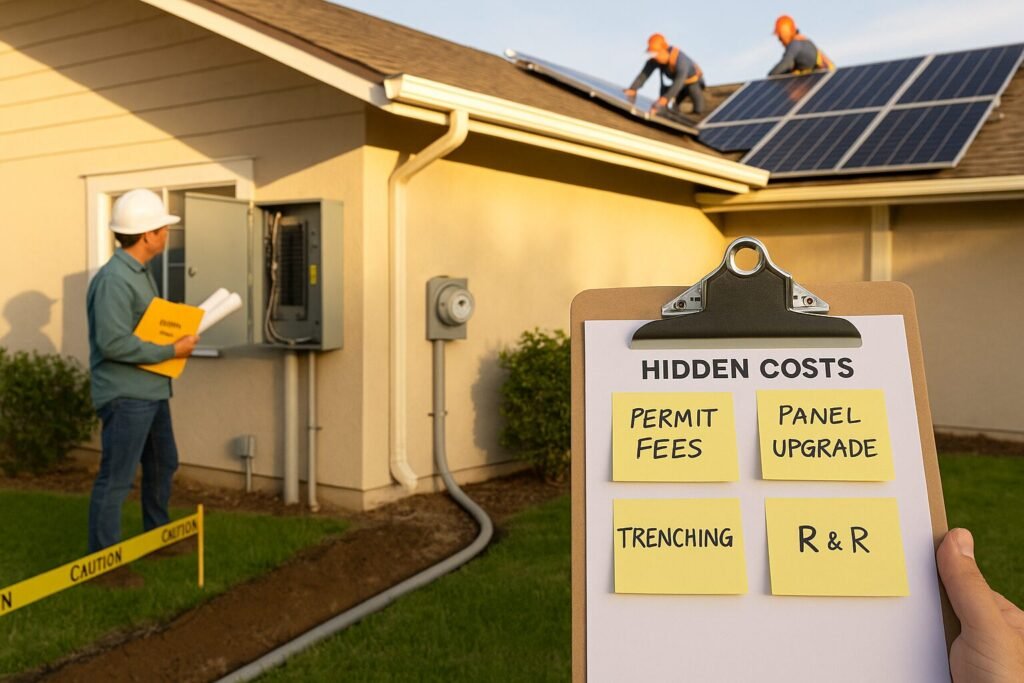
Hidden Costs of Solar: Avoid Budget-Killing Surprises

See the real costs of going solar—panel upgrades, R&R, permits, fees, financing traps, and policy risks—plus scripts and checklists to protect your budget.

I love solar. But I’ve also seen “all-in” quotes turn into surprise invoices.
When I helped a neighbor here in Hawaii compare bids, the cheapest proposal ballooned after the site visit: a main service-panel upgrade, longer conduit run, and a utility meter change. None of it was in the first quote. That experience pushed me to create this guide—so you can spot the hidden costs of solar before you sign.

Use this like a field manual. Skim the TL;DR box, then jump to the sections that match your home. I’ll share the questions I ask installers, the red flags I look for, and simple steps to protect your budget.


TL;DR Snapshot (Skimmer Box)

  • Panel upgrade? Ask for a written load calculation and a capped allowance for service work.
  • Roof near end-of-life? Get remove & reinstall (R&R) pricing locked in now.
  • Permits + utility fees: Request a line-item list. Who pays for resubmittals?
  • Trenching & conduit: Demand a site map with measured runs before you sign.
  • Production shortfalls: Get a performance guarantee with clear remedies.
  • Monitoring & maintenance: Confirm lifetime portal access and who pays for truck rolls.
  • Replacement horizon: Budget for inverter and battery swaps later.
  • Insurance: Ask your insurer about premium changes and documentation.
  • Financing: Watch for dealer fees, origination, and prepayment penalties.
  • Leases/PPAs: Check escalators, buyout tables, and transfer rules.
  • Policy risk: Stress-test ROI for TOU windows, export credits, and fixed charges.

What’s In vs. Out of Your Quote (Scope Map)

Quotes often look comprehensive but hide “exclusions” and “assumptions.” These become change orders later.

Common inclusions

  • Modules, racking, inverter(s) or microinverters/optimizers
  • Single roof plane wiring runs, standard attachments
  • Standard permit and inspection coordination

Common exclusions

  • Main service panel (MSP) upgrades or meter combos
  • Roof repair/replacement or future R&R
  • Trenching, hardscape/landscape restoration
  • Structural engineering upgrades for wind/snow
  • Utility interconnection fees and resubmittals
  • Monitoring subscriptions, cellular gateways, and API access
  • Pest abatement/critter guards, cleaning, and data SIM fees

Pro move: Ask for a scope matrix that lists each item as Included / Excluded / Allowance with dollar caps.


Electrical: Main Service Panel, Wiring & Interconnection

I always start here because electrical surprises are expensive.

When you might need an MSP upgrade

  • Existing panel at capacity (no spaces, hot busbar)
  • The 120% rule is exceeded with back-feed breakers
  • Utility requires a meter/main combo or service relocation
  • High continuous loads (EVs, heat pumps) push ampacity limits

Hidden cost drivers

  • Panel size (e.g., 100A → 200A), service drop/conductor upgrades
  • AFCI/GFCI requirements, relocation, stucco or masonry work
  • Revenue-grade meters, current transformers (CTs), production meters

What to ask

  • “Please include a written load calculation and interconnection method (line-side tap vs. breaker).”
  • “If an MSP upgrade is needed, cap it at $X (allowance).”
  • “List utility fees and whether you or the installer pays them.”

Roof Readiness & Future Reroof Costs

Panels can outlast shingles. If your roof is at the end of its life, consider replacing it before installation.

Key questions

  • What’s the roof age and condition? (Get a roof inspection report.)
  • Who warrants leak penetrations, and for how long?
  • If I reroof later, what’s the R&R price—locked in writing?

Pro move: Ask the installer to include R&R labor pricing now. Future-you will be grateful.


Permits, Plan Review & Utility Interconnection Fees

Soft costs add up.

You might see

  • City/county permit and plan-check fees
  • Structural stamps when required
  • Utility application, engineering study, inspection, and Permission to Operate (PTO) fees

Time traps

  • Resubmittals after plan review comments
  • Utility queue delays and re-inspection fees

What to ask

  • “Provide a line-item list of all permit/plan/utility fees and who pays each.”
  • “What’s the expected PTO date and who handles resubmittals?”

Trenching, Conduit Runs & Structural/Engineering Changes

After the site visit, real-world distances and obstacles appear.

Typical triggers

  • Long conduit runs, difficult attic routes, stucco/concrete coring
  • Trenching to detached garages or ground mounts
  • Structural adds: purlin reinforcement, additional attachments, higher wind/snow requirements

What to ask

  • “Attach a site map with measured conduit length and trench path.”
  • “Include one free re-route if field conditions differ from drawings.”
  • “List structural assumptions in the proposal.”

Production Reality: Shading, Soiling & Shortfalls

Models are optimistic. Real roofs are messy.

What dents production

  • Seasonal shade paths, neighbor trees, chimneys, vent stacks
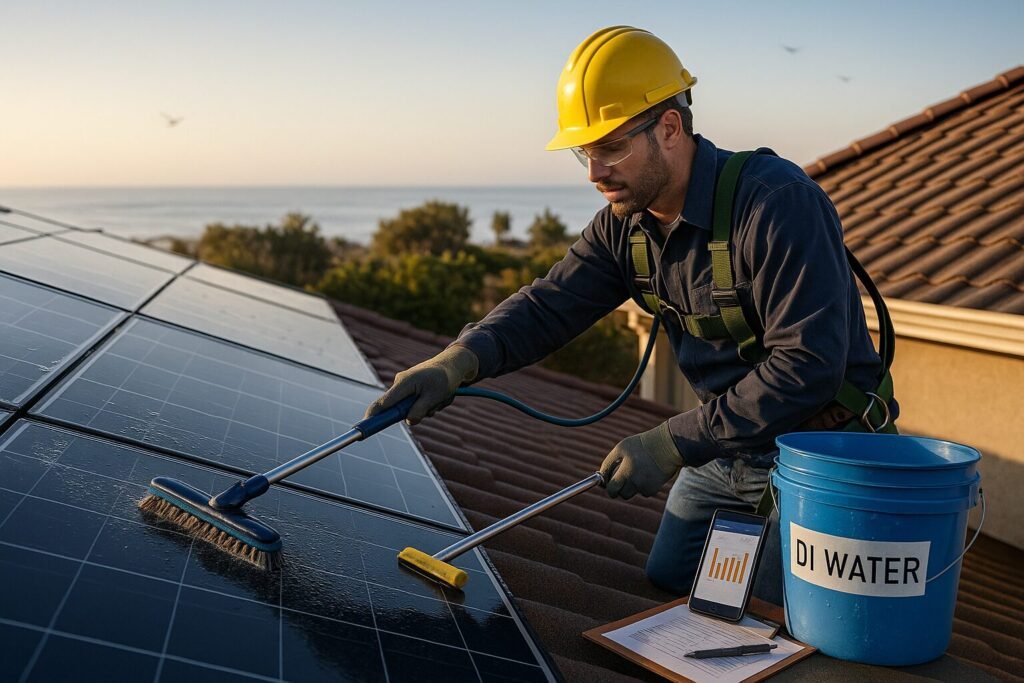
  • Soiling (dust, salt spray, pollen), high temperature, and inverter clipping
  • Performance ratio lower than modeled due to balance-of-system losses

Protect yourself

  • Request the shade study (photos, heatmap, or horizon profile)
  • Ask for module-level electronics (optimizers/microinverters) where shade is non-trivial
  • Clarify the performance guarantee: baseline, exclusions, measurement method, and remedy (cash, extra panels, fixes)

Related read on MicroHomesteader: Clean Solar Panels to Boost Solar Efficiency and What Affects Solar Panel Efficiency?


Monitoring, Data Access & Ongoing Maintenance

I always check the monitoring fine print.

Look for

  • Lifetime portal access (not just the first year)
  • Cellular gateway fees vs. Wi-Fi
  • API/export access if you like data
  • Truck-roll rates for diagnostics, pest abatement, or firmware issues

Ask

  • “Is monitoring included for the life of the system?”
  • “Who pays for on-site labor during RMAs?”
  • “What’s the annual inspection/cleaning price?”

Replacement Horizons: Inverters, Optimizers & Batteries

Panels often run 25+ years. Electronics don’t.

Typical lifespans (ballpark concepts, not quotes)

  • String or microinverters: mid-teens to ~20 years
  • DC optimizers: similar to inverter horizon
  • Batteries: capacity degrades by throughput and time; plan a mid-life service or module swap

Warranty nuance

  • Parts vs. labor
  • Battery capacity retention (prorated)
  • Who handles shipping and onsite work?

Plan a reserve

  • Set aside a small future replacement fund earmarked for inverter/battery events.

Homeowners Insurance & Roof/Structural Coverage

Solar can change your policy details.

Expect conversations about

  • Declared value and coverage limits
  • Wind/hail/fire zones and premium adjustments
  • Documenting roof penetrations and the installer’s leak warranty

Ask

  • “Do you need a completion packet (as-builts, photos, invoice)?”
  • “Will my premium change, and by how much?”

Financing Add-Ons: The “Dealer Fee” Trap

Zero-down looks great until you see the dealer fee quietly inflating the system price.

Watch for

  • Dealer fees, origination, deferred interest
  • Prepayment penalties or interest-accrual gotchas
  • A higher “financed price” vs. “cash price”

Ask

  • “What is the cash price vs. the financed price?”
  • “What’s the exact dealer fee %?”
  • “Can I prepay without penalty?”

Related read: Solar Loan vs Lease vs PPA: Best Option in 2025


Leases & PPAs: Escalators, Buyouts & Home Sale Transfers

Leases/PPAs can work for some homes, but the fine print decides your savings.

Key items

  • Annual escalator (compounds over time)
  • Buyout table (early and end-of-term)
  • Transfer process when selling your home (credit checks, timelines, fees)

Ask

  • “Show the buyout table and escalator in the contract.”
  • “What’s your transfer success rate and average timeline?”

Policy Risk: Utility Rates, TOU Windows & Export Rules

Your savings depend on the rules of the game—and the game changes.

Risks to the model

  • Time-of-Use (TOU) shifts that move peak periods later
  • Lower net-metering/export credits
  • New fixed charges or minimum bills

Protect yourself

  • Ask the installer to stress-test ROI with a lower export rate and later TOU peak.
  • Consider right-sizing and adding load shifting (heat-pump water heaters, batteries) if policy winds are shifting.

Related reads: Federal & State Solar Incentives (2025 Guide) and The Future of Solar Energy: What’s Coming in the Next 5 Years.


Contract Red-Flag Checklist

  • Change-order rules and price caps stated
  • ☐ Detailed inclusions/exclusions list
  • Performance guarantee terms and remedy
  • Monitoring terms and any subscription fees
  • Warranty covers parts + labor (and leak warranty period)
  • R&R pricing for future reroof (locked amount)
  • Interconnection responsibilities + target PTO date
  • Financing disclosures (dealer fee %, penalties)
  • Lease/PPA escalator and buyout table attached

“Ask Your Installer”

  1. Please include a load calculation and identify the interconnection method.
  2. List all permit/plan/utility fees and who pays them.
  3. Attach a site map with measured conduit and trenching.
  4. Provide the shade study (images/heatmap) and expected performance ratio.
  5. Spell out the performance guarantee and the remedy if under-produced.
  6. Confirm lifetime monitoring and any cellular fees.
  7. Clarify warranty (parts and labor) and who handles RMAs/truck rolls.
  8. Lock R&R pricing for a future reroof in writing.
  9. Disclose dealer fee %, origination, and prepay rules.
  10. For leases/PPAs, include the escalator, buyout table, and transfer steps.

Example Scenarios (Mini Case Studies)

A. Roof at 18 years
Reroof now + solar once = no mid-life R&R cost and one set of penetrations. Waiting two years would have meant paying for R&R and risking schedule chaos.

B. 100A panel + EV on the way
Installer A ignored it; Installer B showed a load calc and capped an MSP upgrade. The “cheaper” bid wasn’t cheaper after the inevitable change order.

C. TOU shift & evening peaks
Modeling a later peak pushed the homeowner to add a small battery for load shifting. Savings were steadier even after export credits dropped.


Key Takeaways & Next Steps

  • Surprises are optional. Most “gotchas” are visible if you know where to look.
  • Demand specifics in writing. Load calcs, site maps, fee lists, and guarantees.
  • Budget realistically. Include one-time adders, recurring costs, and future reserves.
  • Stress-test your ROI: policy, TOU, and export credit changes—plan for them.

The Future of Solar: What’s Next by 2030

Panels, batteries, rates, VPPs, and permits—see what’s changing in solar over the next 5 years and how to plan a smart, resilient system.

Hi, I’m Crazy Old Prepper. I live small, tinker constantly, and I’m building a micro homestead one practical project at a time. Here’s what I’m watching in solar over the next five years—and how I’d plan a system today so it still feels smart in 2030.

TL;DR Snapshot (Skimmers start here)

  • Panels: You’ll see more back-contact / heterojunction / TOPCon first; perovskite tandems will appear in niche retail SKUs, then spread. Expect modest, real-world efficiency bumps on rooftops before major leaps.
  • Prices: Hardware keeps trending down long-term, but soft costs (labor, permitting, interconnection) and tariff/supply swings can whipsaw quotes.
  • Batteries: LFP (and variants) rule for safety + cycle life; faster installs and clearer throughput warranties.
  • Policy: More net billing and time-of-use → batteries move from “nice” to “often worth it.”
  • Blackouts: Typical homes land around 10–30 kWh storage with 7–15 kW PV if backup matters.
  • VPPs: Virtual power plants expand; payouts depend on your utility + event frequency.
  • Permitting:Instant” approvals spread where AHJs adopt standardized checks.
  • End-of-life: Better recycling / take-back programs nudge purchase decisions.
  • New use cases: Agrivoltaics, balcony kits, and smarter microinverters open doors for small spaces and small farms.

Skim-Stopper: Buy Now or Wait?

If your roof is ready, rates are moving to TOU/net billing, and you want blackout resilience, buying now with battery-ready wiring (or a modest starter battery) usually beats waiting for the “next big panel.” If your roof is tight on space, it can be worth waiting for higher-efficiency modules—but I’d still pre-wire.


1) What New Panel Tech Actually Reaches Homes?

I love reading lab headlines, but I plan purchases around what installers can get, warrant, and service.

What’s real between now and 2030

  • Back-contact / HJT / TOPCon continue to replace older PERC: slightly higher module efficiency, better temperature coefficients, and lower degradation.
  • Perovskite-silicon tandems: pilot lines and early retail models appear first in premium ranges; ramp depends on durability, encapsulation, and bankability.
  • Bifacial on rooftops: helps in high-albedo settings (white roofs, bright ground), less so over dark shingles.

Roof-reality vs. datasheets

  • Nameplate jumps don’t always equal kWh gains after you factor tilt, azimuth, shading, soiling, wiring, inverter clipping, and performance ratio.
  • Expect incremental roof output gains first; bigger leaps arrive as tandems mature.

Buyer checklist

  • Bankability + warranty (product + performance).
  • Degradation rate and temperature coefficient.
  • Weight, dimensions, and mounting for your racking.
  • Inverter/microinverter matching with higher-power modules.

2) Will Solar Prices Fall—or Whipsaw?

I’ve seen quotes drop on modules, only to bounce from tariffs, freight, or factory ramps.

What drives today’s price

  • Hardware: modules, racking, wiring, inverters, optimizers.
  • Soft costs: design, permitting, inspections, labor, overhead (these often dominate).

What pushes up or down

  • Trade actions & tariffs, shipping costs, polysilicon cycles, and U.S. manufacturing build-outs.
  • Local labor markets and AHJ requirements can swing bids more than module prices.

Practical moves

  • Get multiple quotes within a 2–3-week window.
  • Ask for price-hold windows and clarify escalation clauses.
  • Lock interconnection steps early to avoid delays.

3) Batteries: Safer, Longer-Lived, Easier to Install

I favor LFP for home storage: stable, predictable, widely supported.

Chemistry & form-factor trends

  • LFP / LFP-plus dominate for safety and cycle life.
  • Modular cabinets and pre-wired enclosures shorten install time and clean up the look.

What to compare

  • Round-trip efficiency, continuous/peak power, depth-of-discharge, and usable kWh.
  • Throughput warranty (total MWh over life), not just years.
  • DC-coupled vs AC-coupled: DC can be more efficient in solar-charging paths; AC is easier to retrofit.

Buy now vs wait

  • If you have TOU rates or frequent outages, consider buying now.
  • If you’re purely chasing export arbitrage, wait to see your utility’s net billing math.

4) Net Metering → Net Billing + TOU: Do Batteries Become Essential?

We’re seeing a steady move from classic net metering to net billing with time-variant export values.

What that means for your bill

  • Daytime exports may be worth less; evening peak power costs more.
  • A battery lets you shift solar from low-value hours to peak hours.

Sizing rules of thumb

  • Daily bill shaving: size for 3–5 hours of evening peak loads.
  • Resilience + bills: split capacity—reserve 20–30% for outages; use the rest for TOU.

5) Blackout Readiness: Typical Solar + Battery Sizes by 2030

I plan for critical loads first (fridge, lights, internet, a few outlets), then decide if whole-home is worth it.

Typical pairings I expect to keep seeing

  • 7–15 kW PV with 10–30 kWh storage for most homes wanting a day of resilience + TOU shifting.
  • Multi-day coverage needs load management, conservative thermostat settings, and sometimes a generator hybrid.

Step-by-step

  1. List critical loads and watts.
  2. Decide hours of coverage (8–24+).
  3. Calculate usable kWh (account for DoD and reserve).
  4. Check inverter power for motor starts (soft-start helps).

6) Will Virtual Power Plants (VPPs) Actually Pay?

VPPs stitch together thousands of home batteries to help the grid.

How it works

  • You opt in; the aggregator schedules limited dispatch windows.
  • You get credits for capacity and/or energy delivered during events.

What matters to a homeowner

  • Payout structure: $/kW-month, event payments, or bill credits.
  • Cycling impact: confirm warranty allowances for third-party dispatch.
  • Opt-out controls: can you set reserve for your own backup?

7) Permitting & Interconnection: From Weeks to “Instant”

I’m excited about standardized plan sets and automated checks.

Faster paths

  • Jurisdictions adopting instant permits for standard rooftop designs.
  • Utilities offering online interconnection portals, clear smart-inverter settings, and pre-approved equipment lists.

Your action list

  • Ask installers if they use standardized plan sets eligible for same-day approval.
  • Confirm interconnection timelines before you sign.

8) Incentives: What’s Likely, What’s Sunsetting

Policy changes, but a few patterns help planning.

Baseline to know

  • The federal ITC covers qualified solar + storage; storage eligibility is now broader.
  • State / utility adders come and go: battery rebates, performance-based incentives, and low-income carve-outs.

Planning moves

  • Time your paperwork: claim in the year the system is placed in service.
  • Track basis reductions for certain rebates.
  • If you’re a business, consider depreciation and bonus incentives.

For details, start here: 2025 Solar Incentives & Tax Credits Guide.


9) Smarts Everywhere: Inverters, EV Chargers, V2H/V2G

The home is becoming an energy orchestra.

Device roles

  • Smart inverters manage grid ride-through and volt/VAR.
  • Load controllers and smart panels shape when big loads run.
  • EVSE integrates charging with solar and rates; bidirectional units add V2H/V2G potential.

Design patterns I like

  • A critical-loads subpanel for clean backup.
  • Whole-home transfer only if you size for it (or accept managed loads).
  • Leave space in the main panel for future EV + battery expansion.

10) End-of-Life: Recycling, Reuse, and Warranties

End-of-life rules are tightening, which is good for the ecosystem.

What to watch

  • Take-back programs from manufacturers and regional recyclers.
  • Clarify product vs performance warranty, RMA process, and transferability if you sell the home.

Buy with the end in mind

  • Favor bankable brands, transparent recycling partners, and clear support channels.

11) New Use Cases: Agrivoltaics, Balcony Kits, Micro-Inverters

Small spaces and small farms get real options.

Agrivoltaics

  • Elevated racking for shade-tolerant crops, fencing for animal safety, and careful row spacing for equipment access.

Balcony / plug-in kits

  • Great for renters/condos where allowed. Check utility rules, rapid-shutdown compliance, and GFCI details.
  • Expect modest yield—nice bill trim, not whole-home power.

Micro-inverter / optimizer roadmap

  • Higher per-module power ratings, robust rapid-shutdown, cleaner module-level monitoring, and better salt-mist/wind certifications for coastal roofs.

Mini-Calculators (Quick Math You Can Do)

Battery value under TOU
(kWh shifted to peak each day) × (peak – off-peak rate) × (days/month)

Blackout coverage estimate
(Critical-load watts × hours needed) ÷ (usable kWh) → sanity-check your size


Simple Flowchart: Buy Now vs Wait

  • Tight roof space? → Consider waiting for higher-efficiency modules or use premium-efficiency now.
  • Rates moving to TOU/net billing?Add a battery or at least battery-ready wiring.
  • Frequent outages? → Prioritize backup now; consider V2H-capable EVSE later.
  • Slow permitting in your area? → Choose an installer with standardized plan sets and clear interconnection playbook.

Installer Checklist

  • Module tech: TOPCon/HJT/back-contact? Warranty (product + performance)?
  • Battery: Usable kWh, throughput warranty, round-trip efficiency, continuous/peak power.
  • Inverter: Smart functions, rapid shutdown, EVSE integration.
  • VPP eligibility: Payouts, cycling policy, opt-out.
  • Paperwork: Permit timeline, interconnection steps, incentive forms.

Helpful Next Reads on MicroHomesteader

Choose a Solar Installer: 7 Tips That Protect Your Wallet

Verify credentials, compare bids fairly, sanity-check savings, pick the right financing and gear, and avoid red flags.

TL;DR for Skimmers

  • Check credentials: license, insurance, NABCEP.
  • Warranties you can use: workmanship, equipment, and roof penetration.
  • Compare bids apples-to-apples: models, DC vs AC kW, assumptions.
  • Pressure-test savings: shade study, weather data, utility rates, buyback.
  • Match financing to your goals: cash, loan, lease/PPA.
  • Pick the right design: string vs microinverters/optimizers; battery-ready.
  • Trust but verify: reputation, monitoring, service SLAs—plus roof and incentives details.

Introduction: The quote that made me pause

When I got my first solar quotes, the sales pitch was smooth. The numbers looked great. Then I asked for the license number and insurance cert—and the tone changed. That moment taught me the difference between a friendly salesperson and a professional solar installer who will stand behind their work for 25+ years.

If you’re feeling a little overwhelmed by acronyms (NABCEP, PR, NOCT), rate plans, and warranty fine print—breathe. In this guide, I’ll walk you through exactly how I vet installers, what I request in writing, and the red flags I avoid. It’s simple, repeatable, and it works whether you’re grid-tied, hybrid, or planning a battery later.


Tip 1: Verify Credentials (License • Insurance • NABCEP)

Goal: Confirm you’re hiring a qualified, insured contractor—not a pass-through sales outfit.

What I ask for (in writing, as PDFs):

  • State contractor license number + link to the state lookup page.
  • General liability (commonly $1M+) and workers’ comp certificates with active dates.
  • NABCEP certificate number and credential (e.g., PV Installation Professional).

In this post, I will share valuable tips on how to choose a solar installer that best fits your needs.

In this article, I will explain how to choose a solar installer to ensure you make the best decision for your solar needs.

In this guide on how to choose a solar installer, I’ll walk you through exactly how I vet installers, what I request in writing, and the red flags I avoid.

In this article, I will also share insights on how to choose a solar installer effectively.

In this guide on how to choose a solar installer, I’ll walk you through exactly how I vet installers, what I request in writing, and the red flags I avoid.

In this guide, I’ll also explain how to choose a solar installer to ensure you make the best decision for your needs.

Quick checks:

  • License is active, classification includes solar/PV, and company names match.
  • The insurance holder is the same entity on the contract.
  • The NABCEP credential is current and actually tied to the people overseeing your job.

In this guide on how to choose a solar installer, I’ll walk you through exactly how I vet installers, what I request in writing, and the red flags I avoid.

Red flags: “Our partner is licensed,” expired policy dates, and no NABCEP anywhere on the team.

Skim-Stopper: Ask, “Who is the license holder of record for my project?” Write the name down.


Tip 2: Warranties You Can Actually Use

Not all warranties are equal. Get documents, not promises.

Three buckets to confirm:

  1. Equipment warranties
    • Panels: product & performance (e.g., 25-yr output retention),
    • Inverters/microinverters/optimizers: product term and replacement policy,
    • Racking: corrosion/structural coverage.
  2. Installer workmanship (craftsmanship, wiring, conduit routes): 10+ years is common.
  3. Roof-penetration/leak coverage: who pays, response time, and documentation required.

What to capture:

  • Term lengths, claim process, and who you call first.
  • Transferability if you sell the home.
  • Exclusions (salt spray, coastal corrosion, critter damage, misuse).

Red flags: “We’ll handle it” without PDFs; roof coverage shorter than workmanship; warranty only valid if you buy add-on services.


Tip 3: Apples-to-Apples Bid Comparison

Bids are only comparable if they use the same assumptions.

Standardize these line items across all quotes:

  • Panel model + wattage (datasheets linked).
  • Inverter type (string vs microinverters vs optimizers).
  • Array size: DC kW and AC kW (both).
  • Tilt/azimuth, shading %, performance ratio (PR), annual degradation %.
  • Monitoring (owner access, alerts), racking, and balance-of-system.
  • Main-panel upgrade (MPU) requirement, meter location, conduit routing.
  • Battery compatibility (communications, UL9540, warranty alignment).

Price sanity: Track $/W DC and $/W AC, but never alone—consider Year-1 kWh and system quality.

Skim-Stopper: If a bid won’t list exact models and assumptions, I stop there.


Tip 4: Pressure-Test Production & Savings Claims

Pretty charts are easy. Evidence is harder.

Ask for:

  • Shade study with an on-site tool (e.g., SunEye) or lidar-based modeling.
  • Weather dataset used (TMY/typical meteorological year).
  • Hourly modeling that matches your rate plan and export/buyback rules.
  • PR (performance ratio) and degradation assumptions (e.g., 0.5–0.8%/yr).

Do a quick sniff test:

  • Year-1 kWh vs DC size—does it match your site and tilt?
  • Are rate escalation assumptions realistic?
  • Does the cash flow include any dealer fees or loan points?

Red flags: “Up to” savings, no shade file, no hourly modeling, or using an old net-metering policy that no longer applies.


Tip 5: Financing That Matches Your Goals (Cash • Loan • Lease • PPA)

Ownership drives incentives and long-term ROI.

  • Cash: Lowest lifetime cost; you own the equipment and claim any eligible tax credits.
  • Loan: You still own the system; confirm APR, term, fees, prepayment rules, and any UCC-1 filing.
  • Lease/PPA: Low upfront, but the third party owns it and typically claims incentives. Watch the escalator.

What I request in writing:

  • Who owns the system?
  • Whether I’m eligible for the federal ITC.
  • Total finance charges and fees.
  • Escalator % for lease/PPA.

Rule of thumb: If you can handle the payment and want maximum control, cash or a transparent loan usually wins long term.


Tip 6: Choose Equipment & Design for Your Use Case

Match the architecture to the roof, shade, and future plans.

String inverters

  • Great for simple, unshaded roofs; fewer electronics on the roof; central point of service.

Microinverters

  • Best for complex roofs, multiple facets, or partial shading; module-level monitoring; flexible expansion.

DC optimizers + string

  • Middle ground; good shade tolerance with a central inverter.

Battery-ready design

  • Confirm communications compatibility, breaker space, rapid shutdown, and UL9540 listings.
  • If backup is the goal, specify the critical loads panel on day one.

Extras that matter: critter guards, coastal-grade fasteners, wind/salt exposure considerations, clean conduit runs.

Skim-Stopper: “One-size-fits-all” is not a design—ask for the why behind each component.


Tip 7: Reputation, Service, and Support After the Sale

You’re marrying the installer for the next decade. Pick someone who answers the phone.

How I vet beyond testimonials:

  • Local references from the last 6–12 months.
  • Permit history with your AHJ (shows real, recent volume).
  • Complaint records and how the company resolved them.
  • Years in business and leadership with verifiable track records.

Service terms I want in writing:

  • Monitoring access for the homeowner, with uptime alerts.
  • Response SLA (e.g., triage in 2 business days; on-site within X days for leaks/failures).
  • Truck-roll fees (if any) and what’s covered under workmanship.

Red flags: Third-party monitoring only, no written SLA, or “call the manufacturer” as the default.


Project Timeline & Common Delays

Typical flow (your mileage may vary):

  1. Site survey → photos, roof/attic/electrical.
  2. Design & engineering → one-line diagram, structural calcs if needed.
  3. Permits → AHJ review.
  4. Install → usually 1–3 days for residential.
  5. Inspection → local authority sign-off.
  6. Interconnection → utility approval, meter, or PTO.

Common delays: AHJ backlog, utility queue, main-panel upgrades, reroof scheduling, special-order equipment.


Roof Condition, Structural Work, and Leak Liability

Before anyone steps on the roof, align on conditions and responsibilities.

  • Request a pre-install photo log of decking, underlayment, penetrations, and attic areas.
  • If a reroof is coming within ~3–5 years, strongly consider doing it first.
  • Clarify who pays if hidden damage is found.
  • Get leak liability and response times in writing.

Incentives & Taxes (ITC + State/Utility)

  • The federal Investment Tax Credit may apply if you own the system; you typically claim it in the year it’s placed in service.
  • Some rebates can reduce your project’s tax basis; certain production credits may be taxable income.
  • Leases/PPAs: the system owner (often the financier) usually claims the credits.
  • Many states/utilities offer incentives or export/buyback programs—ask who files that paperwork and when.

Pro tip: Look up incentives in one place with databases like DSIRE. Ask your installer to list every program they’re assuming.


15 Questions to Ask at the Site Visit

  1. Who is the license holder for my project?
  2. Will you use employees or subs? Who carries workers’ comp?
  3. Can I see the shade study file and the assumed PR/degradation?
  4. Which rate plan and export/buyback did you model?
  5. Why this inverter architecture for my roof?
  6. Is the system battery-ready? Which models integrate cleanly?
  7. Will I need a main-panel upgrade? Who coordinates it?
  8. How will conduit be routed (aesthetic plan)?
  9. What’s the monitoring platform and alerting?
  10. What’s your response SLA for leaks/inverter faults?
  11. Do you install critter guards or corrosion-resistant hardware for coastal sites?
  12. What’s the roof-penetration detail (flashing, sealants)?
  13. Who handles permits and interconnection paperwork?
  14. What are the warranty exclusions I should know about?
  15. Can I speak to two recent local customers?

Red Flags & Deal-Breakers

  • Won’t share license/insurance PDFs or the shade file.
  • Vague equipment models (“Tier 1 panels”).
  • Savings claims based on old net metering rules.
  • Pushy “today-only” discounts.
  • No written roof-leak coverage or service SLA.

Mini-FAQ

Are microinverters worth it on a simple south roof?
If shade is minimal and the roof faces due south, a quality string inverter can be efficient and cost-effective. Microinverters add module-level monitoring and shade resilience; decide based on roof complexity and future expansion.

Can I add batteries later?
Yes—if the system is designed for it. Confirm communications compatibility and breaker space now to avoid rework later.

What if I need a reroof in 3 years?
Either reroof first or plan for detach & reset costs later. Get both numbers now.

Who handles interconnection?
The installer usually submits and tracks the interconnection. Ask for a copy of the final permission-to-operate (PTO).


Practical Takeaways

  • Standardize quotes. You’ll see who’s real fast.
  • Get every promise as a document.
  • Choose a design for your roof and goals, not a sales script.
  • Tie financing to ownership and incentives.
  • Service after the sale matters for 10–25 years—treat it that way.

Resources


Helpful External References

Federal & State Solar Tax Credits: Simple 2026 Guide

Last updated: January 2026 (rules change fast—bookmark this)

Big 2026 headline: the federal residential solar/battery credit (IRC §25D, claimed on Form 5695) was repealed for “expenditures made after December 31, 2025.” In plain English: if your solar or battery installation is completed in 2026, you generally don’t get the federal residential credit.
(You can still claim and carry forward unused credit for qualifying installs completed by 12/31/2025.)

State + utility incentives didn’t disappear—so in 2026 they matter more than ever.


TL;DR Snapshot (Skimmers, start here)

  • Homeowners (federal): The Residential Clean Energy Credit (§25D) is not available for expenditures made after Dec 31, 2025. If your install was completed by 12/31/2025, the credit rate was 30% and you claim it on IRS Form 5695.
  • Timing gotcha: Under §25D, an “expenditure” is treated as made when the original installation is completed—so a project started in 2025 but finished in 2026 generally won’t qualify.
  • Carryforward: If you qualified (installation completed by 12/31/2025) but didn’t use the full credit, you can carry it forward into future years (Form 5695 even has a “carryforward to 2026” line).
  • Businesses / landlords (federal): For projects placed in service after Dec. 31, 2024, the Clean Electricity Investment Credit (§48E) may apply (base 6%, increased up to 30% with prevailing wage/apprenticeship; plus possible adders). Claimed on Form 3468.
  • Batteries: Under the old residential rules, battery storage needed ≥ 3 kWh and was eligible (for qualifying installs through 2025).
  • Stacking incentives: Rebates and subsidies can affect what “costs count” for credits (and programs can have their own rules).
  • Best 2026 strategy for most homeowners: Focus on state + utility incentives and verify everything on DSIRE (state-by-state database).

Why this matters (my real-world take)

When I installed my first PV system, incentives were the difference between “maybe someday” and “let’s do this.” The tricky part wasn’t the gear—it was the paperwork and the timing.

In 2026, the game changed: the federal residential credit is gone for new installs, so your best savings now come from state, utility, and local programs (plus smart system design and financing).


1) Quick Definitions (No Jargon)

  • §25D (Residential Clean Energy Credit): The old federal homeowner credit you claimed on Form 5695repealed for expenditures made after 12/31/2025.
  • §48E (Clean Electricity Investment Credit): The current federal business/nonprofit investment credit for qualifying projects placed in service after 12/31/2024 (tech-neutral).
  • “Expenditures made” / “installation completed”: For §25D, the key timing concept is when original installation is completed.
  • Placed in service: Generally means installed and ready to operate (often aligned with inspection/interconnection approval in practice).
  • Rebate vs. tax credit: A rebate is cash back; a tax credit reduces tax you owe.

2) Federal Solar Incentives in 2026: What’s Still Available?

2.1 Homeowners (Primary/Second Homes)

For new 2026 installs: The federal residential credit does not apply if installation completes in 2026.

For installs completed by 12/31/2025:

  • Credit rate was 30% (for 2022–2025).
  • Claimed on Form 5695.

2.2 Businesses / Landlords / Some Third-Party Ownership (Still a Thing)

For projects placed in service after 12/31/2024, §48E may apply:

  • Base credit 6%, increased up to 30% for facilities meeting prevailing wage + apprenticeship rules, plus potential adders.
  • Claimed on Form 3468.
  • Direct pay or transfer may be available (and requires pre-filing registration).

Why you care as a homeowner: With a lease/PPA, the company owning the system may still qualify under business rules—and that can affect pricing. (You don’t claim the credit; they do.)


3) What Costs Count (If You’re Claiming a Credit for a 2025-Completed Install)

If your installation was completed by 12/31/2025 and you’re filing for it:

3.1 Typical Eligible Costs (Residential §25D rules through 2025)

  • Solar equipment that generates electricity for your home, plus labor allocable to onsite prep/assembly/original installation and required wiring.
  • Solar roofing tiles/shingles that function as both roof + solar collector can qualify; decking/rafters and purely structural roof components do not.
  • Battery storage had to be installed in connection with the home and be ≥ 3 kWh.

3.2 Rebates/Subsidies: The “Basis” Gotcha

For Form 5695 credit calculations, IRS instructions say you must subtract certain subsidies/rebates from qualified costs (examples include public utility rebates).

Skim-Stopper rule of thumb: If a program directly reduces what you paid, assume it can reduce what counts—until you confirm.


4) Timing Rules (This Is Where People Get Burned)

4.1 The 2026 Timing Trap

Because §25D is repealed for expenditures made after 12/31/2025, and because “expenditures made” generally means installation completed, a project that finishes in 2026 typically doesn’t qualify—even if you paid deposits in 2025.

4.2 What to Save

  • Final inspection sign-off / PTO letter
  • Itemized invoices + proof of payment
  • Permits + interconnection documents
  • Photos (labels/serials help)

5) How to Claim (If You’re Eligible)

5.1 Homeowners (Eligible 2025-Completed Installs)

  • Form 5695 → flows to Schedule 3 (Form 1040).
  • Form 5695 includes a line for carryforward to 2026 if your credit exceeds your tax liability.

5.2 Businesses / Landlords (2025+ Projects)

  • Form 3468 for §48E.
  • Basis reduction: Instructions for Form 3468 state you generally reduce the basis of energy property by 50% of the energy credit.

6) State + Utility Incentives (Your Main Savings Lever in 2026)

Since the federal homeowner credit is gone for new installs, your best play is to stack state + utility + local incentives.

6.1 The Fastest Way to Find What You Qualify For

Use DSIRE (Database of State Incentives for Renewables & Efficiency). It’s a long-running, state-by-state incentives database run by the NC Clean Energy Technology Center.

My workflow:

  1. Search DSIRE by ZIP/state
  2. Write down every program: rebates, tax credits, sales/property tax exemptions, battery incentives, net metering, grants
  3. Go to your utility’s site and confirm budgets, deadlines, waitlists, and required paperwork
  4. Apply early (many programs are “first come, first funded”)

6.2 Stacking Rules (Practical)

  • Usually you can combine programs, but each program may require you to apply in a certain order.
  • Keep a single spreadsheet with: program name, deadline, required docs, approval date, amount.

7) Batteries in 2026 (What to Know)

  • Residential federal battery credit: only relevant now if your battery installation was completed by 12/31/2025 (and met the ≥3 kWh rule).
  • State/utility battery programs: still common (especially for backup resiliency). Treat these like mini-grants with strict paperwork.

8) Common Pitfalls (2026 Edition)

  1. Installer says “30% federal credit” for a 2026 install → double-check. The IRS Form 5695 instructions say no residential clean energy credit for expenditures after 12/31/2025.
  2. Project crosses New Year: started in 2025, completed in 2026 → likely not eligible for §25D.
  3. Roof confusion: solar shingles may qualify; decking/rafters don’t.
  4. Missing paperwork: no itemized invoice, no final inspection/PTO, no proof of payment → headache later
  5. Not checking DSIRE + utility fine print: budgets, caps, waitlists, and pre-approvals are where savings go to die

9) Example Walkthroughs (Numbers You Can Copy)

A) Homeowner who completed install in 2025

  • Solar project cost: $22,000
  • Eligible credit rate (2022–2025 installs): 30%
  • Credit computed on Form 5695; unused amount can carry forward to 2026.

B) Business rooftop PV (placed in service after 12/31/2024)

  • Possible §48E credit: base 6%, can increase up to 30% + adders; filed on Form 3468.
  • Basis reduction rule applies.

C) 2026 homeowner install

  • Federal homeowner credit: generally not available
  • Your savings plan: state + utility rebates, tax credits, battery programs, net metering (start with DSIRE).

10) Your “Audit-Ready” Folder (Do This Once)

Use a simple naming pattern:
Solar_2025_Project/Invoices/
Solar_2025_Project/Permits_PTO/
Solar_2025_Project/Specs_Serials_Photos/

Keep it for years.


11) Pick Your Path (Internal Links)

  • New to solar? Read: Understanding Solar Power: A Beginner’s Guide to Self-Sufficient Living
  • Costs: How Much Do Solar Panels Cost in 2025
  • ROI: Are Solar Panels Worth It? ROI & Payback Period
  • Hardware: Solar Panel System Components Explained
  • Placement: Optimal Angle & Placement for Solar Panels
  • Maintenance: Solar Panel Cleaning Guide

Practical Takeaways

  • If you completed installation by 12/31/2025: claim what you’re owed, and don’t forget carryforward if needed.
  • If you’re installing in 2026 as a homeowner: treat state + utility incentives as the main event (DSIRE first).
  • If it’s business/rental/third-party owned: model §48E carefully (labor rules, adders, Form 3468, basis reduction).

Friendly reminder: I’m not your CPA. Incentives are worth real money, and the details matter—so if you’re close to a deadline or have mixed-use/rental/business complexity, it’s worth a quick consult with a qualified tax pro.

Clean Solar Panels to Boost Solar Efficiency

Boost solar efficiency with safe, simple cleaning. Learn when to wash, what tools to use, and how to track gains—without risking your roof or warranty.

TL;DR Snapshot (Skim-Stopper)

  • Clean when data says so, not by calendar. Watch for a sustained 5–10% drop vs. your normal clear-day output.
  • Use soft tools + cool glass. Early morning, low-pressure water, microfiber/soft brush, DI/distilled water if you can.
  • No pressure washers. No harsh chemicals. No standing on panels.
  • Log everything. Date, method, “before/after” photos, and energy data.
  • Quarterly walk-around. Look for cracks, loose conduit, critter damage, corrosion, and clogged drains.
  • Low tilt, coastal, dusty sites = more frequent rinses.
  • Hire a pro if access is risky or grime is stubborn.

Why this matters (quick story)

When I installed my first small PV array, I assumed tropical rain would keep it spotless. It didn’t. Pollen baked on. Salt mist left mineral spots. Output dipped ~7% and stayed there. A simple early-morning rinse with deionized water and a squeegee brought production back the same day. Since then, I “clean by data,” not by habit—and I’ve kept a maintenance log that’s saved me time, money, and a warranty headache.


11 Common Questions—Answered with Clear, Do-Now Tips

1) How often should I clean my solar panels?

Start with monitoring, not a calendar. If your PV production drops ~5–10% vs. typical clear days (same season), it’s time. In dusty, coastal, or bird-heavy locations, expect light cleaning every 1–3 months. Elsewhere, 2–4 times a year works. After pollen bursts, wildfires, or storms, do a quick rinse.

Do this today: Open your monitoring app, note the average midday power on a clear day, and set a reminder to compare after the next rain or windy week.


2) Do rain showers clean panels well enough?

Rain is a rinse, not a wash. It often leaves hard-water spotting and can’t remove baked-on soiling like pollen, Sahara dust, or bird droppings. If your output is still depressed after rain, plan a proper wash and squeegee dry.


3) What’s the safest way to clean panels?

  • Time it right: Early morning or late evening—cool glass prevents thermal shock.
  • Tools: Telescoping pole + soft brush or microfiber pad, low-pressure hose.
  • Water: DI/distilled is ideal. If using tap water, rinse thoroughly and squeegee.
  • Avoid: Pressure washers, abrasive pads, scouring powders, ammonia/bleach/solvents.

Step-by-step (10 minutes):

  1. Hose a gentle sheet of water across modules.
  2. Lightly agitate with a soft brush (no heavy pressure on frames or junction boxes).
  3. Rinse from top down.
  4. Squeegee to prevent mineral deposits.
  5. Snap a quick photo for your log.

4) Which cleaning solution should I use?

Most of the time: just water. For stubborn grime, add a tiny drop of mild dish soap to a bucket (about 0.1–0.2%). Rinse completely. Don’t use glass polishes, abrasive compounds, or anything that can attack anti-reflective coatings or seals.


5) How do I remove bird droppings or tree sap?

Soak, don’t scrape. Lay a wet microfiber on the spot for 2–3 minutes to soften, then wipe gently. For sap, use warm soapy water and patience. If birds are chronic, consider mesh critter guards under the array and trim perches nearby.


6) Is climbing on the roof necessary—or safe?

Only with proper fall protection and a secure, walkable roof. Wet roofs are slippery. Never step on modules. If access is sketchy, use an extension pole from the ground or hire a pro.

Pro tip: If you must go up, plan a dry-footprint path, wear soft-soled shoes, and protect shingles/metal seams.


7) Could cleaning void my warranty?

It can—if you use the wrong methods. Check your module and racking manuals: water pressure limits, acceptable cleaners, temperature ranges, and no-touch zones. Keep a simple log (date, method, photos). It’s your best friend in a future warranty claim.


8) How do I know cleaning actually helped?

Compare apples to apples. Use similar-weather data: same time window near solar noon, similar temperature, no clouds. If you have panel-level monitoring (microinverters/optimizers), look for outliers—dirty modules rebound quickly.

Easy test: Record power at 12:30 pm the day before cleaning and the day after, both on clear days. Note the % change.


9) What regular maintenance should I do besides cleaning?

  • Quarterly: Visual check for cracked glass, delamination, hot spots/discoloration, loose conduit, chewed wires (hello, squirrels), corrosion on hardware.
  • Inverter check: Unusual fan noise or faults? Investigate.
  • Drainage: Clear leaves and debris near the array; ensure water can’t pool.
  • Electrical connections: Leave torque checks and DC work to licensed pros.

10) Do tilt and location change my cleaning plan?

Absolutely.

  • Low tilt (≤10°) or flat roofs: More soiling and water spots. Clean more often; squeegee every time.
  • Coastal sites: Salt spray → gentle rinses more frequently; add an annual corrosion inspection.
  • Arid/windy regions: Dust film after gusts; quick rinse restores long-term energy yield.
  • Under trees: Plan for pollen seasons and leaf litter.

11) When should I hire a professional?

  • Risky access or very steep pitches.
  • Stubborn contamination (cement dust, heavy sap, overspray).
  • Very low-tilt/flat commercial-style arrays.
  • Want a full system inspection (IR scan, torque checks, electrical tests).

What to ask for: Soft-brush methods, deionized water, proof of insurance, and before/after photos.


A Simple, Data-Driven Cleaning Plan (Buyers Love Clarity)

Monthly (1 minute):

  • Open your monitoring app and note midday power on a clear day.
  • If production is off by ~5–10%, schedule a wash.

Seasonal cadence (adapt to your climate):

  • Spring: Pollen rinse + quick inspection.
  • Summer: Dust or salt mist checks; spot-clean after windy weeks.
  • Fall: Remove leaves; check critter guards; confirm conduit is secure.
  • Winter: For snow, use a foam roof rake from the ground; never chip ice.

DIY Tools That Make It Easy

  • Telescoping water-fed pole with soft nylon/boar-hair brush
  • An inline DI canister or a jug of distilled water for the final rinse
  • Microfiber pads + squeegee
  • Gentle spray hose head
  • PPE: gloves, eye protection; fall-arrest gear if roof work is unavoidable
  • Phone/camera for log photos

(No need for fancy chemicals; technique beats products.)


Step-By-Step: My 15-Minute “Clean by Data” Routine

  1. Confirm the need: Quick look at last week’s production and today’s sky.
  2. Set up: Fill bucket (warm water), attach soft brush, grab squeegee.
  3. Rinse: Start top row to bottom with low-pressure water.
  4. Light scrub: Gentle passes; let water do most of the work.
  5. Final rinse: Prefer distilled/DI water.
  6. Squeegee dry: Prevent mineral spotting that hurts module efficiency.
  7. Log it: Two photos + note of time and any issues spotted.
  8. Verify: Check the output at the same time tomorrow. Note the % gain.

Troubleshooting Soiling & Output (Quick Reference)

  • Chalky film returns fast: You’re in a dusty/salty corridor → increase rinses; install critter mesh if pigeons are nesting.
  • One string lags: Look for a shaded or heavily soiled module; check optimizers/microinverters for errors.
  • Spots won’t lift: Pre-soak longer; avoid scraping; consider a pro clean.
  • Thermal shock worry: Never spray cold water onto hot glass at noon; stick to mornings/evenings.

Warranties, Manuals, and Safety (Don’t Skip)

  • Read your module manufacturer’s cleaning guidelines once. It takes five minutes and prevents costly mistakes.
  • Respect water pressure limits and temperature guidance.
  • Never open junction boxes or disconnect DC without training.
  • If something looks structurally wrong (loose rails, flashing issues), call a pro.

Fast ROI Check (Is Cleaning Worth It?)

If a careful wash restores ≥5% and takes you less than an hour, it’s almost always worth the water and time. If the gain is <2% and access is sketchy, stretch the interval or hire it out during your regular PV maintenance visit.


Internal Links (keep readers exploring)

Practical Takeaways

  • Clean, cool, clean, gentle, clean when data says so.
  • Document everything for warranty and for your own learning.
  • Match frequency to your site: low tilt, coastal air, or dust = more rinses.
  • Safety first. A modest output gain isn’t worth a risky climb.

Are Solar Panels Worth It? Payback & ROI Guide

See if solar pays off. Estimate payback from solar panel cost, rates, incentives, and net metering—plus when batteries help your ROI..

1) TL;DR Snapshot (for skimmers)

If your roof gets decent sun and you pay average-to-high electric rates, solar often pays for itself in 6–12 years, then keeps saving for decades. The biggest ROI swings are your utility rate, self-consumption vs export, installed cost, and incentives. Add batteries when you value backup or TOU bill control—not just for raw ROI. Get 2–3 quotes, run the simple payback math below, and sanity-check your numbers with your utility plan.

Quick hits

  • Worth it when: solid sun, fair pricing, usable incentives, good TOU match.
  • Slow payback when: heavy shade, very low usage, low export/buyback, costly re-roof needed now.
  • First step: pull 12 months of kWh and your current rate plan.

2) How to Calculate Your Payback (Step-by-Step)

I like simple math first, fancy modeling later. Here’s the exact walkthrough I used for my own home.

You’ll need

  • Last 12 months of usage (kWh) from your bill
  • Your current rate (¢/kWh) and rate plan (flat or TOU)
  • A system quote: size (kW DC) and total price
  • A quick production estimate (see PVWatts below)

Production estimate (fast & free):
Use NREL PVWatts to estimate kWh/year for your roof. Note azimuth (direction), tilt, shading, and a performance ratio (derate) roughly 0.80–0.90.

Payback formula (cash purchase):
Payback (years) = Net Upfront Cost ÷ Year-1 Bill Savings

ROI (lifetime, simple view):
ROI = (Lifetime Savings − Lifetime Costs) ÷ Net Upfront Cost

Worked example (swap your numbers):

  • System size: 7.0 kW
  • Gross price: $21,000 (example)
  • Federal tax credit (as of 2025, typically 30%): −$6,300
  • Net cost: $14,700
  • PVWatts production: 9,450 kWh/year
  • Your rate: $0.28/kWh
  • Year-1 savings: 9,450 × 0.28 = $2,646
  • Simple payback: $14,700 ÷ $2,646 ≈ 5.6 years

Reality check: TOU plans, export rates, and future rate changes will nudge this number. We’ll adjust for those next.


3) The Big ROI Levers (What Moves the Needle Most)

  • Electric rate & tariff: Higher ¢/kWh → faster payback. TOU can be a win if you use or export during peak times.
  • Usage & load timing: More self-consumption at peak value = bigger savings.
  • Sun hours/irradiance: Location + tilt/orientation + shade set your kWh/year.
  • Installed cost ($/W): Every $0.10/W shift can change payback by months.
  • System size: Right-sizing matters—oversizing into low export rates slows ROI.

Back-of-napkin sensitivities (same 7 kW, 9,450 kWh/yr):

Rate (¢/kWh)Year-1 SavingsPayback on $14.7k Net
$0.20$1,8907.8 yrs
$0.28$2,6465.6 yrs
$0.36$3,4024.3 yrs

4) Incentives: Tax Credits, Rebates, and How They Change Payback

  • Federal credit (residential clean energy credit): Often 30% of eligible costs (equipment + labor). Consult your tax pro.
  • State/utility rebates: These can stack and shorten payback further.
  • Where to check: DSIRE (U.S. incentive database)

Cost waterfall (example):
Gross $21,000 → State rebate −$1,000 → Federal credit −$6,000 = Net $14,000

Tip: Incentives can impact what’s considered “basis.” Read the fine print and keep every receipt.


5) Net Metering & Export/Buyback: Still Worth It?

Not all exported solar kWh are paid equally.

  • Full retail NEM: Exported kWh credited at your retail rate—great for payback.
  • Reduced export/buyback: Exports earn less than retail. Focus on self-use (run laundry/dishwasher mid-day, pre-cool home, charge EV).
  • TOU plans: Try to match your production with peak windows or store energy to discharge at peak.

Mini scenarios (very simplified):

  • Full NEM: You save close to retail for most kWh → fast payback.
  • Export < retail: Each exported kWh earns less → moderate payback.
  • Export caps: Size carefully and shift loads → still good if self-consumption stays high.

6) Cash vs Loan vs Lease/PPA: How Financing Reshapes ROI

Cash:

  • Fastest payback, highest NPV, no interest costs.
  • Best if you have the capital and plan to stay put.

Loan:

  • Compare the monthly payment vs the monthly bill savings.
  • Aim for positive cash flow in Year-1 or near break-even with strong long-term savings.
  • Watch interest rate, fees, and prepayment options.

Lease/PPA:

  • Low upfront. You “buy power,” not the system.
  • Often slower long-term value; can complicate home resale.
  • OK if cash is tight and you prioritize simplicity.

7) Batteries: When They Help (and When They Don’t)

I added storage mainly for peace of mind during outages—and to squeeze value from a TOU plan.

Economics to consider

  • TOU arbitrage: Charge from solar mid-day, discharge at peak.
  • Demand charges (rare for homes): Batteries can clip peaks.
  • Backup value: Hard to price, but real if you face frequent outages.
  • Incentives for storage: Some regions offer separate rebates—check DSIRE.

Sizing tip: Start with critical loads (fridge, lights, internet, a few outlets). Expand if economics or resilience needs justify it.

Example: If a battery lets you shift 6 kWh/day into a $0.25/kWh premium window, that’s ~$1.50/day or ~$45/month before losses—enough to change ROI for some homes, not for others.


8) Lifespans, Replacements, and O&M (Realistic Lifecycle)

  • Panels: Warranties often 25 years with ~0.3–0.7% annual degradation.
  • Inverters: String inverters commonly last 10–15 years; microinverters/optimizers may last longer—budget for a future replacement.
  • Batteries: Cycle-life driven; plan for replacement within the 10–15 year window depending on usage.
  • O&M: Occasional cleaning, monitoring alerts, maybe a service call.

Pro move: Build a 25-year schedule that includes an inverter swap and potential battery refresh so your ROI isn’t rosy by accident.


9) Electricity Price Growth (Inflation): What Should You Assume?

I run three cases for sanity: 0%, +2%, +4% per year. Don’t bank on aggressive escalation to “force” a payback.

Escalation25-yr Savings Impact
0%Conservative baseline
+2%Moderate boost
+4%Optimistic—use with caution

10) Site & Design: Roof, Tilt, Orientation, Shade, Location

  • Azimuth: South is best (N. Hemisphere), but SW/SE can be close.
  • Tilt: Match local latitude or your roof pitch; not perfect? It’s okay—production is resilient.
  • Shade: Trees, chimneys, neighbors—consider microinverters/optimizers to reduce mismatch losses.
  • Alternatives: Ground mounts or carports can beat a bad roof.
  • Regional irradiance: Your cousin in the desert will outproduce your coastal cottage.

Deep dive: Solar Panel EfficiencySolar Panel Placement Guide Do Solar Panels Work on Cloudy Days?


11) Home Value: Does It Move the ROI Needle?

Owned systems (not leased) generally help at resale when you can show:

  • Production history (download from your monitoring app)
  • Warranties & permits neatly filed
  • Utility bills before/after

Leased or PPA systems may require transfer paperwork. Neutral to positive, but disclose early.


12) Special Situations: Is Solar Worth It If…?

  • Low usage/vacation home: Consider a smaller array, aim for self-consumption, or explore community solar.
  • TOU plans: Great with daytime loads or a battery for peak shaving.
  • Condos/HOAs: Check roof rights; sometimes balcony PV or carport is allowed, or join community solar.
  • Off-grid: Different math altogether—include generator fuel, battery replacements, and higher maintenance.

Related reads:
Grid-Tied vs. Off-Grid Solar SystemsSolar System Components ExplainedHow Long Do Solar Panels Last?


13) Three Quick Personas (Mini-Models)

A) High bill, good roof, cash buyer

  • Expect short payback (often under 7 years).
  • Verdict: Go. Add battery only if TOU or outages justify it.

B) Average bill, loan, reduced export rate

  • Neutral to slightly positive monthly cash flow.
  • Verdict: Still good—shift loads to mid-day; consider a small battery later.

C) Low usage, shaded roof, curious about PPA

  • Savings are limited; export is low-value; shade hurts production.
  • Verdict: Pause. Fix shade, price a smaller array, or consider community solar.

14) DIY Your Numbers: Copy/Paste Worksheet

Fill this mini-table with your data:

InputYour Number
System Size (kW DC)
Gross Cost ($)
Incentives ($)
Net Cost ($)
Est. Annual Production (kWh/yr)
Rate (¢/kWh)
Year-1 Savings ($) = kWh × rate
Simple Payback (yrs) = Net ÷ Year-1 Savings

Tools I use:


15) Common Mistakes That Skew Payback

  • Overestimating production or future rate escalation
  • Forgetting inverter/battery replacements
  • Misreading TOU/export rules
  • Ignoring roof work or main panel upgrades
  • Oversizing into low export rates with little self-use

16) FAQ (quick answers, link to sections)

  • How accurate are online calculators? Good for ballparks—confirm with PVWatts and your exact rate plan.
  • What if I’ll move in 5–7 years? Factor in the home value bump and transferability.
  • Should I oversize for a future EV? Maybe. Add conduit now; expand later if export rates are weak.
  • Do I need permits and inspections? Yes—your installer or AHJ handles this; keep copies for resale.

17) Conclusion: A Simple Decision Flow

  1. Good sun + fair pricing + usable incentives? → Keep going.
  2. Rate plan fit (TOU/export) + self-consumption plan? → Strong case.
  3. Cash or affordable loan with realistic assumptions? → Numbers likely work.
  4. Battery: Add for TOU/backup; skip if pure ROI is your only goal.

Next steps today

  • Pull your 12-month kWh and rate
  • Run PVWatts for kWh/year
  • Get 2–3 quotes and fill the worksheet
  • Post your numbers in the comments—I’m happy to sanity-check.

🔶 Skim-Stopper Box: 3 Fastest Ways to Improve Payback

  • Shift loads to mid-day: laundry, dishwasher, EV charging.
  • Right-size the array: avoid low-value exports.
  • Stack incentives: claim federal credit and check local rebates.

✔️ Buyer Confidence Checklist

  • I’ve modeled Year-1 savings using my actual rate plan
  • I included inverter/battery replacements in the math
  • I confirmed incentives on DSIRE and kept all receipts
  • I have two quotes with apples-to-apples $/W and warranties
  • I understand my export or TOU rules

Helpful Internal Links

Helpful External Links


Final thought

I’ve made all the optimistic mistakes—overestimated the sun, ignored TOU quirks, forgot an inverter swap. The fix was simple: build a plain-English worksheet, pressure-test assumptions, and only then chase shiny extras like storage.

Solar Panel Cost 2026: Real Prices, Payback & Savings

2026 Update: 2025 Solar Costs Explained (and the fastest way to get your best quote)

I remember the first time I priced out solar for my little homestead project. I thought the “panel price” was the price. Nope. By 2025, what you actually pay is a mix of hardware, design, permits, labor, and (if you want backup) batteries—plus soft costs like sales commissions and financing fees.

Big 2026 update (don’t skip): the 30% Residential Clean Energy Credit (25D) for homeowner-owned solar/batteries was ended for installations completed after December 31, 2025. If your system was completed in 2025, you can still claim it on your 2025 tax return (filed in 2026). But if the install finished in 2026, you generally can’t claim 25D—even if you paid a deposit in 2025.


TL;DR Snapshot (for skimmers)

  • Typical 2025 installed price (before incentives): Many “normal roof + cash price” quotes landed roughly $2.4–$3.2 per watt (Wdc), with a national median around $2.50/W in late-2024 quote data and $2.48/W in early-2025 quote data.
  • What that means in dollars: A 10–12 kW system often pencils out around $24k–$38k before incentives (equipment + labor + permits + overhead).
  • Federal 30% credit (2026 reality check): 25D was ended for installs completed after 12/31/2025. If your system was completed in 2025, you can still claim it on your 2025 return using Form 5695, and unused amounts can carry forward (per the form).
  • Batteries (2025 pricing): Quoted storage pricing hit about $999 per kWh stored in late-2024 data; a common storage size was ~13.5 kWh.
  • Soft costs are the whole game: Panels can be a surprisingly small slice of the bill (EnergySage pegs panels at ~12% of total cost), so permits + sales + financing structure often decide whether you get a great deal or a “meh” one.

Skim-Stopper: Your 60-Second Cost Estimator

  1. Grab 12 months of bills and total your annual kWh.
  2. Quick sizing rule-of-thumb:
    • Annual kWh ÷ 1,300–1,500 ≈ system size in kW (lower number for northern/cloudier areas; higher for sunnier areas).
  3. Ballpark gross price:
    • kW × $2.4–$3.2/W × 1,000
  4. Sanity-check production with PVWatts (free).
  5. If your install was completed in 2025: estimate net cost at roughly ~70% of eligible costs (that was the 30% credit), then confirm on Form 5695 guidance.

1) 2025 Cost Basics: $/W and What It Looks Like by System Size

A lot of homeowners compare bids using gross $/W (Wdc). Marketplace data showed record-low median quoted prices around $2.50/W (late 2024), and around $2.48/W (early 2025).

Here’s a simple “most homes” table you can use for quick math (before incentives):

System sizeLow ($2.4/W)Mid ($2.8/W)High ($3.2/W)
4 kW$9,600$11,200$12,800
6 kW$14,400$16,800$19,200
8 kW$19,200$22,400$25,600
10 kW$24,000$28,000$32,000
12 kW$28,800$33,600$38,400

Reality check: price spreads are real. EnergySage found that a typical shopper could see thousands of dollars between their lowest and highest quote.

Why prices can still feel “high” even when panels got cheap

Wood Mackenzie noted module prices hit historic lows (roughly $0.07–$0.09/W) in 2024/early-2025—yet rooftop installs didn’t fall by the same amount because soft costs don’t shrink as fast.


2) The Federal 30% Credit (ITC/25D): What’s true in 2026

The part people miss:

  • If your solar/battery installation was completed after December 31, 2025: you generally can’t claim the Residential Clean Energy Credit (25D).
  • Deposits don’t save it: IRS guidance says if the installation is completed after 12/31/2025, you can’t claim the credit even if you paid before that date.
  • If your system was completed in 2025: claim it on your 2025 return using Form 5695 (filed in 2026). Any unused amount can carry forward per the form.

What costs counted (for 2025-completed installs)

Form 5695 instructions describe eligible costs including equipment plus labor tied to onsite prep/assembly/original installation and wiring/interconnection.

Important nuance: if you received a non-taxable utility subsidy/rebate, IRS instructions say you generally reduce your cost basis by that amount before calculating the credit.


3) Local Incentives + Net Metering / Buyback Rates: The real ROI lever

In 2026, local incentives matter even more because the homeowner-owned federal credit is gone for new installs.

My simple workflow:

  1. Check DSIRE for state/utility/local incentives.
  2. Pull your utility’s export / buyback rules (net metering vs net billing vs avoided-cost rates).
  3. Model your system with PVWatts and your actual bill structure.

Also: markets have moved toward lower export compensation (EnergySage calls out California’s Net Billing Tariff as a demand driver), which often increases the value of self-consumption (running loads midday) and sometimes batteries.


4) Batteries in 2025: how much they add (and how to decide without “vibes”)

EnergySage reported quoted storage prices around $999/kWh in late-2024 data, and a common battery size around 13.5 kWh—that’s roughly $13.5k for the storage portion at that benchmark (installed, with real-world variance).

Batteries usually pencil out best when:

  • You have frequent outages and real “value of backup”
  • You’re on TOU with big on-peak rates
  • Your utility pays low export rates, so storing solar is worth more than selling it

Battery reality check for 2026 installs: without the homeowner federal credit, batteries need a stronger “why” (backup/TOU/export limits) to justify the extra cost.


5) Payback & ROI: a simple way to think about it (2025 vs 2026)

A clean, practical framework:

Year-1 savings ≈
(kWh you don’t buy × retail rate) + (exported kWh × export rate)

Simple payback ≈
(net installed cost) ÷ (year-1 savings)

EnergySage’s marketplace data showed a median quoted payback period around ~7.1 years (late-2024).

What changes in 2026 for new installs?

If you’re comparing “same system, same savings,” losing a 30% credit means your payback can be roughly ~1.4× longer (because cost would be ~30% higher than the “credit net” scenario).

So a “7-year” payback environment can easily become ~10 years if nothing else changes—unless local incentives, installer pricing, or your rate structure makes up the gap.


6) Soft-Cost Tricks that actually work (aka: how to get a better quote)

These aren’t hacks—they’re the boring moves that force clean pricing and prevent surprise change orders.

A) Send installers an “apples-to-apples” spec sheet

Copy/paste this when requesting quotes:

  • Target system size: __ kWdc (or annual kWh offset target: __%)
  • Roof type + age: __ (and whether you plan to reroof within 5–7 years)
  • Inverter preference: string / micros / optimizer (or “bid both”)
  • Adders: battery yes/no; if yes, target usable kWh: __
  • Request: cash price + financed price, itemized
  • Confirm: includes permits, interconnection, monitoring, critter guard (if needed)
  • Include: panel/inverter/battery models + warranty terms + production estimate

B) Ask one question that exposes “dealer fee pain”

“What’s the cash price for this exact system, and what’s the total financed amount? What portion is financing/program fees?”

High dealer fees were called out as a major driver of inflated pricing in residential solar financing.

C) Reduce permit friction (yes, it can affect price)

Ask your installer whether your city/county uses SolarAPP+. NREL reports instant approvals and very fast issuance times where it’s adopted, which can reduce the “time carrying cost” installers bake into bids.

D) Kill the “surprise adders” before they appear

Have each installer explicitly answer:

  • Do I need a main panel upgrade or service upgrade?
  • Any roof work required (racking zones, setbacks, structural)?
  • Any trenching (ground mount, detached garage, long runs)?
  • Any insurance/engineering adders?

7) “What should I buy?” (equipment choices that move price the most)

  • String inverter: usually cheaper; best on simple, unshaded roofs
  • Microinverters/optimizers: cost more but can help on complex roofs/shade and give module-level monitoring
  • Ground mount: often higher cost (steel, footings, trenching), but great tilt/azimuth and easy access

8) Ongoing costs (owning the system)

Routine maintenance is usually small, but budget for:

  • Cleaning/visual checks (especially dusty/salty areas)
  • Inverter/battery replacement risk over long horizons
  • Optional monitoring subscriptions

NREL’s ATB notes residential PV fixed O&M can vary widely (they cite a range up to ~$40/kWdc-year).


Step-by-Step: Get Your Best Price in 5 Moves

  1. Total your last 12 months of kWh.
  2. Run PVWatts for your address and a realistic system size.
  3. Get 2–3 quotes using the same spec sheet (above).
  4. Verify local incentives on DSIRE + confirm your utility export rate.
  5. Choose the lowest lifetime cost offer with clear workmanship/warranty terms—not the prettiest monthly payment.

Quick FAQs (2026 edition)

Can I still get the 30% federal credit in 2026?
For homeowner-owned systems, IRS guidance tied to the One Big Beautiful Bill changes indicates you generally can’t claim 25D for installations completed after 12/31/2025.

What if I paid a deposit in 2025 but the install finished in 2026?
IRS FAQ guidance says you generally can’t claim the credit if the installation was completed after 12/31/2025, even if you paid before then.

How do I estimate production?
Use NREL’s PVWatts.


Suggested internal links (MicroHomesteader)

  • Solar Panel System Components Explained
  • How Solar Panels Work: A Simple Guide
  • Are Solar Panels Worth It? ROI & Payback Period
  • Solar Loan vs Lease vs PPA (2026 reality check)

What changed with solar tax credits (late 2025)

The Washington Post

Solar tax credits are ending. Here’s why that could be good for solar.

Sep 23, 2025

reuters.com

New US community solar fell by 36% in first half of 2025 after record year – Wood Mackenzie

Sep 30, 2025

ChatGPT can make mistakes. Check important info.