Microhomesteader.com empowers people in small spaces to build practical self‑reliance—growing food, generating power, and creating simple, resilient systems—one doable project at a time.
Learn the basics of solar energy—PV explained, key components, solar efficiency tips, batteries, and system types—to size a system and lower bills.
Why I Finally Went Solar
I still remember the first day my monitoring app showed more green bars than gray. It felt like I’d unlocked a cheat code. Before that, I was overwhelmed by acronyms, diagrams, and opinions. If you’re there right now—confused but curious—this post is for you. I’ll keep it simple, practical, and honest. I’ll share what I learned, the shortcuts I wish I’d known, and a few mistakes I made so you don’t have to repeat them.
What Is Solar Energy—and How the PV Effect Makes Electricity
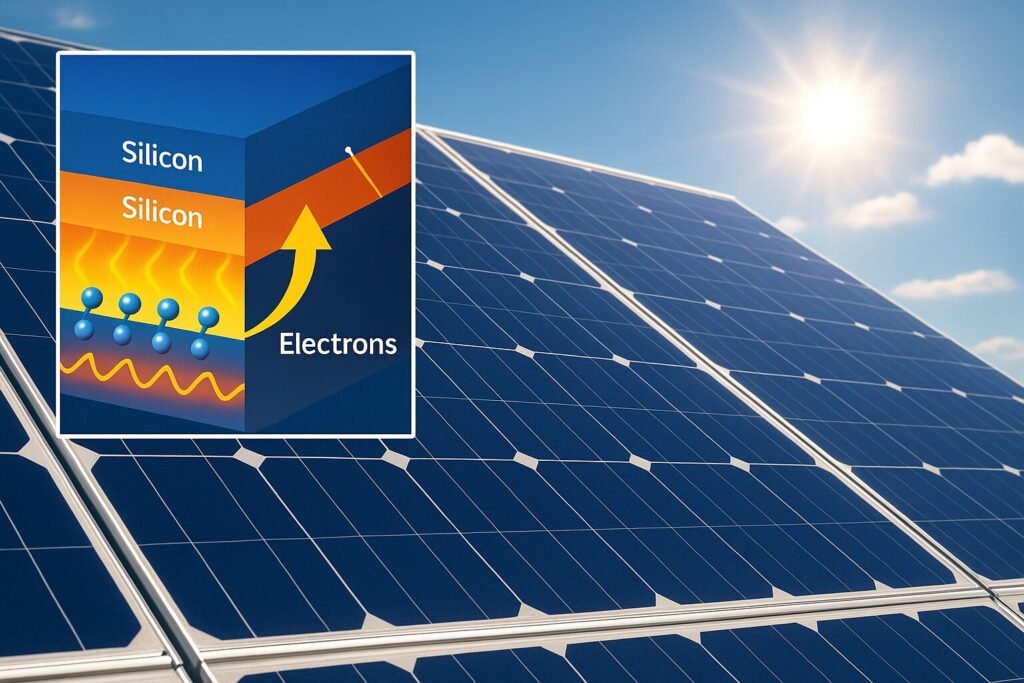
Sunlight, photons, and semiconductors (plain-English). Sunlight is a stream of tiny energy packets called photons. Solar cells are slices of semiconductor (usually silicon) designed so incoming photons knock electrons loose. That movement creates an electric current. That basic interaction is the photovoltaic (PV) effect.
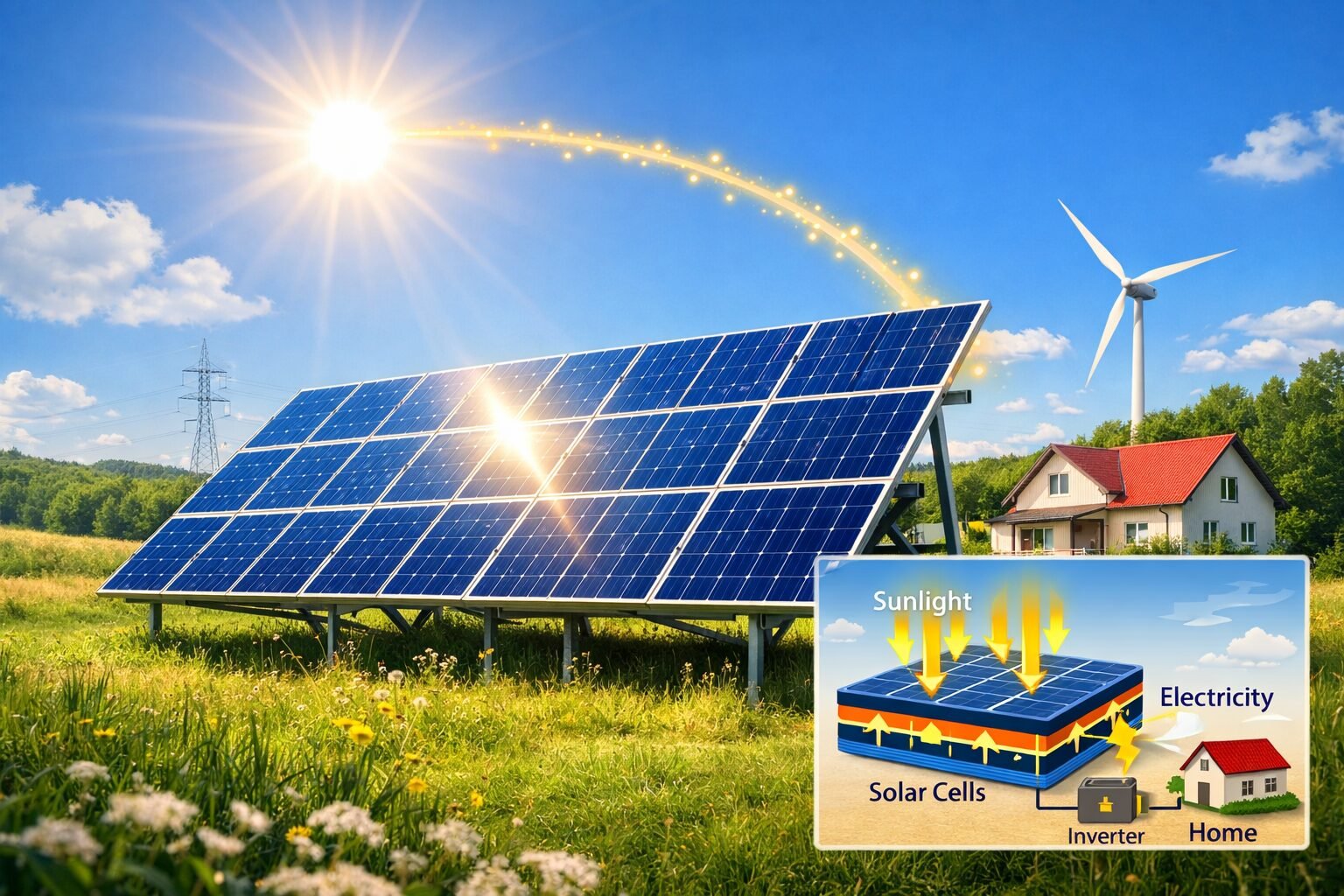
From DC to usable power—where the inverter fits. Panels produce DC electricity. Your home and the grid use AC. The inverter converts DC to AC, synchronizes with the grid, and keeps everything safe and useful. Think of panels as the muscles and the inverter as the translator.
My quick analogy. Imagine a row of dominoes (electrons). Sunlight taps the first domino. Panels guide the fall so the motion becomes a steady flow of electricity. The inverter takes that orderly motion and turns it into the kind your home can use.
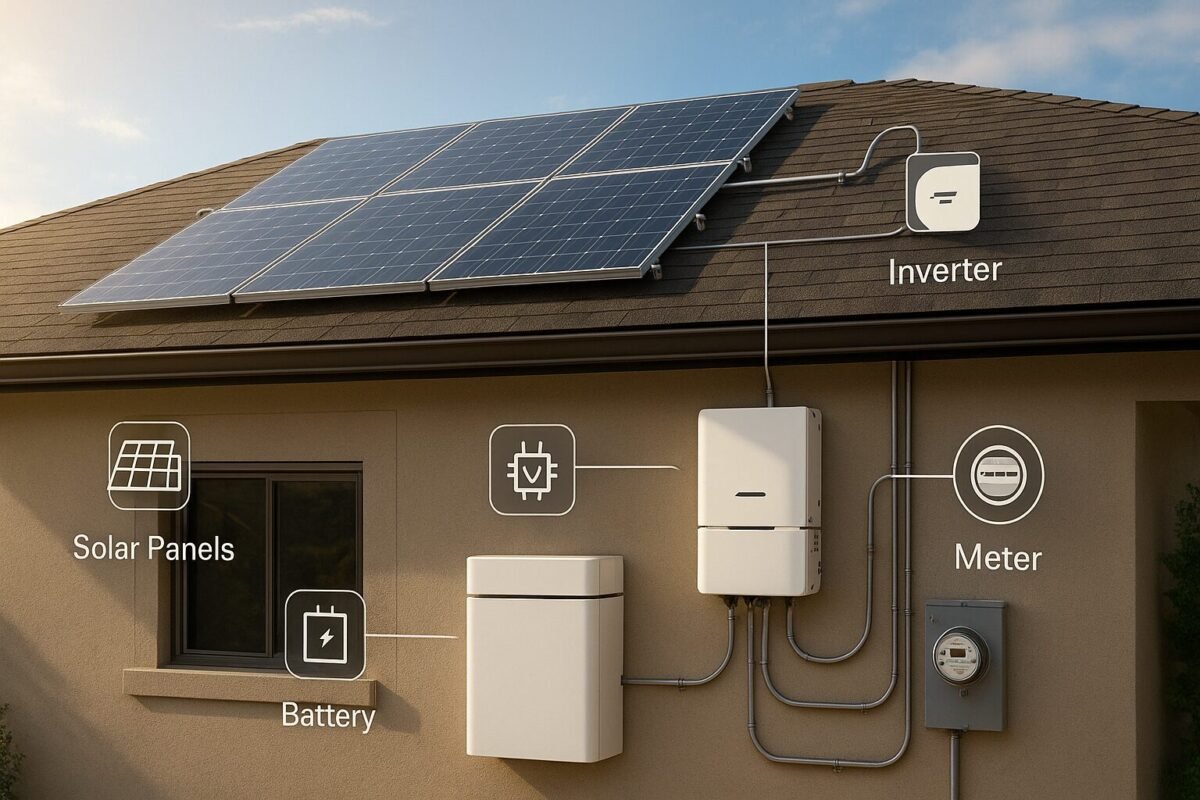
The Main Parts of a Home Solar System
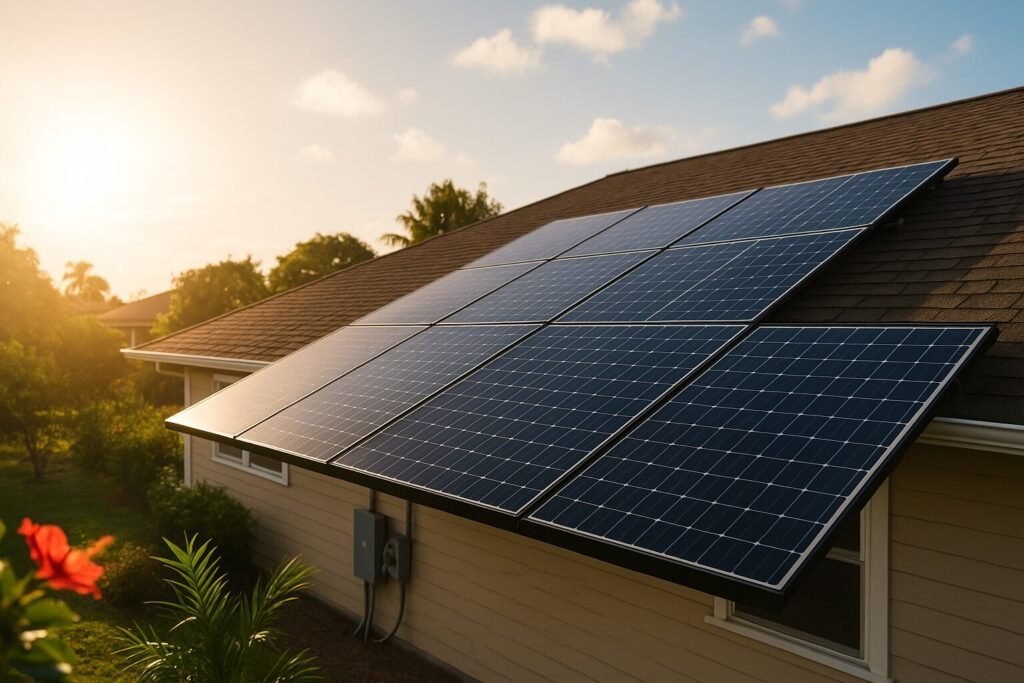
Solar panels (modules). A panel is a frame, glass, a backsheet, and cells wired into strings. Panels are grouped to reach your target system size (e.g., 4–10 kW for many homes).
Inverters.
String inverters: one unit for many panels.
Microinverters: one per panel for panel-level optimization.
Hybrid inverters: can manage both solar and batteries.
Racking & attachments. Racking secures panels to the roof or ground. Pay attention to waterproofing on roof penetrations and corrosion-resistant hardware.
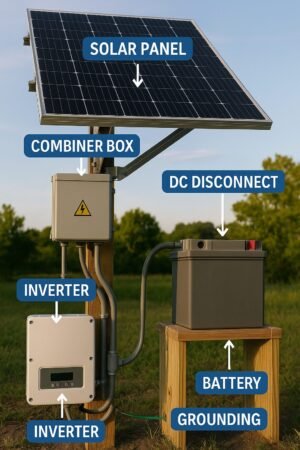
Wiring, safety gear, and monitoring. You’ll see combiner boxes, disconnects, grounding, and a production meter. Monitoring lets you see daily, monthly, and lifetime solar generation.
Alternatives to roof mounts. If the roof is shaded or awkward, consider a ground mount or solar carport. They allow perfect tilt and orientation and are easy to clean.
PV vs. Solar Thermal—Don’t Mix These Up
PV = electricity. Solar thermal = heat (typically for water or space heating). PV is the standard for home electricity generation. Solar thermal can still make sense if you use a lot of hot water and have good sun exposure.
What I chose and why. I went PV because I wanted to offset my electric bill and support future electric loads (EV charging, heat pump). If you’re mostly chasing hot water savings, solar thermal is worth a look; otherwise, PV is the flexible workhorse.
Do Panels Work on Cloudy Days, in Shade, or at Night?
Clouds. Yes, panels still produce power under diffuse light, just less. Expect lower output on overcast days.
Shade. Shade reduces production. Bypass diodes and panel-level electronics help, but they can’t create sunlight. If shade is unavoidable, microinverters or optimizers can protect your overall system performance.
Night. No sunlight means no generation. At night, you draw from the grid or from batteries if you have them.
How Much Power Can a Panel or Home System Produce?
Watts vs. watt-hours vs. kilowatt-hours.
Watt (W) or kilowatt (kW): power/size of the system.
Kilowatt-hour (kWh): energy over time (what your utility bills you for).
Back-of-envelope math. Daily kWh ≈ system kW × average sun-hours (plus losses). If you have a 6 kW system and average 5 sun-hours/day: 6 × 5 = ~30 kWh/day before losses. Real-world numbers vary with weather, temperature, shading, and hardware.
What a typical array covers. A 4–8 kW system can cover a good portion of a typical home’s electricity, depending on usage and sun. Pull your last 12 months of bills to know your actual kWh.
What “Efficiency” Really Means (and Why Roof Space Matters)
Panel efficiency. Efficiency is how much sunlight a panel turns into electricity per area. Higher efficiency = more watts from the same roof space.
System efficiency. Inverters, wiring, temperature, and dirt reduce output. Brochure numbers assume great conditions; real life is messier.
When higher efficiency pays off. If you have limited roof area, aim for higher-efficiency panels. If roof space is abundant, you can often achieve the same annual kWh with more standard panels.
Site Factors That Make or Break Performance
Orientation and tilt. South-facing (in the northern hemisphere) with a moderate tilt is ideal, but east/west can still work well, especially for morning/evening loads.
Shade mapping. Check for year-round shade from trees, chimneys, and neighboring buildings. Shade often changes with seasons and tree growth.
Temperature effects. Panels don’t love heat. Hot roofs reduce voltage and output. A bit of airflow under panels helps.
Roof condition. If the roof needs work, handle it before installing. You’ll save time and avoid future rework.
Do Panels Store Energy? (No—But Batteries Do)
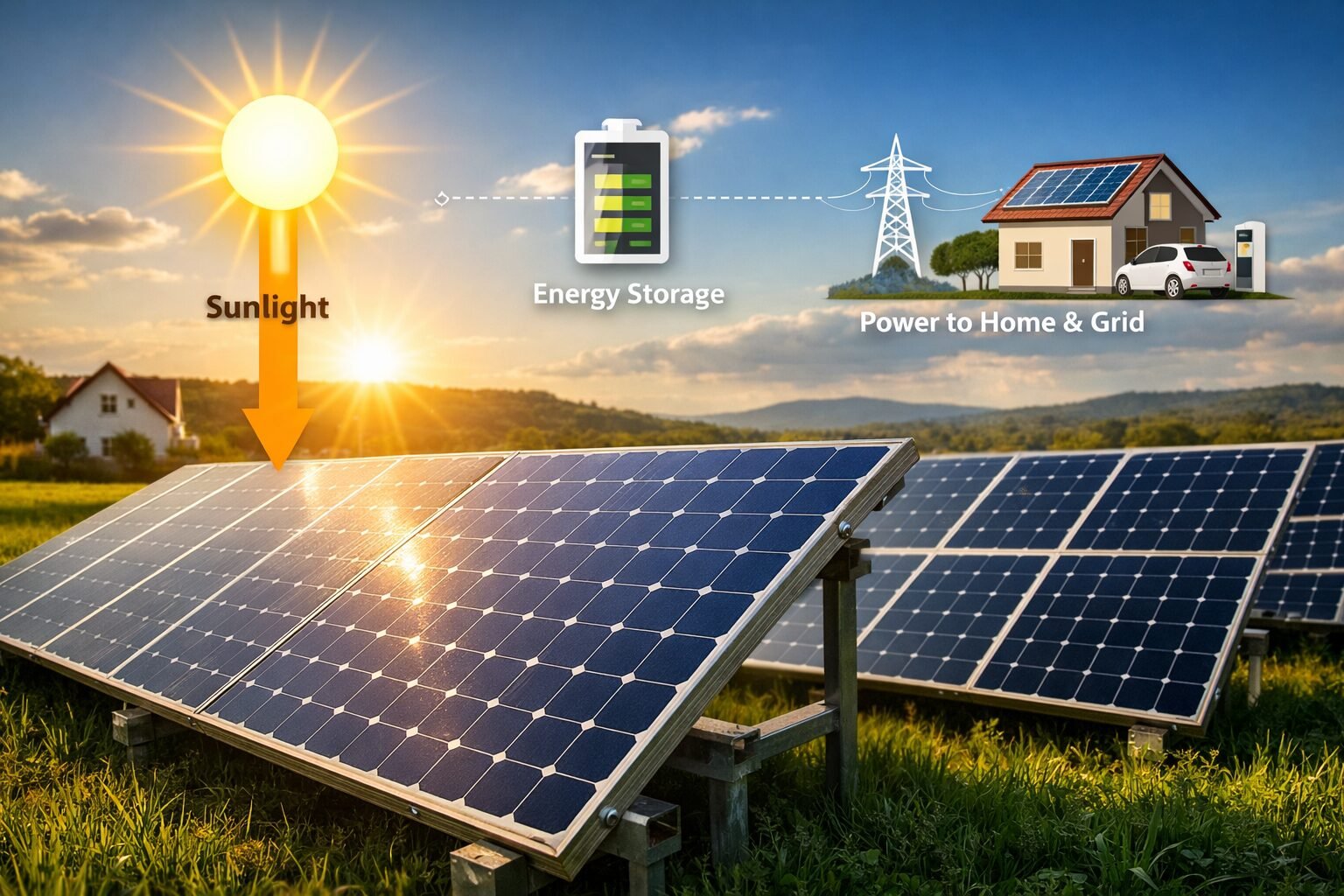
Panels generate. Batteries store. Inverters coordinate. Panels send power to the inverter. The inverter powers your home, charges the battery (if installed), and exports excess to the grid.
Battery basics.
Capacity (kWh): how much energy it can store.
Power (kW): how fast it can deliver energy.
Depth of Discharge (DoD): how much of the battery you can use.
When I recommend storage. If you experience outages, want backup for essentials, or want to shift solar to the evening peak, batteries are great. If your grid is stable and you’re primarily chasing bill savings, you might wait.
Grid-Tied, Off-Grid, and Hybrid—Which Fits Your Life?
Grid-tied. Your system connects to the grid. You use solar when available and export excess. Simple, cost-effective, and common.
Off-grid. You’re fully independent. You’ll need a larger battery capacity and a generator plan for long cloudy stretches. Freedom with tradeoffs.
Hybrid. Grid-tied with batteries. You get backup power plus the ability to shift solar to evenings. A nice balance if resilience matters.
Lifespan, Reliability, and Maintenance
Panels. Panels often carry 20–25+ year performance warranties and can last longer. Expect a slow decline in output over time.
Inverters. Inverters do the heavy lifting and may need replacement once or twice over a system’s life, depending on the type and environment.
Maintenance, I actually do.
Visual check of racking and wiring.
Clean panels only if grime or bird droppings are obvious.
Review the monitoring app monthly for odd dips or inverter alerts.
After storms, I look for debris and shading changes.
Costs, Incentives, and Payback Basics
What drives cost? Equipment (panels, inverter, batteries), labor, racking, permits, and any roof or electrical upgrades.
Incentives to research. Look into federal tax credits, local rebates, and net metering or similar programs. These can improve the project’s math and shorten payback time.
Payback vs. peace of mind. Payback is one lens. Also consider bill stability, resilience during outages, and long-term energy independence. I like to model simple payback, then look at cash flow and “sleep-at-night” benefits.
Step-By-Step Mini-Guide—From Idea to Switch-On
Check the roof and the sun. Look for good exposure, minimal shade, and solid roofing. Note obstacles (vents, skylights).
Pull 12 months of bills. Track kWh, not just dollars. Your usage pattern is your sizing roadmap.
Define your goal. Bill savings? Backup power? Both? Your goal affects inverter and battery choices.
Pick an approach. Grid-tied for simplicity, hybrid for resilience, off-grid for independence.
Plan permits and interconnection. Your utility and local jurisdiction will have steps. Expect inspections and an official permission-to-operate.
Install, inspect, monitor. Once live, watch your monitoring app for the first month. You’ll learn your peak production times and where small tweaks help.
Common Pitfalls I See (And How to Dodge Them)
Oversizing without checking the main panel. Your electrical service may need an upgrade or a busbar calculation.
Ignoring seasonal shade. Trees grow. The winter sun path is lower. Use shade analysis, not just a quick glance in July.
Skipping roof work. If the roof is near end-of-life, handle it first. It’s cheaper and cleaner than doing it later.
Forgetting future loads. Planning to add an EV, heat pump, or workshop? Consider it now so you’re not boxed in later.
Quick Glossary (Bookmark-Worthy)
Photovoltaic (PV): Turning light into electricity. kW vs. kWh: kW is system size (power); kWh is energy used over time. Sun-hours: Average daily sunlight useful for solar (varies by location). Microinverter: A Small inverter attached to each panel. Optimizer: Panel-level device that improves performance with a central inverter. DC-coupled / AC-coupled: Battery integration architectures. Depth of Discharge (DoD): How much of a battery’s stored energy you can use. Net metering: Credit for excess solar you send to the grid. Interconnection: Utility approval to operate your system.
Conclusion: My Takeaways After Living With Solar
If I could go back, I’d do three things sooner:
Audit my usage so system sizing matches my real life.
Plan for future loads so expansion wouldn’t be painful.
Pick a clean layout with minimal shade and easy maintenance.
Solar isn’t just about lower bills. It’s about control, resilience, and using clean energy every single day. Start with your roof, your bills, and your goals—and build from there.
Discover how solar panels turn sunlight into electricity—learn the PV effect, key parts, efficiency tips, and real-world power output in plain English.
🌞 1. The Day I Finally Understood How Solar Works
I still remember the exact morning I finally understood how solar panels work. It wasn’t in a classroom or while reading a thick manual — it was standing in my driveway, coffee in hand, staring up at my roof, wondering, “Okay, how does sunlight actually turn into the power running my fridge?”
Like most people, I’d heard all the buzzwords — photovoltaic cells, renewable energy, clean electricity — but I didn’t really get how it all came together. The panels looked sleek and futuristic, but the process behind them felt like magic. That’s when curiosity took over, and I decided to dig in. What I found was surprisingly simple — and completely changed how I think about solar energy.
☀️ Why Understanding Solar Basics Matters
Before installing or even considering solar panels, I think it helps to grasp the basics. When you understand how solar panels capture sunlight and turn it into usable electricity, the entire system makes more sense — from energy output to battery storage to net metering credits.
For me, this basic understanding made later decisions (like system size and inverter type) so much easier. I wasn’t guessing — I was informed. And the confidence that came from knowing what was happening on my roof every day? Worth it.
👉 If you’re just starting out, this is where your solar journey really begins.
⚡ From Curiosity to Clarity
I started by asking one simple question: What are solar panels actually made of, and how do they do what they do?
That question sent me down a rabbit hole of YouTube videos, blog posts, and installer FAQs. Eventually, the fog lifted — I realized that solar panels don’t “store” sunlight; they convert it directly into electrical energy through the photovoltaic (PV) effect. In other words, the panels act as translators — turning sunlight into electrons that flow as current, which your inverter then turns into the kind of electricity your home appliances can actually use.
Once that clicked, everything else about solar — system types, efficiency, battery backups — finally made sense.
💡 What You’ll Learn Here
In this post, I’ll walk you through the essentials:
What solar panels are made of and how they capture sunlight
How the photovoltaic effect actually works (in plain English)
The difference between solar energy and solar power
Whether panels still work on cloudy days or at night
How much electricity a typical panel can produce
And what makes one type of panel more efficient than another
By the end, you’ll be able to look at any solar panel system and actually understand what’s happening behind the scenes — no technical background required.
I used to think a solar panel was just a flat piece of dark glass — like a high-tech window that somehow “soaked up” sunlight. Turns out, it’s a lot more sophisticated than that. When I finally got a chance to see one up close (an installer had a sample panel on display), I realized it’s really a layered machine — every piece has a purpose.
Let’s peel it apart, layer by layer, and look inside.
🧩 The “Sandwich” Structure of a Solar Panel
Think of a solar panel as a kind of energy sandwich — multiple thin layers stacked together to capture sunlight, move electrons, and protect the system for decades. Here’s what’s inside most photovoltaic (PV) modules:
Front Glass Layer: The outermost layer you see when you look at a solar panel. This tempered glass protects the delicate solar cells from rain, hail, wind, and UV damage. It’s tough but designed to let through as much sunlight as possible.
Encapsulant (Protective Glue): Beneath the glass is a clear, rubbery material that “glues” everything together and cushions the solar cells. It keeps moisture out and prevents tiny cracks that could affect performance.
Solar Cells (The Real MVPs): These are the heart of the panel — thin slices of silicon wafers that convert sunlight into direct current (DC) electricity through the photovoltaic effect. Each cell is wired together in a grid pattern to form a panel. Fun fact: The silver lines you see on a panel’s surface? Those are thin metal conductors that carry electricity away from each cell.
Backsheet: This opaque back layer seals the panel from behind, providing insulation and protection from weather and humidity. It’s kind of like the shell that keeps the sandwich together.
Aluminum Frame: Surrounding everything is a metal frame — usually aluminum — that gives the panel rigidity and allows it to be mounted on your roof or ground rack. It also helps with cooling and stability.
Junction Box and Wiring: On the back of every panel is a small, weatherproof box that houses wiring connections and bypass diodes (these prevent shading on one cell from reducing the performance of the whole panel). This is where the generated DC power exits the panel and heads toward your inverter.
🔍 Monocrystalline vs. Polycrystalline Cells
When people talk about solar panel “types,” they’re usually referring to what kind of silicon cell the panel uses:
Monocrystalline (Mono): Made from a single, continuous crystal structure. They’re dark black and highly efficient — perfect for limited roof space.
Polycrystalline (Poly): Made from multiple crystal fragments melted together. They look bluish and cost less to produce, but they’re slightly less efficient.
Each layer of a solar panel plays a critical role in efficiency, durability, and energy yield:
The glass ensures light gets in, but the weather stays out.
The silicon cells generate the electricity.
The encapsulant and backsheet keep everything sealed and safe.
The frame and junction box handle the physical structure and power flow.
When I understood this, I realized why solar panels can last 25–30 years — they’re built to survive heat, cold, wind, and time. In short, a solar panel is a quiet, hardworking energy machine wrapped in glass and metal.
💡 Takeaway for Homeowners
You don’t have to be an engineer to appreciate how these components work together. But knowing the basics helps you:
Ask better questions when talking to installers.
Spot quality materials in product descriptions.
Understand warranties — because now you know what’s actually being protected.
The more I learned, the more solar stopped feeling mysterious — and started feeling like an incredibly smart piece of home technology I could confidently maintain and trust.
⚡ 3. How Do Solar Panels Turn Sunlight into Electricity?
I’ll admit — the first time I tried to explain how solar panels make electricity, I sounded like a magician. “Well… the sun hits the panel and… magic happens!”
If that’s ever been you, don’t worry — I was there too. The science behind solar power generation sounds complicated, but it’s actually a pretty simple story of light, electrons, and a clever bit of engineering. Once I visualized what happens inside a panel, everything about solar energy finally made sense.
☀️ The Simple Version: Sunlight In, Electricity Out
Here’s the short version:
Sunlight hits the solar cells inside your panel.
Electrons in the silicon cells get excited and start moving.
That movement creates direct current (DC) electricity.
Your inverter converts that DC into alternating current (AC) — the kind your home actually uses.
You can then use it, store it, or send it to the grid.
That’s the full journey, from sunlight to socket. But let’s break it down a little more so it’s easy to picture.
🔬 The Magic Inside the Silicon
Each solar cell inside your panel is made of two layers of silicon — one slightly positively charged and one slightly negative. When sunlight (photons) hits the surface, it knocks electrons loose in the silicon atoms.
Those freed electrons start moving toward the opposite charge, and that movement is electricity.
I like to imagine it like a crowd leaving a concert — the photons are the lights switching on, and the electrons are the people all rushing for the exits. That “rush” creates the flow we call current.
This natural process is called the photovoltaic effect — the foundation of how all solar panels work.
🔌 From DC to AC: Making It Useful for Your Home
The electricity coming directly from your solar panels is direct current (DC), meaning it flows in one direction. But your home — and almost everything plugged into it — runs on alternating current (AC) power.
That’s where the inverter comes in. It’s like a translator for electricity, converting DC into AC so your appliances can use it. Some modern solar systems use microinverters (one per panel), while others have a single string inverter that handles the whole array.
👉 Want to understand how these parts connect? Check out Solar Panel System Components Explained for a full walkthrough of how panels, inverters, and meters work together.
🔁 What Happens After Conversion
Once your inverter has done its job, the AC power flows into your home’s electrical panel — the same one your utility power feeds into.
If you’re grid-tied, your solar energy gets used first, and any extra gets sent back through the meter. That’s where net metering comes in (you might even earn credits for that power).
If you’re off-grid, your electricity flows to battery storage so you can use it later when the sun’s not shining.
That’s it. You’ve just followed a single photon’s journey from sky to socket.
⚙️ A Real-World Example
One summer afternoon, I checked my inverter app and realized something cool — my panels were generating more power than my house was using. My coffee maker, laptop, and air conditioner were all running completely on sunlight.
That’s when it really hit me: solar power isn’t abstract. It’s electrons literally moving from photons hitting your roof to the outlets in your kitchen. Once you understand that, “going solar” feels less like science fiction and more like common sense.
💡 Takeaway: Simple Science, Big Impact
When you strip away the jargon, solar panels work by freeing electrons with sunlight and turning that flow into electricity we can use every day.
The process is silent, clean, and endlessly repeatable — no fuel, no moving parts, just light transformed into power. And the more sunlight your panels capture, the more those electrons flow.
If you understand this one concept, you understand the beating heart of every solar system — whether it’s a tiny rooftop setup or a massive off-grid array.
☀️ 4. Solar Energy vs. Solar Power (Yes, There’s a Difference!)
I’ll be honest — for the longest time, I used “solar energy” and “solar power” interchangeably. They sound the same, right? I’d catch myself saying things like “solar energy powers my home” or “I’m storing solar power in my batteries,” without realizing those two terms actually mean slightly different things.
It wasn’t until I started writing about solar and talking with installers that I realized why this distinction matters. Once you see the difference, the entire solar electricity generation process becomes way clearer.
🔆 Solar Energy = The Raw Sunlight
Solar energy refers to the sun’s radiation itself — the light and heat we receive every day. It’s the source, the fuel, the raw ingredient of everything solar.
Every sunbeam that hits your roof carries energy in the form of photons, which your solar panels capture and convert into electricity. So when we talk about harnessing solar energy, we’re really talking about collecting sunlight and turning it into something useful.
I like to think of solar energy as the potential — the sunshine waiting to be turned into power.
⚡ Solar Power = The Electricity We Use
Now, solar power is what happens after that sunlight gets converted into electricity by your photovoltaic (PV) system. It’s the product — the actual electric current that runs your fridge, charges your phone, and powers your lights.
In short:
Solar energy is sunlight.
Solar power is the usable electricity created from it.
That’s it! Easy, right? Once I understood that difference, I could actually follow conversations about system output, energy efficiency, and power consumption without getting lost.
💡 A Simple Way to Remember the Difference
Here’s how I keep them straight:
🧠 Energy is potential. Power is performance.
Energy is the sunlight — the stored possibility of doing work. Power is the action — your devices running off the converted electricity.
When your solar panels capture solar energy, your inverter converts it into solar power. Then your home’s electrical system puts that power to work.
🔋 Why This Difference Matters in Real Life
This isn’t just a vocabulary thing — it affects how you read your solar monitoring app or utility bill.
For example:
Your system capacity (in kilowatts) shows how much power your panels can produce at one moment.
Your energy production (in kilowatt-hours) shows how much energy you’ve collected over time.
If you’re comparing systems or estimating savings, understanding that difference helps you make better decisions. It’s like the difference between how fast your car can go (power) and how far it can travel on a tank (energy).
When we talk about going green, both terms matter.
Solar energy is an infinite resource shining on us every day.
Solar power is how we turn that resource into renewable electricity that replaces fossil fuels.
Every watt of power your panels produce is another small step toward energy independence — and a cleaner planet.
🧭 Quick Recap for Skimmers
Concept
Meaning
Easy Analogy
Solar Energy
Sunlight — radiant energy from the sun
The sunlight shining on your roof
Solar Power
Converted electricity your panels produce
The light bulb glowed from that energy
🌤️ Cloudy Days: Power Doesn’t Disappear, It Just Dims
Here’s the good news — solar panels still generate electricity on cloudy or overcast days, just not at their full potential.
Think of sunlight like water flowing through a hose. On a sunny day, the hose is wide open. On a cloudy day, the flow narrows, but it doesn’t stop.
Even when the sky looks gray, diffused sunlight still reaches your panels and activates the photovoltaic (PV) cells. Typically, you’ll see around 10–30% of your normal output, depending on how thick the cloud cover is.
In my case, I once compared my inverter readings between a sunny July afternoon and a foggy November morning. The output dropped by about 75%, but it never hit zero. My lights stayed on, my fridge hummed along, and my home didn’t notice a thing.
🌙 What About Nighttime?
Now, this one’s easy: solar panels don’t generate power at night. No sunlight = no photons = no excited electrons = no electricity.
That’s why solar power systems rely on energy storage or grid connection to keep things running after sunset.
Here’s what usually happens:
Grid-Tied Homes: Your system automatically switches to grid power when the sun goes down. During the day, you likely send extra energy to the grid (through net metering), so you draw it back when needed.
Off-Grid or Hybrid Homes: You use solar batteries (like lithium-ion or deep-cycle units) to store extra daytime energy for nighttime use.
So even though your panels rest at night, your system doesn’t — it’s just switching energy sources behind the scenes.
⚡ How Batteries Fill the Nighttime Gap
If you’re thinking long-term or aiming for energy independence, battery storage is where the magic happens.
During sunny hours, your system produces more power than you use. That excess gets stored in your battery bank. Later, when it’s dark, your home draws from that stored energy automatically — no need to flip a switch.
Adding a battery doesn’t just help you at night; it also keeps your lights on during grid outages and gives you more control over when and how you use your power.
👉 Curious about whether a battery makes sense for your setup? Check out Grid-Tied vs. Off-Grid Solar Systemsfor a breakdown of how batteries fit into each type.
🔆 Bonus: Do Moonlight or Streetlights Help?
You might’ve heard people ask if moonlight or streetlights can power solar panels. Technically, moonlight is sunlight reflected off the moon’s surface — but it’s about 400,000 times weaker than direct sunlight. That’s nowhere near enough to activate your panels.
Streetlights? Same story. Their light just doesn’t carry enough energy to excite the electrons in your solar cells. So while your panels will quietly “sleep” through the night, your batteries or grid connection keep the power flowing.
💡 Real-World Takeaway
Cloudy = lower output, not zero output.
Night = no generation, but your system keeps you powered through batteries or a grid supply.
Efficiency still matters. Choosing panels known for strong low-light performance (like monocrystalline types) can make a difference in cloudy regions.
Once I understood this, I stopped worrying about cloudy forecasts. Solar is more resilient than most people think — it’s designed to handle nature’s ups and downs.
⚡ 6. How Much Electricity Can a Single Solar Panel Produce?
When I first started researching solar, one of the most confusing things I ran into was the simple question: “How much power does one solar panel actually make?”
Every website seemed to throw around different numbers — 300 watts, 400 watts, 500 watts — and it all felt abstract. What did that even mean in real life? Could one panel really power my fridge? My laptop? My whole house?
It wasn’t until I saw my own system in action that it finally clicked.
☀️ From Watts to Kilowatt-Hours: The Basics Made Simple
Let’s start with the basics. Every solar panel is rated by wattage — that’s how much power it can produce under ideal conditions (full sun, perfect angle, no shade).
Most modern residential panels fall between 350 and 450 watts (W). That number tells you the instantaneous power output — not how much energy it makes over time.
To figure out how much electricity a panel produces in a day, you multiply that wattage by the number of peak sunlight hours your location gets.
For example:
400 W panel × 5 sunlight hours = 2,000 watt-hours (or 2 kilowatt-hours, kWh) per day
That means a single solar panel could generate about 2 kWh on a good day.
To put that in perspective, that’s enough to:
Run a refrigerator for about a day
Power a laptop for 20+ hours
Keep your Wi-Fi, lights, and fans going comfortably
🌦️ Real-World Conditions Matter (A Lot)
Now, that’s the theoretical number. In real life, a few factors can boost or lower your panel’s daily production:
Sunlight Hours: The biggest one! Arizona might see 6–7 hours of full sunlight daily, while Oregon might average closer to 4.
Orientation & Tilt: Panels facing due south (in the northern hemisphere) at a good angle will outperform flat or shaded setups.
Temperature: Believe it or not, solar panels lose efficiency when they get too hot — cooler panels actually generate more.
Shading: Even partial shading from trees or chimneys can drop output significantly.
Panel Type & Age: Monocrystalline panels are more efficient than polycrystalline ones, and all panels experience a slow degradation rate (typically around 0.5% per year).
When I cleaned my panels one spring afternoon after a dusty winter, I noticed about a 7% bump in my daily production. It reminded me how even small factors — like grime or angle — can influence performance.
📈 How Much Electricity Does That Mean Over a Year?
If one 400 W panel makes about 2 kWh per day, that’s roughly:
2 kWh × 365 days = 730 kWh per year
For reference, the average U.S. home uses around 10,000–12,000 kWh per year. So, to offset most of your usage, you’d need somewhere around 14–18 panels — depending on your location and energy habits.
Of course, that’s just a ballpark. A smaller home with energy-efficient appliances might need fewer panels, while a large home with electric heating or EV charging might need more.
🔋 Why Your Inverter and System Design Also Matter
Even if you have the most efficient panels on the market, you’ll only get the full benefit if your inverter and wiring are sized correctly.
The inverter converts DC to AC power, and if it’s undersized or poorly matched, it can bottleneck production. This is why working with an installer who designs a balanced system (panels + inverter + batteries) is so important.
If you’re curious how these components interact, check out Solar Panel System Components Explained — it walks through each piece of the setup in plain English.
🧮 Quick Recap: Solar Output at a Glance
Panel Wattage
Avg. Sunlight Hours
Daily Output (kWh)
Annual Output (kWh)
350 W
4–5 hours
1.4–1.75 kWh
~511–639 kWh
400 W
4–6 hours
1.6–2.4 kWh
~584–876 kWh
450 W
5–6 hours
2.25–2.7 kWh
~821–985 kWh
(Real-world results vary based on location, system design, and maintenance.)
💡 Practical Takeaways
A single solar panel produces roughly 1.5–2.5 kWh per day on average.
That’s enough to power small household essentials, but not a full home.
Multiply that by your total panel count to estimate system capacity.
Efficiency depends on weather, orientation, and cleanliness.
Tracking your production helps you spot issues before they cost you power.
Once I started checking my system’s daily production (via my inverter app), it became a fun habit. On bright days, I’d smile seeing those numbers climb — proof that the sun was literally powering my day.
🔋 7. The Main Types of Solar Panels (And Which One Fits You)
When I first started researching solar, I assumed all panels were basically the same — just shiny rectangles that made electricity. Then I met an installer who asked, “Are you thinking monocrystalline or polycrystalline?”
Cue the blank stare.
That question led me down a rabbit hole I didn’t know existed — and by the end, I realized that the type of panel you choose really does matter. Each has its own personality: some are sleek and powerful, others affordable and flexible. The right fit depends on your space, goals, and style.
☀️ 1. Monocrystalline Solar Panels: The Sleek Performer
When people picture modern solar, they’re usually thinking of monocrystalline panels — deep black, uniform, and efficient.
They’re made from a single continuous crystal of silicon, which allows electrons to flow more freely. That means higher solar efficiency (usually the best of all types) and better performance in low light or heat.
When I installed my system, I chose monocrystalline panels because roof space was limited and I wanted to squeeze as much power as possible from every square foot. They’ve been rock solid, and even on cloudy days, I still see decent output.
Pros:
Highest efficiency (great for smaller roofs)
Long lifespan and strong warranties
Excellent low-light performance
Sleek, all-black design looks sharp on most roofs
Cons:
Slightly more expensive upfront
Overkill for large open areas where space isn’t an issue
👉 If you’re short on space but want premium performance, monocrystalline is probably your best match.
🔷 2. Polycrystalline Solar Panels: The Budget-Friendly Workhorse
Polycrystalline panels (sometimes called multicrystalline) are easy to spot — they have a bluish tint and a textured look. They’re made by melting fragments of silicon together, which makes them cheaper to produce but slightly less efficient.
A friend of mine installed these on a detached garage and was thrilled — the extra few panels he could fit easily made up for the small efficiency difference.
Pros:
More affordable for larger systems
Proven, reliable technology
Lower carbon footprint during manufacturing
Cons:
Slightly lower efficiency (needs more space)
May perform a bit less in very hot weather
Less “sleek” appearance (aesthetic preference)
If you have plenty of roof or ground space, polycrystalline can be a great choice — solid, dependable, and easy on the budget.
🧱 3. Thin-Film Solar Panels: The Flexible Innovator
Thin-film panels are the rebels of the solar world. Instead of rigid silicon wafers, they use a flexible material — like amorphous silicon (a-Si), cadmium telluride (CdTe), or CIGS (copper indium gallium selenide).
They’re lightweight and can even bend slightly, making them great for unusual surfaces — sheds, RVs, curved roofs, or off-grid projects.
I tested a small thin-film panel setup on my workshop roof once — installation was a breeze. While the efficiency wasn’t record-breaking, I loved how easy they were to mount without drilling heavy racking.
Pros:
Lightweight and flexible — easy to install
Performs well in low-light or high-heat areas
Ideal for nontraditional or mobile setups
Cons:
Lower efficiency (needs more space)
Shorter lifespan than crystalline types
Slightly faster degradation rate over time
If you value ease of installation or want something for a DIY/off-grid project, thin-film might surprise you with its versatility.
🧭 For Skimmers: Quick Comparison Table
Type
Efficiency
Best For
Appearance
Key Strength
Monocrystalline
⭐⭐⭐⭐
Small roofs, high efficiency
Sleek black
Power per square foot
Polycrystalline
⭐⭐⭐
Larger roofs, lower cost
Blue speckled
Cost-effective reliability
Thin-Film
⭐⭐
Unusual or mobile setups
Black/Matte
Lightweight flexibility
💡 How to Choose What Fits You
Choosing between these panels really comes down to a few questions:
How much roof space do I have?
Limited space → monocrystalline.
Plenty of room → polycrystalline or thin-film.
What are my priorities — efficiency, cost, or aesthetics?
Efficiency → monocrystalline.
Budget → polycrystalline.
Flexibility or portability → thin-film.
What’s my climate like?
Hotter climates benefit from panels that handle heat well (monocrystalline or thin-film).
Cloudy regions often do well with higher-efficiency options.
Having options is part of what makes solar so adaptable. Whether you live in a sunny desert or a cloudy coastal area, there’s a panel type that fits your needs.
And as solar tech keeps improving, these categories are starting to blur — hybrid designs now combine the best features of each. It’s an exciting time to go solar because your system can truly be customized for your home, climate, and lifestyle.
🔌 8. What Does a Solar Inverter Actually Do?
I remember standing in my garage the day my solar system was installed, watching the electrician flip the switch on a gray metal box labeled “Inverter.” He said, “This is the heart of your solar system.”
At the time, I thought the panels were the real stars of the show — after all, they’re the ones catching the sunlight. But once I learned what the solar inverter actually does, I realized it’s more like the translator that makes all that solar energy usable. Without it, your panels are just expensive roof decorations.
⚡ The Inverter’s Job: Translating Sunlight into Usable Power
Here’s the simple version: Solar panels produce direct current (DC) electricity — it flows in one direction. Your home, however, runs on alternating current (AC) — power that flows back and forth 60 times per second.
The inverter’s job is to convert DC into AC so that your appliances, lights, and outlets can use it.
It’s kind of like converting a foreign language. Your panels “speak DC,” but your home only understands “AC.” The inverter stands in the middle, making sure everyone communicates smoothly.
👉 This process is called DC to AC conversion, and it’s what allows solar to integrate seamlessly into your home’s electrical system.
🔋 What Else the Inverter Does (It’s Smarter Than It Looks)
The inverter doesn’t just convert electricity — it’s the brain of your solar setup. Here’s what it handles behind the scenes:
Energy Monitoring: Most inverters have built-in tracking systems that let you see how much power your panels are producing (and sometimes how much you’re using). I check mine like a weather app — it’s oddly satisfying to watch those kilowatts roll in on a sunny day.
Grid Synchronization: For grid-tied systems, your inverter keeps your home power perfectly synced with the utility grid — same voltage, same frequency. That’s how you can export excess electricity through net metering.
Safety Functions: Modern inverters automatically shut down if they detect faults, surges, or grid outages. This prevents backfeeding electricity into the grid during maintenance — an important safety measure for line workers.
Battery Integration (Hybrid Inverters): If you have or plan to add solar batteries, a hybrid inverter manages both the solar power coming in and the stored power going out. It decides when to charge the battery, when to use it, and when to draw from the grid — all automatically.
🧠 Types of Solar Inverters (and How to Pick the Right One)
There isn’t just one type of inverter — there are three main kinds, each suited for different setups.
1. String Inverters (The Classic Option)
This is the most common type, where all your solar panels connect in a single “string.” The inverter sits on the wall and converts all the DC power together.
Best for: Simple roofs with consistent sunlight
Pros: Affordable, proven, easy to service
Cons: If one panel is shaded, it can reduce the whole string’s output
I started with a string inverter myself — it’s been reliable and easy to monitor through my app.
2. Microinverters (The Independent Workers)
Instead of one central inverter, each panel has its own small inverter attached to it.
Best for: Roofs with shading or multiple angles
Pros: Maximizes energy harvest per panel, easier performance tracking
Cons: Higher cost and more components on the roof
When I upgraded a smaller shed system, I used microinverters — perfect for areas that only get partial sunlight throughout the day.
3. Hybrid Inverters (The Multitaskers)
These can handle both grid connection and battery storage. They convert energy in both directions — solar to battery, and battery to home.
Best for: Homes planning to add battery backup
Pros: Flexible, future-proof
Cons: Slightly more complex setup
If you think you’ll eventually want backup power or go partially off-grid, a hybrid inverter is the smart move.
⚙️ For Skimmers: Quick Comparison Table
Type
Best For
Key Strength
Watch Out For
String Inverter
Simple roofs, grid-tied setups
Proven reliability
Loses efficiency with shading
Microinverter
Complex roofs, partial shading
Maximizes per-panel performance
Higher upfront cost
Hybrid Inverter
Homes with or adding batteries
Handles solar + storage
Slightly complex installation
💡 Practical Takeaways
Your inverter converts DC from your panels into usable AC electricity.
It also monitors performance, syncs with the grid, and manages battery storage.
Choose your inverter type based on your roof layout, budget, and future plans.
Treat it as the nerve center of your solar system — keep it clean, shaded, and well-ventilated for longevity.
Once I understood that my inverter was quietly managing every watt flowing in and out of my home, I started checking it daily. It’s like the “heartbeat” of my solar setup — steady, silent, and essential.
🏡 9. Can Solar Panels Power an Entire House?
I’ll never forget the first time someone asked me this. I was proudly showing off my inverter app when a friend squinted at the numbers and said, “Okay, but can it actually power your whole house — like, everything?”
That’s the question every homeowner eventually asks, and the short answer is: 👉 Yes, solar panels can power your entire house — if your system is sized right.
But there’s more to it than just covering your roof with panels. It’s about balancing your energy use, system size, and how you’re connected to the grid.
⚙️ Step 1: Understand How Much Energy Your Home Uses
Before figuring out whether solar can power your whole home, you need to know how much electricity you actually use.
When I checked my utility bill for the first time with this in mind, I realized my home averaged around 30 kWh per day — about the U.S. household average.
You can find this number on your electric bill under “Usage.” It’s usually shown in kilowatt-hours (kWh) per month.
If you’re using around 900 kWh a month, your system would need to produce roughly that same amount of energy to offset 100% of your usage.
👉 Tip: Write down your past 12 months of usage — it helps smooth out seasonal differences.
☀️ Step 2: Match System Size to Your Energy Needs
Once you know your usage, you can start estimating how big your solar system needs to be.
Here’s a simple formula:
Monthly energy use ÷ (sun hours × 30) = required system size (in kW)
For example: 900 kWh ÷ (5 sun hours × 30 days) ≈ 6 kW system
That means a 6-kilowatt system could cover the average household’s needs — assuming good sunlight, proper orientation, and minimal shading.
Of course, your actual numbers depend on where you live. A home in Arizona might need fewer panels than one in Washington for the same energy output.
🔋 Step 3: Decide If You’ll Stay Grid-Tied or Go Off-Grid
This is where the whole-house conversation gets interesting.
Grid-Tied Systems:
Most homes stay connected to the utility grid. During sunny hours, your panels power your home and send any extra electricity back to the grid through net metering. At night, you draw from the grid as usual.
This setup effectively lets solar power your entire home over the course of a day, even though it doesn’t supply power 24/7.
Off-Grid Systems:
If you live remotely or want complete energy independence, you’ll need battery storage to power your house when the sun’s down.
I’ve experimented with a small off-grid cabin setup, and while it’s liberating to run entirely on sunlight, it takes careful planning — especially around battery capacity and backup generation.
Not all homes are created equal when it comes to energy use.
Here’s what tends to drive electricity demand up:
Electric heating and cooling systems
Water heaters or pool pumps
Electric vehicles
Home offices or power tools
Always-on appliances (like fridges, routers, or aquariums)
When I started tracking my power consumption, I realized my air conditioner alone was eating nearly 40% of my summer electricity. Once I added insulation and upgraded to a smart thermostat, I was able to size my solar array smaller and still hit 100% coverage.
Sometimes, the smartest solar upgrade isn’t more panels — it’s using power more efficiently.
🧭 For Skimmers: Quick Breakdown
Question
Short Answer
Why It Matters
Can solar power an entire house?
Yes, with proper system sizing.
Match energy use to production.
Do I need batteries?
Only for off-grid or backup.
Grid-tied homes use net metering.
How big a system do I need?
Around 5–8 kW for most homes.
Depends on location & usage.
Can it power everything 24/7?
With batteries or grid backup.
Sunlight alone isn’t constant.
💡 Real-World Example
A 7 kW solar system (about 18–20 panels) in a sunny area can easily generate around 10,000–11,000 kWh per year, which matches the average U.S. household’s usage.
That’s enough to power your home — lights, fridge, washer, and even EV charging — as long as your system’s efficiency and sunlight hours line up.
When my panels first started covering my full bill, it felt amazing to see “$0.00 due” pop up from the utility company. It’s one of those moments that makes the planning totally worth it.
⚡ 10. What Happens to the Extra Power My Panels Produce?
I’ll never forget the first time my solar app showed my house producing more electricity than it was using. It was a bright Saturday morning — no AC, no laundry running, just the coffee maker — and yet my panels were cranking out full power.
I stood there wondering, “Wait… where does all that extra energy go?”
That question marks the moment you go from solar newbie to solar-savvy homeowner. The answer depends on how your system is set up — and it’s one of the most rewarding parts of going solar.
☀️ When Your Panels Make More Than You Use
Your solar panels are constantly generating electricity when the sun’s out. If your home isn’t using all of it in real time, that excess power has two possible paths:
It can flow back to the grid (net metering)
It can charge your battery system (if you have one)
Let’s break down both options, because they work a little differently — but both can save you money and boost your energy independence.
🔁 Option 1: Net Metering (Sending Power Back to the Grid)
In a grid-tied solar system, any extra electricity your panels produce is automatically sent back through your utility meter into the power grid.
Your utility then gives you credit for that energy — just like rolling over unused cell phone data (remember those days?). Later, when the sun goes down or on cloudy days, you “draw” power back from the grid, using up your credits.
This setup is called net metering, and it’s one of the key ways solar homeowners offset their electric bills.
When I first watched my electric meter run backward, it felt like magic — my roof was feeding clean power into the neighborhood, and I was literally watching my bill shrink in real time.
💡 How Net Metering Works (Simple Version)
Panels produce DC electricity → inverter converts it to AC.
Home uses what it needs first (lights, appliances, etc.).
Any extra electricity flows back to the grid automatically.
The utility meter tracks both directions (imported and exported power).
You earn credits for what you send out.
At the end of the billing cycle, your utility compares what you exported vs. imported.
If you produced more than you used, you’ll often roll over the credit.
If you have solar batteries or a hybrid inverter, things get even cooler. Instead of sending all that surplus power to the grid, your system can store it locally.
During the day, your panels first power your home. Then, once your home’s needs are met, extra electricity flows into your battery bank.
At night — or during a power outage — your system automatically pulls from those stored kilowatt-hours to keep things running.
I love this setup for the peace of mind it gives me. During a summer storm when the grid went down, my house didn’t miss a beat. Lights on, fridge running, Wi-Fi humming — all powered by yesterday’s sunshine.
🧭 Which Option Is Right for You?
Setup
Where Extra Power Goes
Best For
Key Benefit
Grid-Tied (Net Metering)
Back to the grid
Urban & suburban homes
Earn energy credits and lower bills
Hybrid (Batteries + Grid)
First to battery, then grid
Energy-conscious homeowners
Backup power + grid savings
Off-Grid
Battery only
Remote or self-sufficient homes
Total energy independence
Most homeowners start with net metering, then add batteries later if they want backup power or more control. It’s a flexible journey — you can start small and expand as your needs grow.
💬 Real-World Tip
Check your utility’s net metering policy before you install. Some utilities offer full retail credit (you get the same value per kWh you’d pay them), while others use a lower feed-in tariff rate.
Understanding that upfront helps you plan whether adding storage might pay off faster.
The first time I saw my electric bill say “–$14.27,” I took a screenshot. It wasn’t about the savings — it was the feeling of control. I was producing clean power, meeting my own energy needs, and even sending some back to help the grid.
That’s when I realized solar energy isn’t just about panels. It’s about participation — becoming part of the power system instead of just consuming it.
💡 For Skimmers: Quick Takeaway
Scenario
What Happens to Extra Power
What You Get
Grid-Tied (Net Metering)
Sent to grid
Energy credits, lower bills
Battery Storage (Hybrid)
Stored for later
Backup power & energy independence
Off-Grid System
Stored only in batteries
Full autonomy, no grid reliance
🧼 11. How Long Do Solar Panels Last and What Maintenance Do They Need?
I remember asking my installer, “So, how long before these things wear out?” He just smiled and said, “You’ll probably replace your roof before your panels.”
That answer stuck with me. Solar panels feel like tech — and we’re used to gadgets getting outdated fast — but they’re actually built more like infrastructure than electronics. They’re designed to last decades, quietly doing their job in sun, wind, and rain.
Let’s unpack what that really means — and what you can do to keep your system performing like new for as long as possible.
☀️ The Typical Lifespan of Solar Panels
Most quality solar panels last 25–30 years or more. That doesn’t mean they suddenly die at year 30 — it just means their efficiency gradually declines over time, a process known as degradation.
On average, panels lose about 0.5% of output per year, which means after 25 years, they’ll still produce around 85–90% of their original power.
That’s impressive longevity for something sitting outside 24/7.
Mine have been up for a little over five years now, and they still generate within 98% of their rated output — not bad for hardware that’s endured heatwaves, hail, and a surprise windstorm.
⚙️ Why Solar Panels Last So Long
Solar panels have no moving parts, which is the secret to their durability. Each panel is basically a sealed sandwich of silicon cells, glass, and protective materials that resist corrosion and weathering.
Most panels are tested to withstand heavy rain, snow loads, and even small hail impacts. The key wear factors over time are:
UV exposure is slowly breaking down materials.
Thermal cycling (heating and cooling each day).
Moisture intrusion in low-quality seals.
This slow “aging” process is called PV module degradation — and it’s been studied for decades. High-quality panels undergo strict testing to minimize it.
🧰 Maintenance: What (Little) You Actually Need to Do
Here’s the best part: solar panels are practically maintenance-free.
Still, a little care goes a long way in keeping your energy yield high. Here’s my simple annual routine:
1. Visual Inspection (Twice a Year)
I make it a habit to do a quick roof check every spring and fall. I look for:
Debris buildup (leaves, dust, bird droppings)
Loose wiring or mounting brackets
Cracked glass or shading from new tree growth
Most times, everything looks perfect. But I’ve caught a few early issues — like a loose junction box cable — that were easy fixes.
2. Cleaning (As Needed)
Rain usually does most of the work, but I rinse mine every few months with a gentle hose spray — no pressure washer, no soap. If you live in a dusty area or near trees, grime can reduce output by a few percent. Clean panels = better sunlight absorption.
Tip: If you notice a sudden drop in your inverter app’s production data, dirty panels are often the culprit.
3. Keep Records
I track monthly production through my inverter app. Over time, it helps me spot slow performance changes that might hint at inverter issues or wiring degradation — rare, but worth monitoring.
🔋 Inverters and Batteries Age Differently
Your inverter and battery (if you have one) won’t last quite as long as the panels.
Inverters: typically last 10–15 years, depending on type.
Batteries: last 10–12 years before they start losing capacity.
Plan to replace those components once or twice during your system’s lifetime. The panels themselves? They’ll likely still be going strong.
🛡️ Warranties and Long-Term Confidence
Nearly all solar panels come with two key warranties:
Product Warranty (covers materials and manufacturing defects) — usually 10–15 years.
Performance Warranty (guarantees power output) — often 25 years, promising at least 80–90% of rated capacity by the end.
These warranties reflect how confident manufacturers are in the long-term durability of their products. It’s why solar is such a set it and forget it technology — once installed, it just works.
🧭 For Skimmers: Quick Snapshot
Component
Typical Lifespan
Maintenance Needed
Notes
Solar Panels
25–30+ years
Minimal
~0.5% annual degradation
Inverter
10–15 years
Occasional inspection
Converts DC to AC
Battery Storage
10–12 years
Check cycles & charge
Optional for off-grid/hybrid
Mounting & Wiring
25+ years
Visual checks
Durable hardware
🌞 My Real-World Takeaway
When I first went solar, I thought I’d need to constantly check or clean things. Five years in, I’ve learned that solar panels are basically the “crockpot” of home technology — set it, monitor occasionally, and enjoy free power for decades.
The key to long-term performance is simply awareness: check your output, keep panels clean, and schedule a quick inspection every couple of years. That’s it.
Solar energy isn’t just renewable — it’s reliable.
⚡ 12. TL;DR Snapshot (For Skimmers)
I get it — sometimes you just want the highlights before diving deep. Here’s the short version of everything you need to know about how solar panels work, how long they last, and what makes them worth it.
☀️ What Solar Panels Actually Do
Solar panels capture sunlight using photovoltaic (PV) cells, turning it into electricity. That electricity starts as DC (direct current) and is converted by an inverter into AC (alternating current) — the kind your home appliances use. It’s clean, silent, and renewable — sunlight straight to sockets.
⚙️ Main Components of a Solar System
Panels: Collect sunlight and generate DC electricity.
Inverter: Converts DC into usable AC.
Mounting System: Holds panels securely on your roof or ground.
Battery (Optional): Stores extra power for night or outages.
Grid Connection: Lets you send excess power back for credits.
Absolutely — if your system is sized right. A well-designed solar setup can offset 100% of your energy use through a mix of sunlight, grid connection, or battery backup. Grid-tied homes often achieve “net zero” energy use thanks to net metering credits. Off-grid homes rely fully on batteries to store daytime energy for nighttime use.
In a grid-tied system, it’s sent back to the grid and earns you energy credits.
In a hybrid system, it’s stored in batteries for later use. Either way, that extra sunlight never goes to waste.
🧽 Lifespan & Maintenance
Solar panels typically last 25–30 years — and often longer. They lose only about 0.5% of efficiency per year, which means even after decades, they’re still going strong. Maintenance is minimal:
Rinse occasionally to remove dust or leaves.
Check your inverter app for sudden output drops.
Schedule a pro inspection every few years for peace of mind.
Your inverter may need replacement every 10–15 years, and batteries after about 10–12, but the panels themselves? Practically bulletproof.
When I first went solar, I thought it’d be complicated — constant cleaning, tech headaches, and maybe regret. Instead, it’s been the opposite: quiet, dependable, and honestly kind of fun to monitor. Watching sunlight turn into my morning coffee (literally) never gets old.
Solar isn’t just about saving money — it’s about feeling good every time the sun shines.
If you’ve made it this far, you probably know more about solar energy than most homeowners — but let’s wrap it all up in plain English. Here are the key lessons I’ve learned (and lived) about how solar panels work, how long they last, and why they’re absolutely worth it.
☀️ 1. Solar Panels Turn Sunlight into Real, Usable Power
At their core, photovoltaic (PV) panels convert sunlight into direct current (DC) electricity, which your inverter then transforms into alternating current (AC) — the kind your home uses every day. No moving parts, no fuel, no noise — just sunlight and smart design. When you flip a light switch powered by solar, you’re literally tapping into energy from the sky.
⚙️ 2. Your Solar System Is a Team Effort
Each component has a role:
Panels capture energy.
Inverters convert it into usable power.
Batteries store extra energy for later.
The grid acts as your backup and credit bank through net metering.
They work together to make your system efficient, flexible, and nearly hands-free. 👉 For a breakdown of how these pieces fit together, visit Solar Panel System Components Explained.
🌤️ 3. Solar Works Even on Cloudy Days
Solar panels don’t need blazing sunshine to produce power — just daylight. Even on overcast days, diffused sunlight can keep your home running. And at night? That’s where batteries or the grid take over.
Once I saw my inverter report energy production on a rainy afternoon, I realized solar power is more consistent than most people think.
🔋 4. You Can Power Your Entire House with Solar — If It’s Sized Right
A properly designed system can offset 100% of your household’s energy use. It’s not just about the number of panels — it’s about understanding your energy consumption, sunlight hours, and whether you’re grid-tied or off-grid.
💰 5. Extra Power Isn’t Wasted — It Pays You Back
🧽 6. Solar Panels Are Low-Maintenance, Long-Lived, and Reliable
Solar panels typically last 25–30 years (and often longer). They lose only about 0.5% of performance per year, meaning they’ll still be producing strong power decades later. All they really need?
Occasional cleaning to remove dust or debris
A quick visual inspection twice a year
Regularly checking your inverter app for output trends
Beyond the savings, there’s something deeply satisfying about powering your life with sunlight. Every time I check my production data or see a “$0.00 due” bill, it’s a reminder that clean energy isn’t just possible — it’s practical. Solar has taught me that sustainability doesn’t have to be complicated; it just takes a few smart choices up front.
🧭 Quick Recap Table
Lesson
Key Insight
Why It Matters
Sunlight = Power
PV cells convert light to electricity
Clean, renewable source of energy
System Synergy
Panels, inverter, and batteries work together
Efficiency + reliability
Cloudy Days Count
Panels still produce diffused power
Solar isn’t “all or nothing”
Whole-House Potential
Right system size = energy independence
Lowers or eliminates your bill
Excess Energy Wins
Send it to the grid or store it
Get credits or backup power
Built to Last
25–30 years, minimal upkeep
Long-term return on investment
Feels Great to Use
Produces tangible energy and impact
Personal empowerment + sustainability
🌞 14. Conclusion: Why Understanding Solar Makes It More Rewarding
When I first started learning about solar energy, I’ll admit — it felt overwhelming. There were acronyms I didn’t understand, diagrams that looked like spaceship schematics, and way too many opinions about what “works best.”
But once I broke it down — sunlight, silicon, inverter, electricity — something clicked. Solar stopped feeling like mysterious technology and started feeling like what it really is: a simple, elegant way to power your life directly from nature.
💡 From Curiosity to Confidence
I still remember the day my inverter showed my home producing more power than it was using. That single number on a screen changed how I thought about energy forever.
It wasn’t just about saving money (though that part’s nice). It was about independence — knowing that my roof, my sunlight, and my small corner of the world were quietly generating clean, renewable electricity.
Understanding how the pieces fit together — panels, inverter, grid, battery — gave me a sense of confidence I never expected. It made me feel like I was part of the process, not just a passive consumer.
And honestly? That feels amazing.
⚙️ Why Knowledge Makes Solar Ownership Easier
When you understand how solar power works, everything about owning it becomes simpler. You can:
Spot issues early (like dirt buildup or shading) before they affect output.
Make smarter choices when upgrading or expanding your system.
Appreciate performance data instead of just glancing at it.
Explain solar clearly to friends, neighbors, or family who are curious but hesitant.
I’ve had plenty of conversations that started with “So… how does that thing actually work?” and ended with “I’ve been thinking about getting one too.” Knowledge spreads — and that’s how real change happens.
🌎 The Bigger Picture
Solar isn’t just about powering your own home — it’s part of a global shift toward cleaner, smarter living. Every panel you install reduces fossil fuel demand, lowers carbon emissions, and makes communities more resilient.
The beauty is that it starts small — with one roof, one inverter, one curious person asking questions.
That’s why I believe understanding solar is so rewarding: it’s empowering. It turns you from a consumer of energy into a producer of it — and that’s a powerful mindset shift.
🧭 Practical Takeaways
Knowledge = savings + confidence. Understanding your solar setup helps you get the most out of it.
Maintenance is simple. A quick rinse, a yearly check, and a glance at your inverter app go a long way.
Solar is built to last. 25+ years of quiet, consistent production means you’re investing in long-term stability.
You’re part of something bigger. Clean energy isn’t just personal — it’s progress for everyone.
The more you learn, the more connected you feel to what’s powering your home — and that makes the entire experience far more meaningful.
Understand solar panel cost, incentives, and right-sizing: run a load audit, choose grid-tied/off-grid/hybrid, and plan batteries for year-round reliability.
TL;DR Snapshot (for skimmers)
PV in plain English: Sunlight knocks electrons loose in silicon → DC power → inverter makes AC for your home.
Site matters: Tilt, azimuth, shading, wind/salt exposure.
DIY vs pro: You can DIY small/off-grid; grid-tie usually needs permits and interconnection.
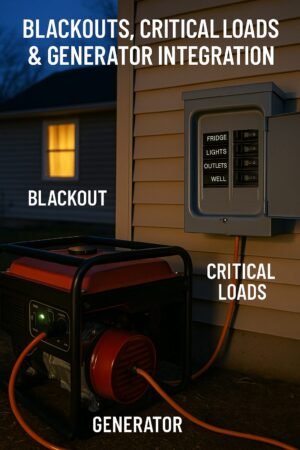
Be blackout-ready: Critical loads sub-panel, transfer switch, and generator integration.
Stay dialed: Monitor, troubleshoot, and leave room to expand.
Why I Went Solar (and What I Learned Fast)
When I started tinkering with solar, I wasn’t chasing perfection. I wanted fewer headaches during storms, lower bills, and the option to keep the lights on without babysitting a noisy generator. My early mistake? I focused on panel wattage and ignored the boring (but crucial) bits: daily energy use, inverter limits, battery autonomy, and the realities of shade.
This guide is the version I wish I had on day one—plain English, practical steps, and just enough theory so you can make confident choices for your home, cabin, or RV.
1) Plain-English Solar: How Sunlight Becomes Electricity
In one sentence: Photons from the sun hit a solar cell, bump electrons free, and create DC electricity that an inverter turns into AC for your outlets.
PV effect, super simple: A solar cell has layers of silicon with an internal electric field. Sunlight energizes electrons; the field pushes them one way; wires give them a path → current.
Solar energy vs solar power:Energy is how much you use over time (kWh). Power is the rate at any moment (kW).
Where power goes:
First to active loads in your home,
Then, to charge the battery (if you have one),
Excess goes to the grid (grid-tie/hybrid) or gets curtailed (off-grid when batteries are full).
Key terms you’ll actually use: DC, AC, kWh, kW, MPPT, State of Charge (SoC), Depth of Discharge (DoD).
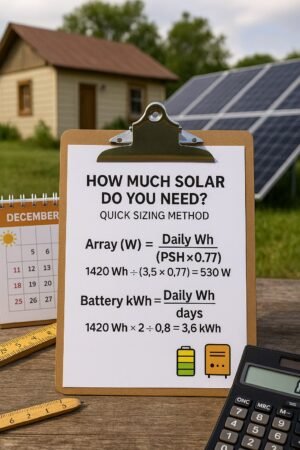
2) How Much Solar Do You Need? (Quick Sizing Method)
Here’s the simple path I use before spreadsheets:
Find your daily energy use
From a bill or monitor, note kWh/day. If you only have monthly kWh: monthly kWh ÷ 30 ≈ kWh/day.
Cabin/RV? Make a loads list (device watts × hours/day → Wh/day, then sum and ÷1000).
Convert kWh/day → array size (kW)
Look up peak-sun-hours (PSH) for your location (average full-sun equivalents per day).
Rule of thumb:Array kW ≈ (kWh/day) ÷ (PSH × 0.75 to account for losses).
Monitoring: Inverter apps/portals for production, consumption, and battery SoC.
4) Grid-Tied vs Off-Grid vs Hybrid (Which Fits Self-Reliance?)
Grid-tied: Best ROI and simplicity. Offsets your usage, but no backup unless you add batteries and a transfer solution.
Off-grid: Full independence. Requires a larger battery bank and usually a generator for long cloudy stretches.
Hybrid: Connects to the grid and a battery. Gives backup for critical loads + daily bill savings.
Decision Cues
Live with frequent outages or remote? Hybrid or off-grid.
Is the priority the shortest payback? Grid-tied (with or without a small backup battery for outages).
Want resilience + savings? Hybrid hits the sweet spot for many homes.
60-second picker: If outages are rare → Grid-tied. If outages are common and you need seamless backup → Hybrid. If no utility or you want full independence → Off-grid (with generator plan).
5) Weather, Shade & Night: What Really Happens
Cloudy days: Expect reduced output, not zero. Cool temps can help panel efficiency.
Shade: A few shaded cells can drag a whole string. Microinverters/optimizers and smart stringing reduce losses.
Night: PV is zero at night. You’ll need batteries or a generator for overnight power.
Design tips: Aim for good azimuth (south in the Northern Hemisphere), reasonable tilt (near your latitude), and minimal shade during peak hours.
Pro tip: If you have unavoidable morning or afternoon shade, module-level power electronics are usually worth it.
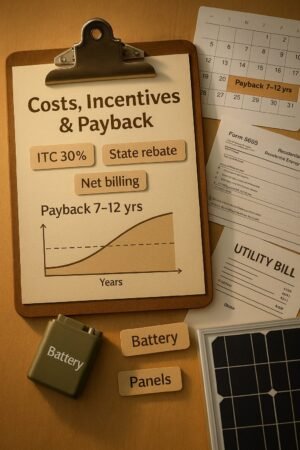
6) Costs, Incentives & Payback (Realistic View)
What drives cost: Panel count, inverter type, battery size, BOS, labor, permits, inspections, and utility interconnection.
Incentives: Look for federal tax credits plus state/utility programs and potential property/permit breaks.
Payback basics:
High electric rates + good export/buyback policies → faster payback.
Lower rates, low exports, heavy shade → slower payback.
Include degradation, battery cycle value (backup peace of mind), and future rate changes in your math.
Ownership choices: Cash (best lifetime ROI), loan (spreads cost), third-party (low-friction but different benefits).
Buyer’s Clarity Box: Before you sign, ask: expected annual kWh, DC:AC ratio, shading assumptions, warranty terms, monitoring access, and scope of work (roof, trenching, main-panel upgrade).
7) Lifespan & Maintenance
Panels: Expect 0.4–0.7%/yr degradation on modern modules and 25–30 years+ of service.
Inverters: Plan for replacement around year 10–15 (warranty varies).
Batteries: LFP often delivers thousands of cycles; life depends on depth of discharge, temperature, and charge profile.
Maintenance:
Clean when soiling is obvious (or after dusty/pollen events).
Visual checks for loose conduit, hot spots, or shading changes.
Update firmware and check alerts in your monitoring portal.
Monitoring: Watch daily kWh, peak power, battery SoC, and alerts.
Common issues: Tripped breakers/GFCI, loose terminations, unexpected new shade, dirty glass.
Data-driven tuning: Compare actual output to expected for your PSH; mismatches can flag string or optimizer failures.
Plan to expand: Leave inverter headroom, choose batteries that allow parallel growth, keep panel models/voltages compatible, and check main-panel capacity.
12) Step-By-Step: Your First Self-Sufficient Solar Plan
Define goals: Savings only? Backup? Full independence?