
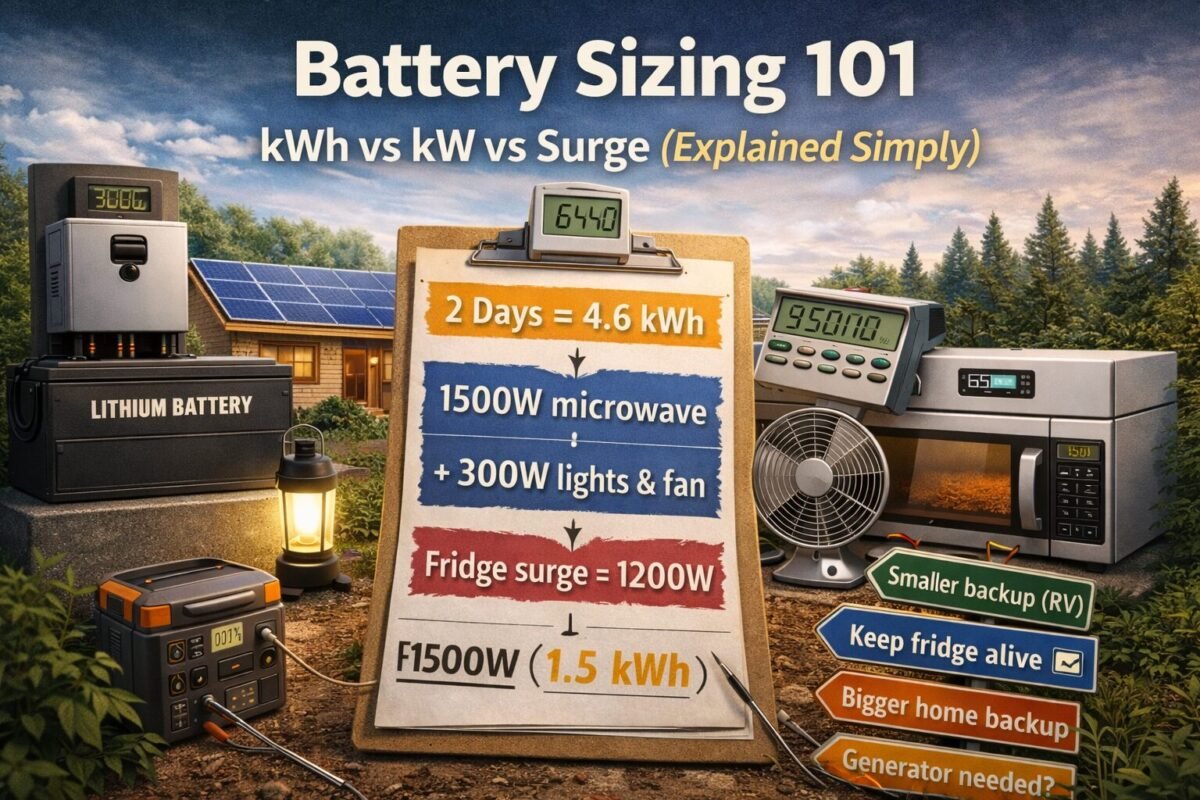
Size backup power the easy way: list critical loads, calculate daily kWh, account for surge watts, then pick the right battery + inverter. Understanding battery sizing for solar is essential for optimal performance.
Battery sizing for solar is a critical component in ensuring you have reliable energy storage. Proper battery sizing for solar can prevent issues like overloading or underutilizing your system.
When I first started looking at batteries, I thought it was a simple question:
“How many hours will this battery last?”
Turns out, that’s only half the story.
Battery sizing gets confusing because we’re really juggling two different problems:
- kWh = how long you can run stuff (energy)
- kW = how much you can run at once (power)
- Surge watts = the momentary “kick” some appliances need (starting power)
If you size for only one of these, you can end up with a battery that looks great on paper… but trips, shuts off, or disappoints when you actually need it.
Let’s fix that.
TL;DR
- Make a critical loads list (what you must run).
- Calculate your daily energy (kWh/day).
- Check your peak watts + surge (kW).
- Choose battery size with a little “real life” cushion for losses + cloudy days.
- Don’t forget the hidden add-ons (panel upgrades, subpanels, electrical work).
Start here (Backup Power hub): /backup-power-for-microhomesteads/
Related: /hidden-costs-of-solar-avoid-budget-killing-surprises/
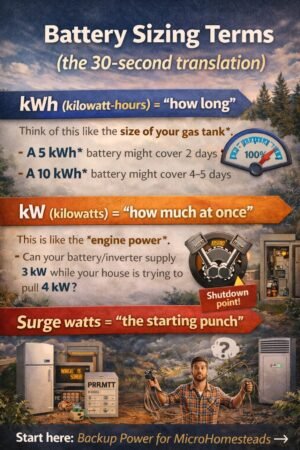
Battery sizing terms (the 30-second translation)

When considering your setup, remember that battery sizing for solar impacts not only efficiency but also your overall system reliability.
kWh (kilowatt-hours) = “how long”
Think of this like the size of your gas tank.
If your loads use 2 kWh per day, then:
- A 5 kWh usable battery might cover ~2 days (in perfect conditions)
- A 10 kWh usable battery might cover ~4–5 days
Ultimately, effective battery sizing for solar will ensure you have the right amount of power when you need it most.
kW (kilowatts) = “how much at once”
This is like the engine power.
If your battery/inverter can supply 3 kW, and your house tries to pull 4 kW, something gives (usually: shutdown).
Surge watts = “the starting punch”
To successfully implement battery sizing for solar, you must consider the unique demands of your energy needs and the expected performance of your system.
Motors do this all the time:
- fridge compressor start
- Well pump start
- power tools
- some AC systems
When estimating energy needs, keep the principles of battery sizing for solar at the forefront of your planning process for better results.
You might run a fridge at 150W… but it may spike much higher for a second or two at startup.
Step-by-step: size your battery the easy way
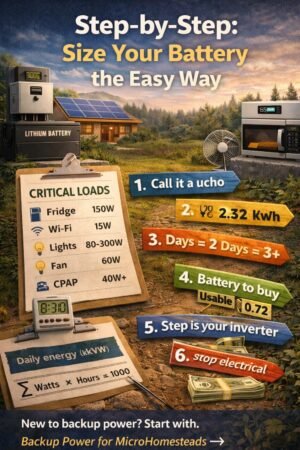
Step 1) List your critical loads (don’t skip this)
Write down what you truly want running in an outage.
Here are common “microhomestead critical loads”:
- Fridge + freezer
- Wi-Fi/router + phones
- A few lights
- Fans
- Medical devices (CPAP, etc.)
- Laptop/charging
- (Maybe) microwave/kettle occasionally
- (Maybe) well pump (big surge!)
If you haven’t done it yet, create a simple list first. (I like a clipboard list I can literally grab during a storm.)
Step 2) Estimate watts (W) and hours per day
You can get watts three ways:
- Nameplate label on the device (easy, but sometimes misleading)
- Kill-A-Watt / power meter (best for plug-in devices)
- Manufacturer spec sheet (useful for pumps/AC)
Quick starter table (ballpark)
Use this as a starting point—verify your real numbers if possible.
| Load | Typical watts (running) | Notes |
|---|---|---|
| Wi-Fi router | 10–20W | Easy win |
| LED light (each) | 8–15W | Multiply by how many |
| Phone charging | 5–20W | Depends on fast charging |
| Laptop | 30–90W | Workloads vary |
| Fan | 20–80W | High impact over time |
| Fridge (average) | 100–200W | Cycles on/off |
| Chest freezer (average) | 80–150W | Cycles on/off |
| Microwave | 800–1500W | Short bursts, big peak |
| Well pump | varies a lot | Often big surge |
Understanding the importance of battery sizing for solar will allow you to maximize the efficiency and effectiveness of your energy system.
Step 3) Calculate daily energy (kWh/day)
This is the math that makes everything click.
Daily kWh = Σ (Watts × Hours) ÷ 1000
Example “Keep-it-running” kit
Let’s say you want:
- Fridge (average 150W) for ~8 hours/day equivalent (because it cycles)
- Wi-Fi (15W) for 24 hours
- 6 LED lights (10W each) for 5 hours
- 2 phones (10W each) for 3 hours
- One fan (50W) for 8 hours
Daily kWh estimate:
- Fridge: 150W × 8h = 1200Wh = 1.2 kWh
- Wi-Fi: 15W × 24h = 360Wh = 0.36 kWh
- Lights: 60W × 5h = 300Wh = 0.3 kWh
- Phones: 20W × 3h = 60Wh = 0.06 kWh
- Fan: 50W × 8h = 400Wh = 0.4 kWh
Total ≈ 2.32 kWh/day
That’s your “how long” number.
Step 4) Decide how many days you want (autonomy)
Be honest about your outage reality:
- 0.5–1 day: “I just need overnight + morning.”
- 1–2 days: “Short outage buffer.”
- 3+ days: “Storms / repeated outages / cloudy stretch.”
If you’re pairing with solar, your “days” might be fewer if you can reliably recharge. If you’re in a cloudy stretch scenario, days matter more.
Related read: /do-solar-panels-work-at-night-cloudy-day-truths/
Step 5) Convert “usable battery” to “battery you must buy”
Here’s the part people forget: you don’t get to use 100% of a battery.
Two common reductions:
- Depth of Discharge (DoD): Many modern batteries allow ~80–90% usable
- System losses: inverter + wiring + conversion losses (often 10–15%)
A safe, simple planning assumption:
- Usable fraction ≈ 0.8 (DoD) × 0.9 (losses) = 0.72 usable
Battery size formula (rated kWh)
Rated battery kWh ≈ (Daily kWh × Days) ÷ 0.72
Using our example:
- Daily kWh: 2.32
- Days: 2
Rated kWh ≈ (2.32 × 2) ÷ 0.72
= 4.64 ÷ 0.72
= 6.44 kWh
Incorporating battery sizing for solar into your planning can help ensure that your system meets all expected loads effectively.
So you’d look at something like ~7–10 kWh rated if you want two days with a cushion.
Now the “power” part: kW + surge sizing

A battery can have plenty of kWh and still fail if the inverter can’t handle your peak.
Step 6) Estimate your peak watts (what runs at the same time)
Ask: “What might be ON together?”
Example peak scenario:
- Fridge running: 150W
- Fan: 50W
- Wi-Fi + lights + charging: 100W
- Microwave: 1200W (if someone uses it)
Peak running watts ≈ 150 + 50 + 100 + 1200 = 1500W (1.5 kW)
If your inverter is only 1 kW, you’re going to hate life.
Step 7) Account for the surge
Motors can surge 2–7× for a moment.
Practical approach:
- If you have a fridge/freezer only, many systems handle it fine.
- If you have well pumps or large compressors, you must plan surge carefully.
Rule of thumb I use:
If you’re backing up motors (fridge/freezer/pump), pick an inverter that can handle your peak running watts plus startup surge without tripping.
If you’re unsure, don’t guess—treat pumps as “special loads” and look up their specs.
Effective battery sizing for solar can save you money in the long run by preventing costly upgrades and ensuring adequate energy supply.
Simple decision paths (pick one)
A: “Keep it simple” (phones/lights/Wi-Fi + small devices)
- Great for apartments, small homes, quick outages, camping/RV style
- Battery target: 1–3 kWh
- Inverter target: 300–1000W
Related:/portable-solar-panels-camping/
B: “Fridge + basics” (most common)
- Battery target: 5–10 kWh (depends on fridge/freezer use + days)
- Inverter target: 1–3 kW (depends on what you’ll run together)
C: “Comfort backup” (fridge + freezer + fans + more household use)
- Battery target: 10–20+ kWh
- Inverter target: 3–8+ kW
- Often pairs well with a critical loads subpanel and careful planning
D: “Long outages / cloudy stretches.”
- Batteries get expensive fast here
- This is where generator integration can be a budget-saver
Common mistakes (that cost money)
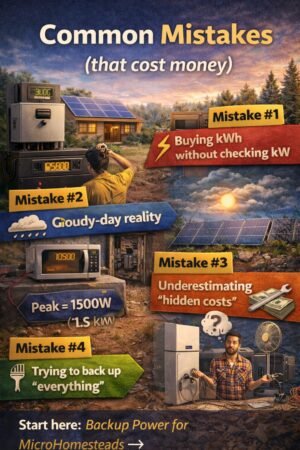
1) Buying kWh without checking kW
You buy a “big battery” and then learn it can’t start your loads. Painful.
2) Ignoring cloudy-day reality
Solar recharging is amazing—until it isn’t. Plan for at least some low-sun days.
3) Underestimating “hidden costs.”
Subpanels, main panel upgrades, conduit runs, permits… these can surprise people.
Read: /hidden-costs-of-solar-avoid-budget-killing-surprises/
4) Trying to back up “everything.”
Start with critical loads first. You can always expand later.
FAQ
How big a battery do I need to run a fridge overnight?
It depends on your fridge’s efficiency and how often it cycles. A common starting point is to estimate 1–2 kWh for the fridge portion for overnight, then add your other loads and losses. If you want reliable results, measure with a plug-in power meter.
What’s the difference between battery capacity and inverter size?
Battery capacity (kWh) is the runtime. Inverter size (kW) is how much you can run at once, including surge.
Can I size smaller if I have solar panels?
Many factors influence battery sizing for solar, so consider all variables before making your decision.
Should I go “whole home” backup?
With battery sizing for solar, you can ensure that your backup system meets the specific demands of your household.
Next step (don’t stop here)
- Build your Critical Loads List (it makes everything easier).
- Run this math with your real appliances (or at least a realistic estimate).
- If you’re still choosing system type, read:
For those considering their options, battery sizing for solar provides a clear framework for developing an efficient energy storage solution.
Knowing the principles of battery sizing for solar is essential for anyone looking to create a self-sufficient energy system.
In the context of energy management, battery sizing for solar becomes a key aspect of planning for efficiency and sustainability.
Consideration of battery sizing for solar allows for tailored solutions that meet the specific needs of your household or business.
Ultimately, success in solar energy systems hinges on proper battery sizing for solar and understanding how to harness stored energy.
With the correct approach to battery sizing for solar, users can achieve a balance between immediate energy demands and long-term sustainability.
The journey toward effective energy management starts with the concepts of battery sizing for solar and its significance in your energy strategy.
To optimize your energy performance, prioritize battery sizing for solar and its role in your overall system design.
By committing to thorough battery sizing for solar, you can enhance your energy resilience and reliability.